LLM4AD Next is branded OpenLoopX, and its method table has two header rows
A next-generation automatic algorithm design platform, making automated algorithm design more accessible and easier to use
At a glance
- What is it?
- A platform that turns a problem description into an evolutionary algorithm search, with an interactive chat entry point and skills that let a coding agent design algorithms. The page, the package and the repository answer to three names, and the search-method table repeats its own separator row.
- Who is it for?
- Use it if you want an LLM to propose and evolve code against a real evaluator rather than generate a snippet once, and start from the chat entry point to get a runnable skeleton. Two things to check first: the skill URLs in the documented prompt point at a `develop` branch while the default branch is `main`, and the method table marks a skill as available for three methods whose orchestrator is still pending, so an agent can be handed a recipe the platform itself cannot run.
- Can I use it commercially?
- Yes. BSD-3-Clause is a permissive licence: you can use, modify and sell software built on it, as long as you keep its copyright and licence notices.
- Is it still maintained?
- Yes. The repository last received commits 2 days ago.
- What is it written in?
- Mainly Python, according to GitHub's language statistics.
Answers come from the project's GitHub data, last synced on November 15, 2026, and from our analysis. They are not legal advice.
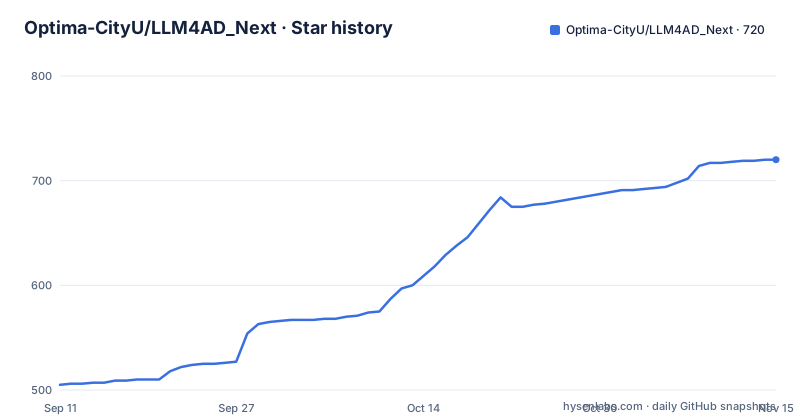
Star history
- Optima-CityU/LLM4AD_Next720 ★ · +215
| Repository | 2026-09-11 | 2026-11-15 |
|---|---|---|
| Optima-CityU/LLM4AD_Next | 505 | 720 |
215 Stars in the last 65 days, measured from the daily GitHub snapshot. Compare with other projects
Editorial analysis
The page says OpenLoopX, the package says llm4ad-next
The single heading on the page reads `OpenLoopX · LLM4AD Next`, pairing a name that appears nowhere else with the name that appears everywhere else. The repository is `LLM4AD_Next`, the distribution is `llm4ad-next` on PyPI, the package name in the manifest is `llm4ad-next`, the site is llm4ad-next.cn, and the docs live at `docs/en/index.md` with a Chinese README beside the English one.
The descriptions drift the same way. The repository description is generic, a next-generation automatic algorithm design platform making automated algorithm design more accessible, while the manifest says interactive LLM-driven automated algorithm design with evolutionary optimization, and the page's own subtitle says from problem description to runnable evolutionary algorithm search in one command.
So there are two brands on one page. For anyone scripting against it, the identifier that matters is `llm4ad-next`, since that is what appears in the install and the command; the OpenLoopX name appears to be a current product label layered over an older project name rather than a rename the rest of the surface has caught up with.
The release line is short: v1.0.0 on 2026-07-09 and v1.1.0 on 2026-09-29, with a `VERSION` file at the root alongside the manifest's version field of 1.1.0.
Two header rows, and skills for methods that cannot run
The search-method table carries two axes, defined in the text above it: Impl means the method has a working orchestrator in code, and Skill means a design skill exists for coding agents. That second axis is where the table gets interesting.
Seven methods are marked implemented: IslandGA, Diverse Island GA, MEoH, DyCA, EoH, ReEvo and MCTS-AHD. Ten are marked pending, among them FunSearch, HillClimb, LHNS, LLaMEA, MLES, MOEA/D, NSGA-II, PartEvo and RandSample. Three of those pending implementations do have skills available: FunSearch, MOEA/D and NSGA-II. An agent can therefore be handed a method recipe for something the platform's own orchestrator cannot execute.
The formatting is imperfect too. The table repeats its separator row directly beneath the real header, so two markdown tables are printed one after the other, and the final three right-hand rows have empty left-hand cells because the left column runs out of methods first. Neither breaks the content, but both are the kind of thing that makes a status table harder to trust at a glance.
The configuration snippet is the part that lines up. Setting `evolution.type` offers exactly the seven implemented names, in the comment as `diverse_island_ga`, `island_ga`, `eoh`, `meoh`, `reevo`, `mcts_ahd` and `dyca`, with `eoh` shown as the value. The comment says options include, so it is illustrative rather than a schema, but nothing in it contradicts the table.
The skill prompt points at a develop branch, and the docs still say chat
The documented way to hand algorithm design to a coding agent is a four-line prompt template:
I want you to design a [PROBLEM] solver using the [SKILL] method.

Skill: https://github.com/Optima-CityU/LLM4AD_Next/blob/develop/skills/algo-design/[SKILL]/SKILL.md
Task: /path/to/your/task/

Read the skill, read the task package, run [N] generations, give me the best algorithm.
Two details in that template matter. The skill URL resolves against a branch called `develop`, while the repository's default branch is `main`, so the recipe a user copies may point at a branch that is not what a fresh clone gives them. And the generations count is a placeholder, which means the stopping condition is left to whoever writes the prompt.
The quick start, meanwhile, is a single command, `uv run llm4ad chat`, described as an interactive conversational terminal where a built-in consultant interviews the user and generates a ready-to-run pipeline consisting of an evaluator, an algorithm skeleton, configuration and a debugger.
A migration document at the root, `MIGRATION_CHAT_TO_AGENT.md`, suggests the chat command is being moved toward an agent-driven flow, and the dependency list agrees in spirit: `claude-agent-sdk` is a required dependency, and a comment in the manifest explains that agentscope is a base dependency specifically so a plain `uv sync` installs it and the second-generation chat path runs out of the box.
Evolution happens at stage 13, and it keeps the original code
The AutoResearch integration is the newest item in the news list, and its design decision is the interesting part rather than the feature. Algorithm evolution is inserted before code is finalized, at stage 13 of a 23-stage research workflow, and candidates are checked with the original evaluator.
The acceptance rule is stated plainly: only better algorithms replace the baseline, and unsuccessful attempts leave the original code intact. That is the difference between an evolutionary search wired into an agent loop and one that overwrites a working solution with a plausible-looking failure, and it is worth checking that the evaluator used for that comparison is the same evaluator that will score the final result.
The workflow is enabled by choosing the `llm4ad` experiment mode, and the underlying research framework is cited as AutoResearchClaw with an arXiv reference on the page.
The dataset side is separate and more concrete. The AlphaEvolve Mathematics Benchmark Suite adds 11 independently runnable mathematical optimization cases, each with its own local evaluator, alongside evolved implementations and reusable experience artifacts, so the benchmark cases can be run one at a time rather than only as a suite.
GitHub stars are exchanged for hosted tokens
One line near the top of the page offers a bonus of ten dollars in tokens for the online website in exchange for starring the repository. The currency is service credit on the hosted platform, not a reward inside the open-source tool.
That is worth separating from the rest of the offering. The hosted side is a trial at llm4ad-next.cn that runs the whole problem-to-algorithm workflow in a browser with no local setup, and the local side is the package you install with uv. The star incentive applies to the hosted balance, so it is a growth mechanic for the service rather than a contribution to the codebase.
For local deployment, the page points at versioned Docker Hub images aligned with GitHub release tags, described as reproducible for that reason. The alignment is the part that matters: an image tagged to a release means the container and the tag can be compared, which is not true of a floating `latest`.
The search methods also arrived as a set over time. The July news entry names EoH, MEoH, ReEvo and MCTS-AHD as newly available as standalone orchestrators, though IslandGA and DyCA are also marked available in the table without appearing in that announcement, so the migration was not limited to the four named.
A pytest plugin sits in the runtime dependencies
The manifest requires Python 3.12 or newer, classifies itself as alpha, targets the console, and declares itself OS independent. The dependency list is where the oddities are.
`pytest-custom-exit-code` is a required dependency rather than a development one. Whatever it does, the plugin is installed for every user of the package, not just for the test suite, which is a common sign of a test invocation being wrapped somewhere in a runtime path.
The rest of the list tells you what the tool actually does. It has a web and network surface with `aiohttp` and `aiofiles`, a terminal surface with `typer`, `click`, `rich` capped below 14, `prompt-toolkit` and `InquirerPy`, and a model surface with `openai` and `claude-agent-sdk`. The numeric stack is substantial for a code-generation tool: `numpy`, `pandas`, `scikit-learn` and `xgboost`, which suggests the evaluators and heuristic search lean on real model fitting rather than string comparison.
Optional extras are split by purpose, with an `infra` group holding `psutil` and a `providers` group starting with OpenAI and continuing with further entries. Vendored third-party code sits in `third_party/` with a licence file beside it, and `.gitmodules` at the root says at least some of it arrives as git submodules rather than copies.
Editorial conclusion
Use it if you want an LLM to propose and evolve code against a real evaluator rather than generate a snippet once, and start from the chat entry point to get a runnable skeleton. Two things to check first: the skill URLs in the documented prompt point at a `develop` branch while the default branch is `main`, and the method table marks a skill as available for three methods whose orchestrator is still pending, so an agent can be handed a recipe the platform itself cannot run.
Frequently asked questions
What is LLM4AD Next?
An alpha, BSD-3-Clause Python platform for LLM-driven automated algorithm design with evolutionary optimization, requiring Python 3.12 or newer. It turns a problem description into a runnable search project with an evaluator, an algorithm skeleton, configuration and a debugger.
How do I start LLM4AD Next?
With `uv run llm4ad chat`, which opens an interactive conversational terminal where a built-in consultant interviews you and generates the runnable pipeline. A hosted trial at llm4ad-next.cn offers the same workflow in a browser with no local setup.
Which search methods does LLM4AD Next implement?
Seven, according to the table: IslandGA, Diverse Island GA, MEoH, DyCA, EoH, ReEvo and MCTS-AHD. Ten more are marked pending, including FunSearch, LHNS, LLaMEA, MLES, MOEA/D, NSGA-II, PartEvo and RandSample. The config comment for evolution.type lists the same seven.
What is the difference between Impl and Skill in LLM4AD Next?
Impl means the method has a working orchestrator in the code, Skill means a design skill exists for coding agents. Three methods have a skill but no implementation yet, FunSearch, MOEA/D and NSGA-II, so an agent can be given a recipe the platform cannot itself run.
Does LLM4AD Next keep the original code when an evolved candidate is worse?
Yes. In AutoResearch experiment mode, candidates are checked with the original evaluator, only better algorithms replace the baseline, and unsuccessful attempts leave the original code intact. Evolution runs at stage 13 of a 23-stage research workflow.
What is OpenLoopX in LLM4AD Next?
It is the name in the page heading, paired with LLM4AD Next, while the repository, the PyPI package, the manifest name and the website all use llm4ad-next. Only the heading carries the OpenLoopX name in the visible material.
Official sources
Add this badge to your README
If you maintain this project, the badge below links readers to this analysis and shows its maintenance status from the daily GitHub snapshot. Paste the markdown into your README; add ?metric=license or ?metric=stars to the image URL for a different field.

[](https://hysenlabs.com/projects/optima-cityu-llm4ad-next)Star history chart for your README
[](https://hysenlabs.com/projects/optima-cityu-llm4ad-next)Was this useful?