OpenRath ships the name openrath, the import package rath, and a homepage pointing at GitHub
An open-source, PyTorch-like runtime for dynamic multi-agent and multi-session workflows.
At a glance
- What is it?
- OpenRath frames agent runtime state as explicit Python objects, mapping a tensor to a session and a device to a sandbox, and version 2.0.0 adds a durable execution layer with runs, checkpoints and leases on top. The manifest is where the interesting inconsistencies are: both provider SDKs are hard dependencies, the Python range stops below 3.14, and the headline release is called production while the HTTP surface is still labelled beta.
- Who is it for?
- OpenRath fits a team whose agents branch, fork and share context across many conversations rather than one linear chat history, and the Session-first model is the part worth stealing conceptually even if you do not adopt the package. Four things to check.
- Can I use it commercially?
- Yes. BSD-3-Clause is a permissive licence: you can use, modify and sell software built on it, as long as you keep its copyright and licence notices.
- Is it still maintained?
- Yes. The repository last received commits 48 days ago.
- What is it written in?
- Mainly Python, according to GitHub's language statistics.
Answers come from the project's GitHub data, last synced on November 15, 2026, and from our analysis. They are not legal advice.
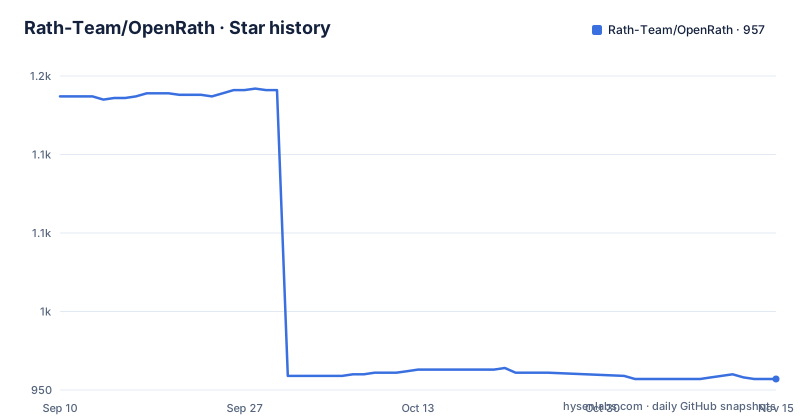
Star history
- Rath-Team/OpenRath957 ★ · -180
| Repository | 2026-09-10 | 2026-11-15 |
|---|---|---|
| Rath-Team/OpenRath | 1.1k | 957 |
-180 Stars in the last 66 days, measured from the daily GitHub snapshot. Compare with other projects
Editorial analysis
The distribution, the import package and the declared homepage are three different things
The manifest names the distribution `openrath`, and the classifiers and description match the README. Everything inside the package is called something else. All three console entry points point into a module called `rath`: the server, the migration command and the worker each resolve to a path under `rath.server.cli`. So you install `openrath` and import `rath`. The third name is the homepage. The project metadata section declares the homepage as a GitHub URL rather than the product site, while the page itself links a documentation site on a different domain and the project's own domain appears in the badge row. Three identifiers for one project, and only one of them is the website visitors are sent to. That is not harmful on its own, but it does mean a quick search for the package name and a quick search for the site will not obviously lead to each other.
The release is announced as production and the HTTP surface is still Beta
The version 2 section opens by saying the defining change is that the project moves beyond a composable Python framework and becomes a durable runtime designed for production deployment, keeping the Session-first API intact and adding an execution and operations layer around it. Two sentences later, the maturity is qualified. The Agent Server HTTP surface remains labelled Beta, and v1 JSONL imports are described as historical records rather than resumable active runs. That pairing matters for planning: the durable machinery underneath is intended for production, but the interface you would actually call over HTTP is the part still moving. The deployment, migration, security and operations guidance is kept out of the main documentation and under a deploy directory, with named documents for operations and migration plus a generated OpenAPI description.
Both provider SDKs are core dependencies, not optional extras
The dependency list has four entries and two of them are provider clients. An OpenAI SDK at version 1.0 or above and an Anthropic SDK at 0.40 or above are required, not suggested, alongside a Pydantic 2 pin and the Model Context Protocol package capped below 2. So an installation pulls in two complete provider SDKs whether or not you intend to call either, and the Model Context Protocol client comes in the same way. Everything else in the package is optional. There are seven extras: a LiteLLM shim, an OpenSandbox group of three packages, an OpenViking memory group that pulls an HTTP client, a JSON repair library and an image library alongside a CSS selector engine, a server group, a Postgres group, a Redis group, an OpenTelemetry group, and an S3 group. That is a wide surface for a library whose stated starting point is a single blank session.
The documented production install line activates two of the seven extras
The install line for the production profile is short.
pip install "openrath[server,postgres]"
openrath-migrate
openrath-migrate --check
Two extras are named, the server group and the Postgres group, and then a migration command is run as a separate operation with a check mode alongside it. So the production path is not just a different import path but a different install plus a schema step you have to remember. The other five extras are not mentioned in that line, which is consistent with the runtime's own description of what it needs: Postgres as the durable source of truth, Redis able to accelerate signalling, and S3-compatible storage for artifacts. Redis is listed as something that can accelerate rather than must, and the telemetry and S3 groups are not in the documented command at all. The LiteLLM extra carries the tightest band of anything here, a lower and an upper bound under 1.88.
A synchronous step cannot declare a preemptive timeout
One sentence in the production section states a hard API limit with two named escapes. A synchronous step cannot declare a preemptive timeout, so a deadline has to be enforced either by making the step asynchronous or by putting it in an isolated executor. That is not a performance note, it is a constraint on the shape of your graph: any step with a time budget in it cannot be written the obvious way. The surrounding security note reads similarly. Runtime identities do not need schema privileges, tokens carry explicit action grants rather than blanket access, and object access stays scoped by tenant and project with policy checks, secret references, trust labels and audit kept as separate boundaries. Together those two sentences tell you what the production profile is actually asking of you: a least-privilege database role and a step graph where the timed parts are already isolated.
Ambiguous non-idempotent effects stop for review instead of replaying
The durable execution design is organised around a small number of named primitives, and the one worth reading twice is the effect ledger. It records outcomes and idempotency keys for side effects, and when an effect is both ambiguous and non-idempotent the run stops in a review state instead of being replayed blindly. That is a deliberate choice against at-least-once delivery for the actions where a retry is worse than a stall, and it means the happy path includes a state a run can be sitting in while a person decides. Around it sit leases, fencing, retries, cancellation, deadlines and resumable queues, all presented as the answer to stale workers committing new state after they should have been fenced off, plus durable interrupts that pause a run for approval or input and resume it without rebuilding hidden loop state. Checkpoints are what make that resume possible.
Selector keeps plain Python control flow, but the branch is chosen by a model call
The lens table maps a tensor to a session, a device to a sandbox or backend, a parameter to memory, a function to a tool, a linear layer to an agent, a module to a workflow, and control flow to a selector. That last row is the one with a wrinkle in it. The selector is described as an LLM-backed router that picks the next workflow at runtime, which is what lets dynamic branching and looping over agents be written as ordinary Python rather than as a bespoke graph language. The control flow syntax is plain; the decision inside it is a model inference. So a loop written that way costs a round trip per decision, and its behaviour depends on which model you point it at. The rest of the mapping is more literal: the sandbox decides where tools actually run, with a local process and OpenSandbox named as backends, and memory is persistent state bound to an agent or store, recalled and committed across runs.
Python support stops at 3.13, and the line length is configured with its own check disabled
The interpreter range is written as 3.10 or above and below 3.14, with classifiers for 3.10 through 3.13. The upper bound is deliberate rather than an oversight, since the classifier list matches it exactly, so anyone on 3.14 is outside what the project supports. Two smaller details sit in the same file. The linter is configured with a line length of 88 and then the lint rule for long lines is placed in the ignore list alongside a whitespace rule, so the configured width is not the width anything enforces. The build backend is hatchling, and the licence is declared by pointing at the licence file with a BSD classifier alongside. One more oddity is visible only in the tree: every top-level directory carries a trailing slash except one called docs, which does not, in a repository that also carries a submodule configuration file.
Editorial conclusion
OpenRath fits a team whose agents branch, fork and share context across many conversations rather than one linear chat history, and the Session-first model is the part worth stealing conceptually even if you do not adopt the package. Four things to check. The Agent Server HTTP surface is labelled beta while the release is announced as production, so plan for that interface to move. Both provider SDKs are required at install whether you use them or not. A synchronous step cannot carry a deadline, so any step with a time budget has to be async or isolated. And the Python requirement is capped below 3.14, so if you are on a newer interpreter you are outside the supported range.
Frequently asked questions
What is OpenRath actually modelling?
Agent runtime state as explicit Python objects rather than message strings. A session carries conversation state and inter-agent lineage, a sandbox decides where tools run, memory persists across runs, a tool is the callable surface shown to the model, and a workflow composes agents and tools.
Is the OpenRath v2 HTTP interface stable?
No. The release is described as built for production, but the Agent Server HTTP surface is explicitly labelled Beta, and v1 JSONL imports are described as historical records rather than resumable active runs.
Which Python versions does OpenRath support?
3.10 up to but not including 3.14. The requirement is written as a lower bound of 3.10 and an upper bound of 3.14, and the classifier list matches, covering 3.10 through 3.13.
What does pip install for the OpenRath production profile pull in?
The server and Postgres extras, followed by a separate migration step. The distribution also installs both provider SDKs, OpenAI and Anthropic, as core dependencies rather than optional extras, along with Pydantic and the Model Context Protocol client.
How does OpenRath handle a side effect it cannot safely repeat?
An effect ledger records outcomes and idempotency keys. When an effect is ambiguous and non-idempotent, the run stops in a NEEDS_REVIEW state rather than being replayed blindly, with durable interrupts used to pause for a human decision.
Official sources
Add this badge to your README
If you maintain this project, the badge below links readers to this analysis and shows its maintenance status from the daily GitHub snapshot. Paste the markdown into your README; add ?metric=license or ?metric=stars to the image URL for a different field.

[](https://hysenlabs.com/projects/rath-team-openrath)Star history chart for your README
[](https://hysenlabs.com/projects/rath-team-openrath)Was this useful?