The LumenPnP repository holds a design-decisions file and a bill of materials, and no machine design
The LumenPnP is an open source pick and place machine.
At a glance
- What is it?
- An open source pick and place machine sold as a product by a commercial vendor, whose releases are named after hardware revisions. The newest release adds secondary fiducial support and names a version of the upstream motion control software, the machine's own design files are not in the repository but attached to releases, powered feeders live in a second repository, and the licence field carries no recognisable value.
- Who is it for?
- LumenPnP is worth a look if you have ever wanted a pick and place machine you can build or inspect, because the project publishes its design decisions, tracks its parts list in the repository and attaches models and schematics to releases rather than leaving you to reverse-engineer anything. Two things to settle first.
- Can I use it commercially?
- Check first. The repository uses a licence we do not classify automatically, so read its LICENSE file before any commercial use.
- Is it still maintained?
- Yes. The repository last received commits 32 days ago.
- What is it written in?
- Mainly HTML, according to GitHub's language statistics.
Answers come from the project's GitHub data, last synced on November 15, 2026, and from our analysis. They are not legal advice.
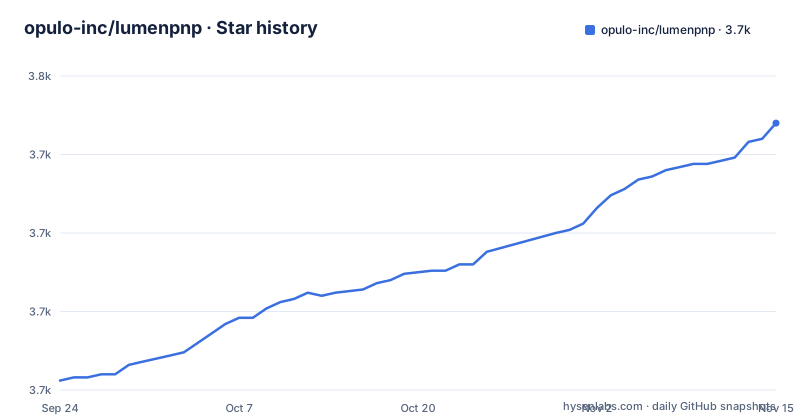
Star history
- opulo-inc/lumenpnp3,735 ★ · +82
| Repository | 2026-09-24 | 2026-11-15 |
|---|---|---|
| opulo-inc/lumenpnp | 3.7k | 3.7k |
82 Stars in the last 52 days, measured from the daily GitHub snapshot. Compare with other projects
Editorial analysis
The releases are named after hardware revisions
The three visible releases are titled for what changed, and the changes are of two different kinds. One adds secondary fiducial support and names a version of the upstream motion control software. Another, a patch level, says only tweaks and adjustments. The third is the significant one, and its title lists three physical things: a new motherboard revision, a new control box, and a dual drag chain. So the version number carries both a hardware revision and a software feature, and a patch release between them can mean either. That is defensible for a machine people assemble from a bill of materials, where the hardware revision genuinely matters, and it makes reading release notes rather than comparing version numbers the correct habit. The newest release is from February 2026 and the default branch has been pushed since September, so there is unreleased work.
The machine's design files are release attachments, not repository files
The readme is explicit that exported versions of the source, meaning models, schematic drawings and compiled binaries, are attached to the latest release rather than committed. That single sentence tells you the repository is not the build. What is committed is a design-decisions document, a bill of materials as a spreadsheet-format file, images, shared libraries, a directory named for the machine and a directory named for the upstream control software. There are no board design files and no firmware sources among the top-level entries. So if you arrive expecting to open a hardware design and rebuild it, the answer is that you go to the release page first. For an open hardware project that is a real friction point, and it is the opposite of what most of them do.
The relationship to the upstream control software is never explained
The tree contains a directory named after the open source CNC motion control project that most hobby pick and place machines run, and one of the release titles names a specific version of it. The readme does not mention it at all, which is the most consequential omission in a hundred and ninety words. Whether that directory is a vendored copy, a fork, a configuration, or an integration cannot be told from the readme, and the difference decides what you have to maintain. People searching for this project are comparing it with that software, and the comparison cannot be resolved from anything published here. The wiki is named as the place that covers the state of the project, so that is where the answer lives.
Only the powered feeders live in another repository
The readme says the project includes feeders designed to work with the machine, and then specifies that the source for the powered feeders is in a separate repository. That qualifier is doing real work: the plain feeders are here and the powered ones are not. It is a small organizational split, but it means anyone building a machine has two repositories to follow rather than one, and the split follows a hardware boundary rather than a software one. The powered feeders are the ones with a cable and a controller, so the split follows cost and complexity, which is the right reason and also the reason a builder is most likely to be caught out.
The readme asks buyers to file bugs
There is one sentence that explains the business model better than anything else in the file: the machine is available for sale from the vendor, machines are being used in active production daily, and if you build or buy one you are asked to document bugs with an issue. That is an unusually direct statement that customers are part of the support model, and it pairs with the phrase that covers both cases, a machine you build and a machine you buy. It also sets the expectation about the project honestly: the people who use it in production are the people who find the problems in it, and the project asks for those reports rather than pretending commercial sales generate them. The rest of the readme points at a wiki for the state of the project, a contributing page that is also on the wiki, a video series cataloguing development, and a chat server.
A parts list is tracked in the repository and a git config is committed
Two root entries explain how seriously this is taken as hardware. One is the bill of materials as a spreadsheet-format file, which means the machine's component list is versioned alongside its design decisions, so a change to what the machine uses shows up as a diff a reviewer can read. That is better practice than most open hardware projects manage. The other is a committed git configuration file, which means the repository ships the git settings its contributors are expected to use, rather than assuming everyone's defaults; in a project where design files and generated outputs both live in one tree, normalising line endings and diff behaviour is not a preference. Both are housekeeping that most projects skip, and both are the kind of thing that tells you what a project's defaults are before anybody reads its documentation.
The licence field is empty where a licence file exists
The repository's licence metadata comes through with no recognisable value, while a licence file sits at the root and the readme calls the project open source four times. The substantive question, whether an open hardware design may be built and sold, is answered by that file rather than by the metadata field, and a machine you build and sell is exactly the case where the distinction between an open licence and a source-available one decides whether you have a product. Nothing in the readme names the licence, and the project is sold commercially by the same organisation that maintains it, which makes that omission worth resolving before you buy parts. The remaining practical points are smaller and easier: the project's own documentation is a wiki rather than the repository, so the readme is a signpost, not a manual.
Editorial conclusion
LumenPnP is worth a look if you have ever wanted a pick and place machine you can build or inspect, because the project publishes its design decisions, tracks its parts list in the repository and attaches models and schematics to releases rather than leaving you to reverse-engineer anything. Two things to settle first. The buildable files are release attachments rather than repository content, so read the wiki before you plan a machine, because the tree here is documentation, an interface and an integration rather than the design. And the licence metadata carries no recognisable value even though a licence file is present and the readme calls the project open source, so if you intend to build and sell one, read that file and settle it with the vendor before you order parts.
Frequently asked questions
What is LumenPnP?
An open source pick and place machine that assembles electronic components onto circuit boards, sold as a product by Opulo. It is used in active production, and the project includes feeders designed to work with it, with the powered feeders kept in a separate repository.
Is there an open source pick and place machine available?
Yes, and this is one. It is sold by a commercial vendor, the readme explicitly covers both a machine you build and one you buy, and it asks users of either to document bugs as issues. Release notes name hardware revisions alongside software features.
lumenpnp vs openpnp
The repository contains a directory named after that project and one release names a specific version of it, but the readme does not say whether that directory is a vendored copy, a fork, a configuration or an integration. The wiki is named as the place covering the state of the project.
Where do I find the LumenPnP STL and schematic files?
Attached to the latest release, not committed to the repository. The top-level tree contains design decisions, a bill of materials, images, shared libraries and two source directories, but no board design files or firmware sources.
What license is the LumenPnP released under?
The readme describes the project as open source and a licence file is present at the root, but the repository's licence metadata carries no recognisable value and the readme never names the terms. Read the file before building a machine to sell.
Official sources
Add this badge to your README
If you maintain this project, the badge below links readers to this analysis and shows its maintenance status from the daily GitHub snapshot. Paste the markdown into your README; add ?metric=license or ?metric=stars to the image URL for a different field.

[](https://hysenlabs.com/projects/opulo-inc-lumenpnp)Star history chart for your README
[](https://hysenlabs.com/projects/opulo-inc-lumenpnp)Was this useful?