MagicWX documents its latest release as v1.1.5, and the newest tag is v1.2.0
Android 17 local LLM prototype with Jetpack Compose and ONNX Runtime for offline AI inference experiments.
At a glance
- What is it?
- An Android app for fully offline text chat and CPU image generation, written in Kotlin with Compose, ONNX Runtime, MediaPipe and an MNN diffusion backend reached through a loopback server. The genuinely useful part is the candidate table, which lists every unsupported model next to the reason it failed.
- Who is it for?
- The candidate table is the reason to read this repository. Publishing garbled output, abnormal output, an ONNX shape mismatch and fragment loops next to the model names is more useful to someone trying to run a small language model on a phone than any benchmark would be, and the five-point support bar behind it is the right way to keep an app's model menu honest.
- Can I use it commercially?
- Check first. The repository uses a licence we do not classify automatically, so read its LICENSE file before any commercial use.
- Is it still maintained?
- Yes. The repository last received commits 17 days ago.
- What is it written in?
- Mainly Kotlin, according to GitHub's language statistics.
Answers come from the project's GitHub data, last synced on November 25, 2026, and from our analysis. They are not legal advice.
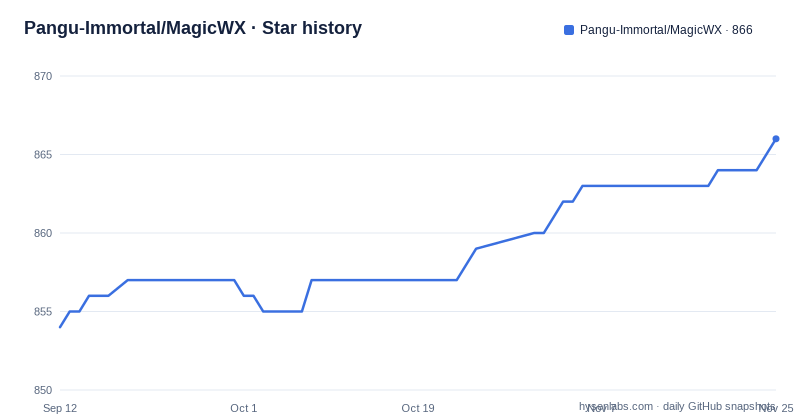
Star history
- Pangu-Immortal/MagicWX866 ★ · +12
| Repository | 2026-09-12 | 2026-11-25 |
|---|---|---|
| Pangu-Immortal/MagicWX | 854 | 866 |
12 Stars in the last 74 days, measured from the daily GitHub snapshot. Compare with other projects
Editorial analysis
The status page names v1.1.5 as the latest release, and no such tag exists
The current status section states the latest release as v1.1.5. The release history contains v1.2.0, v1.1.3 and v1.1.1, so the version the project advertises is neither the newest tag nor one of the tags that shipped. The release titles are also informative where the status line is not: v1.2.0, dated 2026-08-07, is titled for local on-device image generation in Chinese, v1.1.3 on 2026-08-02 for an Android 17 adapter-gated prototype, and v1.1.1 on 2026-07-31 carries a bare version string. The last push on the repository is dated 2026-09-06. So the working line reached v1.2.0 in early August, moved on through the summer, and the README's own version marker was never updated to match. There is a second, softer version disagreement around it. The project's description calls the software an Android 17 local LLM prototype for offline inference experiments, while the same status list states that the Android app is available. Both can be true of a shipped build, but the framing differs depending on which page you land on.
The application ID is com.qihao.open.rwkv and the package tree is RWKV-shaped
The project is called MagicWX. The application ID and the package root are com.qihao.open.rwkv, and the file tree is built around one model family:
com.qihao.open.rwkv/
├── App.kt                    # Application entry
├── MainActivity.kt           # Jetpack Compose UI states
├── model/
│   ├── ITokenizer.kt         # Tokenizer interface
│   ├── RWKVTokenizer.kt      # RWKV vocabulary tokenizer
│   ├── HFTokenizer.kt        # Experimental tokenizer.json reader
│   ├── BuiltinExperienceModel.kt # Built-in no-download demo engine
│   ├── TextGenerationEngine.kt # Shared generation interface
│   ├── RWKVModel.kt          # ONNX Runtime inference wrapper
│   ├── ModelInfo.kt          # Registered model metadata
│   ├── ModelDownloader
The tree stops at a ModelDownloader entry with no file extension and no description, and the last substantive file is a wrapper named for RWKV. Against that, four of the six registered chat models are Transformers, so the code is named for one family while the model menu is not. The default branch is also named Ai, in capitals.
Image generation runs in a separate process on localhost:18081 and streams over SSE
The diffusion pipeline is not called through an in-process bridge. The image backend is a separate native library, libmagicwx_image_backend.so, run as a foreground-service-managed process listening on localhost port 18081 and streaming results over server-sent events. That keeps the heavy pipeline out of the app's own process and gives the foreground service something to supervise, at the cost of a loopback HTTP listener inside an app that otherwise makes no network claims. What is actually released is the CPU path: Stable Diffusion 1.5 verified end to end on a Samsung SM-A566E with text-to-image, image-to-image and inpaint all producing output, at roughly ten to fourteen seconds per 512 by 512 step using MNN, optimisation level three, and an fp16 UNet. The accelerated paths are registered and closed. Around the backend sit three text adapters by name, BUILTIN_TEXT, ONNX_TEXT_GENERATION and LITERT_LM for MediaPipe, which is how one interface covers the bundled experience engine, the ONNX Runtime path and the LiteRT model format. The image side has its own workspace, a prompt area with album import and cropping, mask painting, a parameter panel, an automatic result page and history kept in a Room database, and model downloads run as a user-started foreground service with a persistent progress notification and per-model progress state rather than happening silently.
SDXL, Anima, the SD1.5 NPU path and an upscaler are all registered but closed
Four capabilities sit in the app registered and not open: the Stable Diffusion 1.5 NPU pipeline, SDXL, a model called Anima, and an upscaler. The status line gives the reason in one clause, that they will open after QNN runtime integration, which is a piece of work that has not landed rather than a hardware limit. That distinction matters for anyone reading the feature list, because a registered pipeline is easy to mistake for a working one from a distance. The surrounding roadmap is honest in the same way: speech recognition, voice activity detection, text to speech, image understanding and vision language models are all named as separate future items rather than implied by the text chat that exists today.
The candidate table names the failure for every model it hides
This is the most valuable thing in the repository. The pool is described as a research and implementation queue rather than a support claim, and each row carries the reason it is not in the app. Qwen2 0.5B is hidden for garbled output, SmolLM2 135M for abnormal output, SmolLM2 135M MHA for an ONNX Runtime shape mismatch, MobileLLM 125M for webpage-fragment output, and Gemma 3 270M for repeated-fragment output. Ten further names are listed as deliberately hidden until they clear the same bar, including DeepSeek-R1, Phi-3, Llama 3.2 in ONNX form, StableLM 2 and MiniCPM. The bar itself is stated in five parts: a complete package manifest, the required assets, a successful load, a fixed-input dry-run, and device verification evidence. A model is not to be called supported until all five hold.
One missing llama.cpp adapter is what five GGUF candidates are waiting on
Read the runtime column and the backlog collapses to a short list of missing pieces. The project defines two states, Direct meaning the current ONNX text-generation path can test a model with limited extra work, and Adapter meaning a new runtime layer is required, with the examples named as LiteRT-LM, whisper.cpp, sherpa-onnx, Piper, MediaPipe Tasks, NCNN, MNN or a diffusion pipeline. Five candidates sit in exactly one of those buckets, all of them GGUF, all waiting on a native llama.cpp adapter: Llama 3.2 1B, an uncensored Llama 3.2 1B, a creative-writing roleplay model, a roleplay model called Triangulum, and a companion model in an emotional-companion direction. For those rows the project records that a public non-gated source was checked and that testing should use a normal hello prompt only. The Direct column has its own backlog with the same specificity: Llama 3.2 1B in ONNX is a direct candidate that still needs licence and runtime validation, a DeepSeek-R1 distill of Qwen at 1.5B is a direct candidate carrying a larger memory budget, and the Google AI Edge task files for Gemma3-1B and Qwen2.5-1.5B are marked as needing an adapter. Every one of these is a to-do with a stated reason, which is the difference between a roadmap and a wish list.
Two numbers in the whole project, a regional download path, and two doc systems
Measurement is thin. The only timings given are a hello response from TinyLlama on LiteRT in 4.8 seconds and the ten-to-fourteen second diffusion step; everything else is qualitative. Two registered models record their downloads as verified through an HF mirror fallback, and the keyword line carries four Chinese terms alongside the English ones, which places the project in a market where the primary model host is not always reachable. The documentation is split in two on purpose: doc/ holds human-facing product, design and development documents, while openspec/ holds change plans meant for an agent, alongside a .codex/ directory and an AGENTS.md at the root. The root also holds a shell script for test automation in an otherwise Gradle and Kotlin project, and an image file while the screenshot section of the README is empty. The build side is conventional for the platform, with a Gradle wrapper and its properties file, a settings file and an app module, and the tree also carries a screenshots directory that the README does not point at. No homepage is recorded for the repository at all.
Editorial conclusion
The candidate table is the reason to read this repository. Publishing garbled output, abnormal output, an ONNX shape mismatch and fragment loops next to the model names is more useful to someone trying to run a small language model on a phone than any benchmark would be, and the five-point support bar behind it is the right way to keep an app's model menu honest. Two things to weigh before you install it. The status page names v1.1.5 as the latest release, which is not a tag that exists here and is behind v1.2.0, so read the release list rather than the README's own version line. And the acceleration story is CPU-only today, with the NPU and QNN pipelines registered but closed until a runtime integration lands, which makes the ten-to-fourteen second figure per 512 by 512 step the number to plan against. The Chinese keyword set and the mirror-fallback download paths suggest the project targets one regional market specifically.
Frequently asked questions
What platform does MagicWX run on?
Android, targeting API 37, which the project calls Android 17. It is written in Kotlin with Jetpack Compose and Material3, and its application ID is com.qihao.open.rwkv.
Which language models does MagicWX currently offer?
Six registered entries: a built-in experience engine, RWKV-7 World 0.4B, Qwen3 0.6B, Qwen2.5 0.5B, SmolLM2 360M, and TinyLlama 1.1B Chat on LiteRT. Everything else in the candidate pool stays hidden until it passes device validation.
What has to be true before MagicWX calls a model supported?
Five things: a complete package manifest, the required assets, a successful load, a fixed-input dry-run, and device verification evidence. The project states that no model should be described as supported until all of them hold.
Does MagicWX run image generation on an NPU?
Not yet. The released path is a Stable Diffusion 1.5 CPU pipeline, and the NPU and QNN pipelines for SD1.5 NPU, SDXL, Anima and an upscaler are registered but will only open after QNN runtime integration.
What is the MagicWX image backend?
A separate native library, libmagicwx_image_backend.so, run as a foreground-service-managed process on localhost port 18081 and streaming results over server-sent events.
Why does MagicWX test some candidate models with a hello prompt only?
For the uncensored and roleplay GGUF candidates the project records that a public non-gated source was checked, and that testing should use a normal hello rather than the prompts that would reveal whether the weights load properly.
Official sources
Add this badge to your README
If you maintain this project, the badge below links readers to this analysis and shows its maintenance status from the daily GitHub snapshot. Paste the markdown into your README; add ?metric=license or ?metric=stars to the image URL for a different field.

[](https://hysenlabs.com/projects/pangu-immortal-magicwx)Star history chart for your README
[](https://hysenlabs.com/projects/pangu-immortal-magicwx)Was this useful?