PCJones/usenet-guide: A German Usenet Guide for Newcomers
Ein deutscher Einsteiger-Guide für das Usenet
At a glance
- What is it?
- PCJones/usenet-guide is a German-language introductory guide to Usenet, covering providers, indexers, NZB files and download tools. It is useful for readers who need the basic vocabulary and workflow, but it does not provide software installation steps or complete automation instructions.
- Who is it for?
- Adopt it as an orientation document if you read German and need a map of Usenet terminology. Do not treat it as a complete setup manual or automation guide.
- Can I use it commercially?
- Not without permission. GitHub finds no licence file in the repository, and without a licence all rights are reserved by default: you may read the code but not reuse it. Check the README, or ask the authors, before using it.
- Is it still maintained?
- Yes. The repository last received commits 2 days ago.
- What is it written in?
- GitHub does not report a main language for this repository.
Answers come from the project's GitHub data, last synced on November 7, 2026, and from our analysis. They are not legal advice.
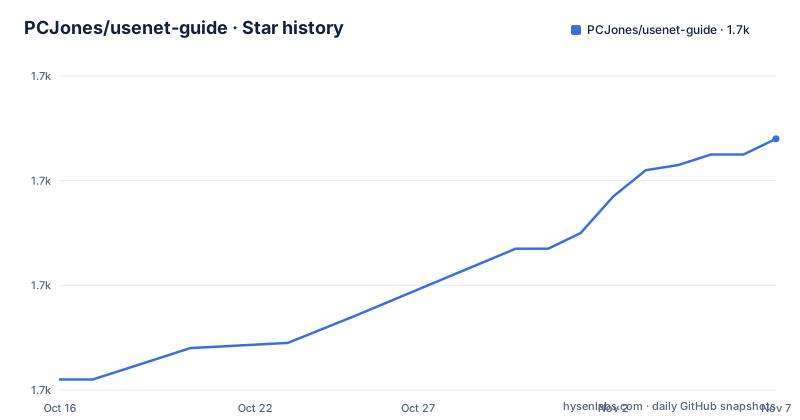
Star history
- PCJones/usenet-guide1,708 ★ · +46
| Repository | 2026-10-16 | 2026-11-07 |
|---|---|---|
| PCJones/usenet-guide | 1.7k | 1.7k |
46 Stars in the last 22 days, measured from the daily GitHub snapshot. Compare with other projects
Editorial analysis
What PCJones/usenet-guide Covers
PCJones/usenet-guide is aimed at people who are new to Usenet and want to understand how the ecosystem fits together. The repository describes Usenet as a global, distributed system that originated as a text discussion forum and is now mainly used for file sharing. Its central contribution is explanatory rather than technical. The guide introduces the roles of a Usenet provider, a Usenet indexer, NZB files and a downloader, then lists optional applications for automation and library-based streaming.
The guide is especially aimed at German-speaking readers. It discusses German productions, German-language releases and releases labeled "German DL". It also recommends Treasure-Maps for those categories and includes a table comparing several indexers by price, daily free-download allowance and registration availability. Those details help explain the choices described by the author, although they can change after the guide was written.
This is not a complete course. The README says that the first part is finished and that automation with Radarr and Sonarr is still missing. It does not give installation commands, configuration files or a complete sequence for connecting a provider, indexer and downloader. That boundary matters. A reader can learn the vocabulary from this repository, but the repository alone does not provide a turnkey technical setup.
The Usenet File-Sharing Model
The mechanism described in the README starts with an upload. A file is placed into a newsgroup and split into thousands of small pieces, described as postings. Those pieces are posted as text-like messages across Usenet servers. After replication, a user with access to those servers can download the pieces.
An indexer is needed because the README says that nearly all modern uploads are encrypted. In practical terms, an indexer searches for these uploads and supplies the information needed to retrieve them. The guide calls NZB files a kind of recipe or map. They tell a downloader how to obtain the individual postings and reconstruct the original file.
The README names SABnzbd as the downloader for NZB files. The architecture therefore has three distinct stages: a provider supplies network access, an indexer locates content and produces the retrieval information, and a downloader retrieves and reconstructs the file. The guide also names Prowlarr for indexer management. Radarr and Sonarr are presented as optional automation tools for films and series, not as components of the completed first part.
Provider and Indexer Choices Described by the README
The guide separates regular users from occasional users when discussing providers. For regular use, it describes Ewaka and states that its retention can reach 15 years or more. The README also lists a monthly promotional price, followed by a higher price after the first year. For occasional use, it discusses block accounts at NewsgroupDirect, where a purchased amount of data can be consumed without monthly time pressure. The guide states a maximum retention period of 12 years for that example and warns that credentials shown immediately after purchase should be saved because access to them is not available later.
For indexers, the README provides a ranked table. Treasure-Maps is presented as the starting recommendation because it focuses on German content. NZBFinder and NZB.life are listed as alternatives with more or less German material, while DrunkenSlug and NzbGeek are also discussed. The table includes prices, free-download allowances and registration status, but the README does not define a common currency for every entry or explain whether all listed prices include taxes.
The author explicitly advises readers to research providers because quality differs. The guide also says that provider deals change frequently. Its pricing table should consequently be read as a documented example, not a current purchasing guarantee. The repository does not provide a neutral comparison method, provider status page or rollback procedure.
A First-Use Path Without Installation Instructions
The repository does not document how to install PCJones/usenet-guide because it is a guide, not an application. It also does not provide commands for installing SABnzbd, configuring a provider or connecting an indexer. The correct first step described by the README is to read the sections on Usenet terminology, providers, indexers, NZB files and downloaders, then identify which parts of the ecosystem are relevant to the intended use.
The guide names the applications involved but does not provide a first-run configuration. It does not show how an NZB file is submitted to SABnzbd, how credentials are entered, how an indexer account is created or how Radarr and Sonarr would communicate with the downloader. No command block can be supplied without inventing steps that the repository does not contain.
The README states that automation is planned and that Radarr and Sonarr will be discussed in a later part. Until that section exists, the guide stops before the automation workflow. Readers should treat the named tools as documented options, not as an already configured stack.
Streaming Scope and Automation Boundary
The guide takes a clear position on streaming: it says there is no support for streaming over Usenet. It attributes this first to rules at German indexers, then explains its concern that mainstream Usenet streaming could attract more commercial and rights-holder pressure. The repository also states that Usenet is not fully decentralized in its current form and raises the possibility that major rights holders could act against providers.
This is an editorial position, not a technical feature list. The README still names Jellyfin as a way to operate a personal streaming service and Jellyseerr as an interface for discovering films and series and requesting them. However, those tools are presented among optional tools, and the guide does not document their installation or configuration.
The automation boundary is equally important. Radarr is listed for films, Sonarr for series and Prowlarr for indexer management. The README says the first part is complete while this automation section is still pending. As a result, the repository is best used to understand terminology and component responsibilities, not to predict the exact behavior of a future integrated setup.
Licensing and Maintenance Signals
The repository information does not identify a license for PCJones/usenet-guide. Because the license is unknown, the repository does not establish clear reuse rights for its text or images. The top-level repository contains `README.md` and an `img/` directory, but the repository listing does not specify separate licensing for those files. Users who need to reuse or redistribute content should verify the repository's license file or obtain clarification from the project owner before copying material.
The repository is not archived, and its last push was on 2026-08-10. The README itself says it was last updated on 11.01.2026. There are no GitHub releases, so the repository has no release history to use for upgrade planning. Its maintenance state is therefore limited to the available repository status and the guide's own update note. The author invites issues and pull requests, but that does not define a release schedule or compatibility policy.
The practical maintenance cost is editorial rather than package-based. Provider prices, retention terms and indexer conditions are external details that can change. Readers comparing this guide with current provider pages must check those pages directly, because the README itself warns that deals change frequently.
Editorial conclusion
Adopt it as an orientation document if you read German and need a map of Usenet terminology. Do not treat it as a complete setup manual or automation guide. Verify provider pricing, retention periods, indexer access and the intended use of any downloaded content before proceeding.
Frequently asked questions
What is PCJones/usenet-guide?
PCJones/usenet-guide is a German introductory guide to Usenet. It explains providers, indexers, NZB files, downloaders and optional automation and streaming tools.
Which downloader does PCJones/usenet-guide recommend?
The guide names SABnzbd as the downloader that accepts NZB files and retrieves the underlying files. It does not provide installation or configuration instructions for SABnzbd.
Does PCJones/usenet-guide cover Radarr and Sonarr automation?
Not yet. The README lists Radarr, Sonarr and Prowlarr as optional tools, but explicitly says that automation with Radarr and Sonarr is still missing and will follow later.
Does the guide support streaming over Usenet?
No. The README says there is no support for streaming over Usenet. It does mention Jellyfin and Jellyseerr as optional related tools, but does not document a complete setup.
Official sources
Add this badge to your README
If you maintain this project, the badge below links readers to this analysis and shows its maintenance status from the daily GitHub snapshot. Paste the markdown into your README; add ?metric=license or ?metric=stars to the image URL for a different field.

[](https://hysenlabs.com/projects/pcjones-usenet-guide)Star history chart for your README
[](https://hysenlabs.com/projects/pcjones-usenet-guide)Was this useful?