Peergos keeps its trust assumptions in writing, including the parts it does not meet yet
A p2p, secure file storage, social network and application protocol
At a glance
- What is it?
- Peergos is a Java peer-to-peer encrypted filesystem, social network and application protocol licensed AGPL-3.0, where encryption happens on the client in 5 MiB chunks and the server is treated as untrusted by design. Its README is unusually candid about limits, from an anti-aims entry admitting anonymity does not arrive yet to two architecture headings numbered 4.0, and it publishes no GitHub releases at all.
- Who is it for?
- Peergos is a serious fit for people who want encrypted storage and social features without handing a central operator the keys, and a poor fit for anyone who needs anonymity guarantees, a stable release trail, or a turnkey install today. The parts worth trusting are the ones the README states as mechanics: client-side chunk encryption, signed writes, self-certifying data, and a data store that can be anything S3 compatible.
- Can I use it commercially?
- Yes, with strict conditions. AGPL-3.0 is a network copyleft licence: if people use a modified version over a network, for example as a hosted service, you must offer them its source code under the same licence.
- Is it still maintained?
- Yes. The repository received new commits within the last day.
- What is it written in?
- Mainly Java, according to GitHub's language statistics.
Answers come from the project's GitHub data, last synced on November 15, 2026, and from our analysis. They are not legal advice.
Star history
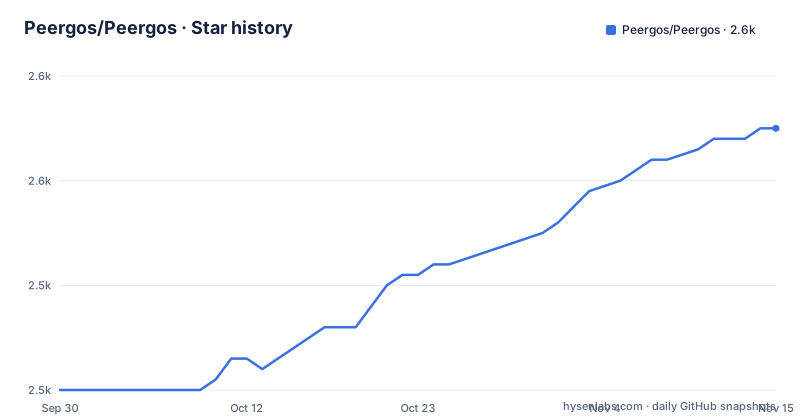
- Peergos/Peergos2,555 ★ · +25
| Repository | 2026-09-30 | 2026-11-15 |
|---|---|---|
| Peergos/Peergos | 2.5k | 2.6k |
25 Stars in the last 46 days, measured from the daily GitHub snapshot. Compare with other projects
Editorial analysis
Files become 5 MiB chunks under random labels
The storage layer is described in four steps. A merkle-champ of encrypted chunks sits under random labels, keyed by a given public key, with no cross links visible to the server, so the server cannot deduce the size of a file. Encryption runs on the user's own machine using TweetNaCl, and each 5 MiB chunk of a file is encrypted independently of the others. Above that sits an authorization layer where a key pair decides who can modify which parts of the filesystem, and every write is signed. The consequence worth planning for is availability rather than confidentiality: a user must have at least one Peergos instance storing their data for it to be available at all, so the fleet of machines a person signs into is the fleet that holds the file. The social layer adds following and friendship without exposing the friend network, and sharing of files with friends is done cryptographically rather than through a server side permission list.
The trust section treats IPFS and the data store as hostile
Peergos spells out which components are not trusted. IPFS itself is not trusted, and all data stored or retrieved from it is self-certifying. The data store is also not trusted, and it need not be IPFS at all: an S3 compatible service is given as the example. Servers are described as trustless, on the assumption that the client is not compromised, so data and metadata cannot be exposed even if a server is. That leads to a three step ladder for how much a user trusts. Someone who trusts a public Peergos server and its SSL certificate chain can use the web interface over TLS. Someone less trusting runs a server or proxy on their own machine and reaches the interface over localhost. Someone more paranoid runs a server at home and uses the CLI or the fuse/webdav binding instead of a browser. Updates arrive through Peergos itself, a mechanism the user can turn off, and one stated aim is independence from the central TLS certificate authority trust architecture.
The anti-aims section says anonymity does not arrive yet
Most project READMEs list aspirations and stop. This one lists aspirations and then the ways it falls short. Under project anti-aims it states that Peergos does not provide anonymity, yet, and that anonymity can be achieved by creating and only ever accessing a user account over Tor. That single entry reframes the rest of the document: the cryptographic properties claimed for the filesystem are about content and friendship graphs, not about network level hiding, and the IPFS layer provides storage, routing and retrieval rather than unlinkability. The aims list next to it makes the same kind of promise in the positive direction, including secure sharing without visible metadata about who shares with whom, web apps loaded and run directly from Peergos in a sandbox that prevents data exfiltration under user granted permissions, and being self-hostable so a user can run Peergos on a machine in their home and get their own storage space and social platform from it.
Passwords go through scrypt with published parameters
The login mechanism gets one paragraph, and it is the last section in the document. A user's username is combined with a random salt and the hash of their password, and the result is run through scrypt with the parameters 17, 8, 1, 96. The sentence then notes that users can choose harder parameters if desired, and the text ends there, in the middle of that clause, so the trade-off the project means to offer between the shipped defaults and a slower login is left implicit rather than explained. The published numbers matter for anyone reproducing the scheme: those are the cost parameters a verifier needs, and they are the ones a reader would otherwise have to read out of the source. What the paragraph does not cover is account recovery, key rotation for the signing key pair that controls writes, or what happens to a user account whose instances are all offline.
No GitHub releases, so versions live on the project's own server
The releases page on GitHub is empty for this repository. Instead of tagged builds, the README points at release notes published on the project's own server and at the releases of the separate web interface repository, which is where the screenshots live too. That arrangement is consistent with the rest of the design, since the software is also delivered to users through Peergos itself, but it moves the version question somewhere other than the code host. The build system in the tree is the other thing you notice: build.xml for Ant, a .travis.yml at the root, a gwt/ directory for the Java to JavaScript cross compilation, lib/, lib-build/ and native-lib/ for dependencies, and two reproducibility tools, ReproducibleJar.java and reproducible-test.sh. The licence file is Licence.txt with the British spelling, and the project is licensed AGPL-3.0. The last recorded push to the repository is 2026-10-02.
Java everywhere, with two libraries kept out of the cross compile
The language section explains how one codebase reaches a browser. The IPFS layer is written in Java as a minimal IPFS implementation called Nabu, and the Peergos server runs on the JVM, predominantly in Java, for portability and speed. The web interface is mostly Java as well, cross compiled to JavaScript, with two exceptions named explicitly: the TweetNaCl and scrypt libraries stay as they are, and a small amount of GUI code is written in JavaScript for Vue.js. Apps themselves are HTML5. Those two exceptions are not incidental, since they are the same two libraries that do encryption and password hashing, so the parts most worth reading in their original form are the parts the cross compiler does not touch. Uniqueness of usernames is handled by a pki node using a structure similar to certificate transparency, with that data mirrored on every Peergos server, and a new node reaches the network by contacting any public Peergos server.
A paid server, donation links and two published audits
Funding and oversight sit in the same document as the architecture. The README says a paid server runs at peergos.net, and it offers a read-only secret link to a folder as a way to try the system, with the key carried in the URL fragment rather than in the path. Support is asked for in the form of a recurring donation of less than 100 EUR per week through Liberapay, or a larger or one-off donation through Donorbox. Oversight comes from audit write-ups published for 2024 and 2019, with all reports kept in the audits directory of the repository, and from a tech book at book.peergos.org that covers the features and architecture in more depth. There is also a public chat room on Matrix used for support, and a set of recorded talks whose links carry no titles at all, so the section reads as a bare list of video URLs.
Two architecture headings are numbered 4.0
The structure of the document has a small numbering fault that matters more than it looks. The layered architecture is presented as 1.0 Layers of architecture, 2.0 Language, 3.0 Nodes, then 4.0 Trust, and the next heading is numbered 4.0 as well, for Logging in. Two different subjects therefore share one number in a document whose subject is a layered system, and the reader who cites a section by number has two candidates. The presentation problems continue at the edges: the file opens with a stray closing anchor tag, and the talk section lists titles such as Deep dive at IPFS Camp 2024 followed by links whose anchor text is empty, so most of that section is a list of video identifiers with no labels. The name itself is explained at the top, from the Greek word for stronghold or tower, phonetically spelled to connect to being peer-to-peer, and pronounced peer-goss as in gossip.
Editorial conclusion
Peergos is a serious fit for people who want encrypted storage and social features without handing a central operator the keys, and a poor fit for anyone who needs anonymity guarantees, a stable release trail, or a turnkey install today. The parts worth trusting are the ones the README states as mechanics: client-side chunk encryption, signed writes, self-certifying data, and a data store that can be anything S3 compatible. The parts to check before committing are the ones it leaves open. Anonymity is explicitly out of scope for now, the release notes live on the project's own server rather than on GitHub, so pin what you deploy, and remember that a user's data stays reachable only while at least one of their own Peergos instances is online. Budget for reading the 2024 and 2019 audit reports before you point anything at it.
Frequently asked questions
is peergos free
The code is licensed AGPL-3.0 and self-hosting is a stated aim, so it can be run yourself. Alongside that, the project runs a paid server at peergos.net and asks for a recurring donation of less than 100 EUR per week through Liberapay, or a one-off donation through Donorbox.
What does peergos store, and on what?
A peer-to-peer encrypted global filesystem with fine-grained access control, plus a secure messenger, an encrypted email client and bridge, and a private social network. Storage runs on IPFS, and a user must have at least one Peergos instance storing their data for it to be available.
Does peergos provide anonymity?
Not yet, by its own account. The project anti-aims section states that Peergos does not provide anonymity, yet, and that anonymity can be achieved by creating and only ever accessing a user account over Tor.
How does peergos encrypt a file?
On the user's machine, with TweetNaCl, encrypting each 5 MiB chunk independently. Chunks sit under random labels in a merkle-champ controlled by a public key, with no cross links visible to the server, so the server cannot deduce the size of a file.
What audits has peergos published?
Write-ups for 2024 and 2019 are linked from the README, and the full set of reports is kept in the audits directory of the repository.
How does peergos deliver new versions?
Through Peergos itself, and that mechanism can be turned off by the user. Someone who trusts a public server can use the web interface over TLS, while a more paranoid user runs a server at home and uses the CLI or the fuse/webdav binding.
Official sources
Add this badge to your README
If you maintain this project, the badge below links readers to this analysis and shows its maintenance status from the daily GitHub snapshot. Paste the markdown into your README; add ?metric=license or ?metric=stars to the image URL for a different field.

[](https://hysenlabs.com/projects/peergos-peergos)Star history chart for your README
[](https://hysenlabs.com/projects/peergos-peergos)Was this useful?