Shelter is a mirror with two signing keys and a declared maintenance mode
This repository is a mirror of https://gitea.angry.im/PeterCxy/Shelter. For bug reports, use https://lists.sr.ht/~petercxy/shelter
At a glance
- What is it?
- Shelter uses Android's work profile feature to hold an isolated copy of your apps. Its repository is a mirror of a self-hosted forge, its two distribution channels are signed by different people so switching between them needs an uninstall, and its README says the feature set is capped by what the unprivileged Android APIs expose.
- Who is it for?
- Shelter is worth installing if you want a second copy of an app or want apps stopped from waking in the background, and its isolation comes from the operating system rather than from the app, which is the main reason to trust its boundary. Three things to know.
- Can I use it commercially?
- Yes, with conditions. GPL-3.0 is a copyleft licence: if you distribute software that includes it, you must release that software's source code under the same licence. Running it internally without distributing it does not trigger that obligation.
- Is it still maintained?
- Yes. The repository last received commits 49 days ago.
- What is it written in?
- Mainly Java, according to GitHub's language statistics.
Answers come from the project's GitHub data, last synced on November 15, 2026, and from our analysis. They are not legal advice.
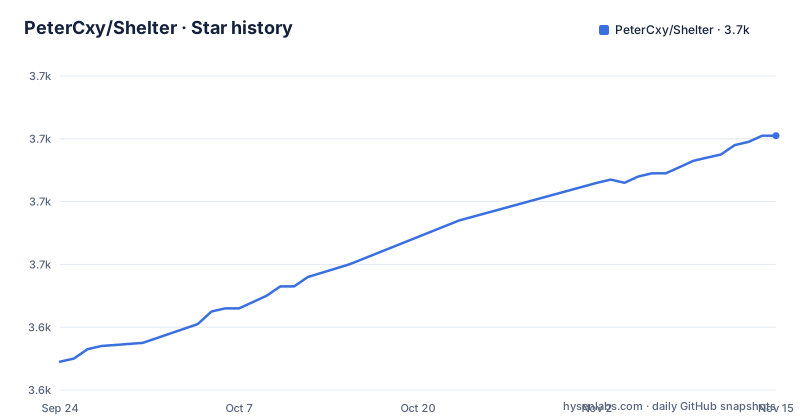
Star history
- PeterCxy/Shelter3,701 ★ · +72
| Repository | 2026-09-24 | 2026-11-15 |
|---|---|---|
| PeterCxy/Shelter | 3.6k | 3.7k |
72 Stars in the last 52 days, measured from the daily GitHub snapshot. Compare with other projects
Editorial analysis
This repository is a mirror and its issues are not read
The repository description says so in the first clause: it is a mirror of the same project on a self-hosted forge, and the bug reports go to a mailing list instead. The README repeats the arrangement in its support section, which lists the mailing list and a chat room, and then says in bold that the issue list and pull requests here are not checked regularly and to use the mailing list instead. The homepage field points at the self-hosted forge rather than at the forge you are reading. So the code is mirrored to a wider audience while the conversation happens somewhere else. That is a deliberate arrangement, and it means the usual expectation, that an issue filed on the code host will be answered, does not hold here.
Two channels, two signatures, and an uninstall in between
There are two ways to get the app and they are not interchangeable. One is the F-Droid listing, signed by the F-Droid project. The other is the author's own repository, signed by him, and it carries the latest development versions rather than the stable ones. You can add that second channel three ways: through an in-app repository link, by scanning a QR code, or by typing a URL and a fingerprint by hand, and the README gives all three with the fingerprint written out in spaced hexadecimal. Then comes the sentence that saves you an afternoon: you cannot switch between the versions listed above that have different signatures without uninstalling first. Same package, two signing keys, and the package manager will not let you swap one for the other in place.
The README declares maintenance mode, and the branch keeps moving
The project state section is unusually direct. It says there is a limited set of features possible through the app, that no new features are intended unless the platform's work profile capabilities change substantially, and that Shelter is currently in an effective maintenance mode. What it promises instead is adaptation: the author says he is committed to regularly adapting Shelter to new Android versions as soon as they are released, listing the target SDK level, new features or restrictions, and dependency updates as the things that change. The last sentence gives the reason, that the author still relies on Shelter daily and so it will not become abandonware, and it contains a typo in the word foreseeable. The repository's own dates agree with the maintenance framing rather than contradicting it: the branch was pushed in late September 2026 while the only tagged release is version 1.6 from September 2020.
The feature ceiling is the platform's unprivileged surface
The reason for the maintenance mode is a design decision stated in the same section. Shelter works by using the work profile APIs Android exposes, and the author says he does not intend to make use of the platform's debugging bridge. Therefore, in his words, the features of Shelter can only be a strict subset of the exposed unprivileged APIs. That is a constraint most app developers would not accept, and it is the reason the feature list is short: three items, install inside the profile, freeze inside the profile, and duplicate an app on the same device. It also explains the shape of the caveats section, which points at the setup wizard as the place where known issues are discussed.
Uninstalling takes two steps in a specific order
The uninstall section is one sentence and the order is the content. Delete the work profile first, in Settings under Accounts, and only then uninstall the app in the normal way. Doing it the other way round leaves the profile on the device, which is the part of the state Shelter actually owns. That is the same dependency the other way round as well: the profile exists because the app created it, so the app has to go last. It is also a useful signal about how the rest of the project behaves, since almost everything here is a thin layer over something the operating system created and the operating system owns.
Freezing is the feature that is not an install
Two of the three features are about what you put into the isolated space: installing apps inside the work profile for isolation, and installing two copies of the same app on one device, which is the classic reason people reach for a work profile at all. The third is different in kind. Freezing an app inside the profile prevents it from running or being woken up when you are not actively using it, which is an energy and background-activity control rather than a separation control, and it is the one feature that does something Android would not do for you by installing an app normally. Read together, the three features say the profile is used for isolation, for duplication, and for taking an app out of the background.
A QR code image and an editor directory sit at the root
The eighteen top level entries describe a Gradle Android project with a publishing step bolted on. There is the usual pair, an application module and a settings file, plus the wrapper and its Windows batch file. Then there are directories that exist for distribution rather than for the app: a metadata directory for the package repository format, a repackaging directory, and a library directory for local jars. At the root sit an image of the repository QR code, which is what the README's scan instruction points at, an art directory for icons, and an editor configuration directory that has been committed. There is also a submodules file, so part of the tree comes from elsewhere and a plain clone without submodules is incomplete.
Editorial conclusion
Shelter is worth installing if you want a second copy of an app or want apps stopped from waking in the background, and its isolation comes from the operating system rather than from the app, which is the main reason to trust its boundary. Three things to know. The two download channels are signed by different keys, so moving between them means uninstalling first. The project has declared itself in maintenance mode, with the feature list capped by the platform rather than by effort. And the repository you are reading is a mirror, so issues here are not the place to report anything.
Frequently asked questions
how to install shelter on android
Through either the F-Droid listing, signed by the F-Droid project, or the author's own repository, signed by him, which carries the latest development versions. The second channel is added through an in-app repository link, by scanning a QR code, or manually with a URL and a fingerprint.
how to use shelter android
You create a work profile in Shelter and install or clone apps into it, and you can freeze an app inside the profile so it does not run when you are not using it. Uninstalling means deleting the profile in Settings first and the app second.
Is Shelter still being worked on?
The README says it is in an effective maintenance mode, with no new features intended unless the platform capabilities change, and promises regular adaptation to new Android versions. The default branch was last pushed on 2026-09-27 and the only tagged release is 1.6 from 2020.
Why does Shelter not have more features?
Because it only uses the unprivileged work profile APIs Android exposes, and its author says he does not intend to use debugging privileges, so the feature set can only be a strict subset of that surface.
How safe is Shelter?
The README says it is only as safe as the work profile implementation of the Android version you are using, and links to the platform's own documentation of that feature. Known caveats are also surfaced during the app's own setup process.
Official sources
Add this badge to your README
If you maintain this project, the badge below links readers to this analysis and shows its maintenance status from the daily GitHub snapshot. Paste the markdown into your README; add ?metric=license or ?metric=stars to the image URL for a different field.

[](https://hysenlabs.com/projects/petercxy-shelter)Star history chart for your README
[](https://hysenlabs.com/projects/petercxy-shelter)Was this useful?