SteamManifestCache repository structure and manifest availability
Steam Depot Manifest Files Cache
At a glance
- What is it?
- SteamManifestCache is a repository of cached Steam depot manifest files with additional game information. Its README says direct manifest downloading no longer works, while the repository remains organized by AppId branches and manifest filename tags.
- Who is it for?
- Adopt the repository only if you need its historical AppId branches, manifest filename tags, or game information and can establish a lawful use for the files. Do not choose it as a current manifest download service, because the README states that free manifest downloading no longer works.
- Can I use it commercially?
- Not without permission. GitHub finds no licence file in the repository, and without a licence all rights are reserved by default: you may read the code but not reuse it. Check the README, or ask the authors, before using it.
- Is it still maintained?
- Yes. The repository received new commits within the last day.
- What is it written in?
- GitHub does not report a main language for this repository.
Answers come from the project's GitHub data, last synced on October 23, 2026, and from our analysis. They are not legal advice.
Star history
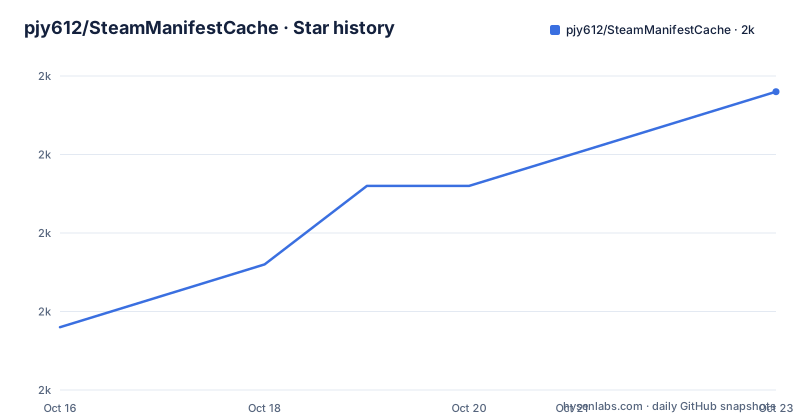
- pjy612/SteamManifestCache1,989 ★ · +15
| Repository | 2026-10-16 | 2026-10-23 |
|---|---|---|
| pjy612/SteamManifestCache | 2k | 2k |
15 Stars in the last 7 days, measured from the daily GitHub snapshot. Compare with other projects
Editorial analysis
What SteamManifestCache contains and who it serves
SteamManifestCache describes itself as a cache of Steam depot manifest files with additional game information. Its intended audience appears to be people who already understand Steam AppIds, depot files, manifest naming, account-related collection, and region restrictions. That is a technical niche rather than a general Steam library interface. The README refers readers to the repository Wiki for terminology and tool explanations, which is a better starting point than assuming that every repository entry has the same role.
The repository explicitly says that unlock keys are not included at present. It also disclaims responsibility for losses arising from use of its contents and asks readers to respect copyright and support legitimate Steam purchases. This matters when judging the project's purpose. It is a data collection centered on manifests, not an official Steam catalog, package manager, or client replacement.
The stated operational model has changed. The README reports that Steam adjusted its server interfaces and that the former feature for downloading manifests freely stopped working. The author therefore returned to a manifest library that is synchronized from a historical offline account pool. The repository does not document a public API, a supported download endpoint, a command-line interface, or a formal data schema. Those omissions make it unsuitable for applications that require a stable service contract.
AppId branches and manifest filename tags
The repository uses Git metadata as its main catalog structure. According to the README, `Branch Name is AppId`, so each Steam application is associated with a branch named for its AppId. This gives engineers a predictable lookup key without requiring them to search filenames for an application number. Automation must therefore treat branch names as identifiers rather than descriptive labels.
The second convention is `Tag Name is Manifest FileName`. A tag points to a particular manifest filename rather than to a release version in the conventional semantic-versioning sense. This distinction matters for scripts. A branch lookup and a tag lookup perform different roles: the branch groups records for one application, while the tag selects a named manifest record. The README does not show the internal file path, tag naming syntax beyond that relationship, or a command for resolving either value.
This structure is useful for reference and archival workflows where a caller already knows the AppId and needs to locate a specific manifest name. It is less useful as a drop-in data feed. No freshness timestamp is shown per manifest, no schema defines the extra game information, and the README does not say whether manifests are stored as ordinary files, Git LFS objects, or another form. The top-level repository entries contain `.github/` and `README.md`, so the detailed storage format cannot be confirmed from the repository layout alone.
Server changes and historical account synchronization
The principal mechanism is not a software program but the repository's collection process. The README states that Steam service interface changes disabled the earlier free manifest download function. In response, the project returned to maintaining a manifest library based on synchronization from a historical offline account pool. The author also says that synchronization is irregular and that maintaining the collection carries a substantial cost.
That explanation places a hard boundary around the project's current utility. The repository may contain historical records, but it is not documented as a live, unrestricted extraction service from Steam servers. The README does not explain how the historical pool is managed, which AppIds it covers, how failed retrievals are retried, or whether every branch is synchronized at the same rate. It also gives no service-level expectation for new releases.
Region locking is a separate completeness limitation. The README says some games are missing because of a local task, and identifies regional restrictions as one possible reason. A missing AppId therefore cannot automatically be treated as proof that the application has no manifest data. At the same time, there is no documented fallback for determining whether a branch is absent because of region restrictions, unavailable history, or collection failure. Users comparing branches need to inspect repository state directly and should not infer complete Steam coverage from the project description.
Getting the repository and performing a first AppId lookup
The README does not provide installation steps, a package-manager command, runtime prerequisites, or an automated ingestion procedure. It points to the GitHub Releases area for the latest release and to the repository Wiki for terminology and tools. A `Free` release dated 2025-07-29 is listed, but the README does not explain whether that label means a free download, a free license, or merely a release name. It should not be treated as license evidence.
For a first use, the only documented workflow is to identify an AppId, inspect the branch with that name, and then look for the relevant manifest filename represented by a tag. The repository supports this through Git branches and tags rather than through a documented application interface. Because the README provides no safe, confirmed command sequence or file schema, this article does not invent one.
A manual review can still establish whether the project is relevant. Check whether the expected AppId branch exists, inspect its available tags, and compare their names with the manifest filename you are trying to identify. Then consult the Wiki before downloading any external helper. The repository does not identify a companion tool or verify one, so choosing a third-party parser solely from a README link would add an unconfirmed dependency.
Collection gaps, unclear licensing, and operational limits
The repository has several limitations that matter more than its catalog size. First, the previous download function no longer works because of Steam server interface changes. A current-looking Steam manifest workflow cannot be inferred from the project's earlier purpose. Second, collection is based on a historical offline account pool and is described as irregular rather than continuous. That model can produce uneven coverage across games and regions.
Third, the repository's data provenance is only summarized at a high level. The README credits contributors and third parties for game resources, historical accounts, keys, and manifest support, but it does not provide a record-level provenance format. This makes it difficult to determine how an individual manifest was obtained, when it was captured, or whether it has been checked against a later Steam change.
Licensing is also unresolved. No license identifier is stated in the repository information, and the README's copyright and disclaimer language does not itself grant reuse rights. Repository access should therefore not be confused with permission to redistribute manifests or use them outside applicable law and Steam terms. This is a licensing boundary, not legal advice.
The project is also the wrong tool for a production dependency that needs an API, documented schema, freshness guarantee, or automated regional fallback. It may help someone locate a historical manifest reference, but the README does not support treating the repository as a reliable live data service.
SteamManifestCache versus an authorized Steam workflow
The practical alternative is to obtain game content through Steam's normal authorized client workflow rather than treating a cached manifest repository as the delivery system. The documented difference is access and purpose. SteamManifestCache stores historical manifest records keyed by AppId branches and manifest filename tags, while the README explicitly says its former direct manifest download feature stopped working after server interface changes.
This comparison has a strict documentation boundary. The README does not document command syntax for Steam's client, depot entitlement rules, regional behavior, or the handling of manifests by official tooling. It supports only the process-level distinction: SteamManifestCache is an archival repository organized for lookup, while an authorized Steam client is the appropriate path for acquiring content under a valid entitlement. The repository is not positioned as a substitute for that workflow.
For engineers, the choice turns on the required artifact. Choose SteamManifestCache when the task specifically concerns locating a historical AppId branch or manifest filename tag for research and reference. Choose the normal Steam workflow when the objective is to download and install owned content. The repository's server-change notice makes the second case a poor fit.
Maintenance state and release handling
The repository is not archived, and its last push was on 2026-10-16. A release named `Free` is listed with a date of 2025-07-29. The README's collection model also says synchronization is irregular and costly, which is a more useful maintenance signal than the presence of a release badge. Users should expect manual synchronization rather than a documented continuous ingestion service.
The repository entries show `.github/` and `README.md`, but no dependency manifest, schema, test suite, or upgrade procedure. There is consequently no documented compatibility matrix for Steam interface changes or supported manifest versions. The most concrete maintenance step is to compare branch and tag availability for the exact AppId, then review the Wiki for any stated tool requirements. The README does not document rollback, data migration, or a retention policy for manifests.
Because no license is identified in the repository information, redistribution and modification rights cannot be inferred. Repository consumers need to resolve that issue separately before incorporating the data into a product or redistribution pipeline.
Editorial conclusion
Adopt the repository only if you need its historical AppId branches, manifest filename tags, or game information and can establish a lawful use for the files. Do not choose it as a current manifest download service, because the README states that free manifest downloading no longer works. Verify the license, intended access model, and relevance of a specific AppId branch first, since the README identifies no license and only the default `main` branch and a release dated 2025-07-29 are confirmed.
Frequently asked questions
What is pjy612/SteamManifestCache used for?
The repository describes itself as a cache of Steam depot manifest files with additional game information. It does not currently include unlock keys.
How are SteamManifestCache branches and tags organized?
The README states that a branch name is an AppId and a tag name is a manifest filename. It does not document the internal file schema or a tag-creation workflow.
Can SteamManifestCache still download Steam manifests for free?
No. The README says that the former free manifest download function stopped working after Steam changed its server interfaces, so the project returned to maintaining a library based on a historical offline account pool.
Official sources
Add this badge to your README
If you maintain this project, the badge below links readers to this analysis and shows its maintenance status from the daily GitHub snapshot. Paste the markdown into your README; add ?metric=license or ?metric=stars to the image URL for a different field.

[](https://hysenlabs.com/projects/pjy612-steammanifestcache)Star history chart for your README
[](https://hysenlabs.com/projects/pjy612-steammanifestcache)Was this useful?