Deep-Learning holds 41 project folders, one notebook at the root, no requirements file and no repository description
The repository metadata lists Jupyter Notebook as its primary language. The metadata lists the MIT license. This article stays within the project description and details documented in the GitHub repository README.
At a glance
- What is it?
- The priya-dwivedi Deep-Learning repository is a personal archive of deep learning projects, one folder each, MIT licensed, with its primary language listed as notebooks. The README is 82 words, the repository declares no description at all, the folder names follow four different conventions including three variants of the same object detection project, and the last commit to the default branch is dated 2023-03-24.
- Who is it for?
- Treat this repository as a portfolio of notebooks rather than as a library or a course. There is nothing to install and nothing to import: each project sits in its own folder, the primary language is listed as notebooks, and the README's entire promise is that you will clone it and try things yourself.
- Can I use it commercially?
- Yes. MIT is a permissive licence: you can use, modify and sell software built on it, as long as you keep its copyright and licence notices.
- Is it still maintained?
- Probably not. The repository last received commits 43 months ago, on March 24, 2023.
- What is it written in?
- Mainly Jupyter Notebook, according to GitHub's language statistics.
Answers come from the project's GitHub data, last synced on October 22, 2026, and from our analysis. They are not legal advice.
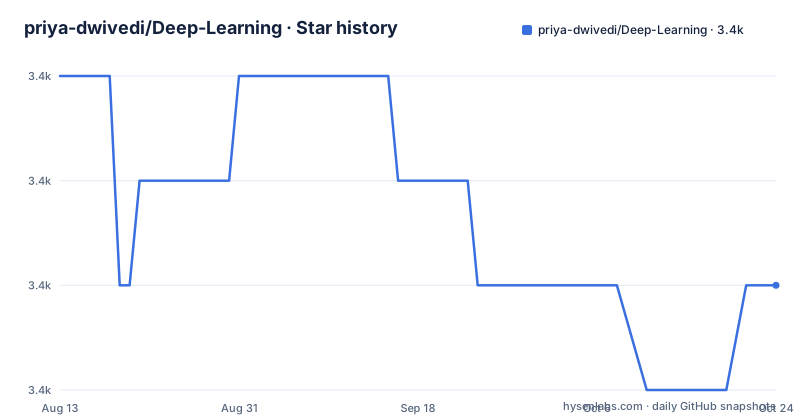
Star history
- priya-dwivedi/Deep-Learning3,354 ★ · -2
| Repository | 2026-08-13 | 2026-10-22 |
|---|---|---|
| priya-dwivedi/Deep-Learning | 3.4k | 3.4k |
-2 Stars in the last 70 days, measured from the daily GitHub snapshot. Compare with other projects
Editorial analysis
Forty-one folders, three files, and no description at all
The repository listing is short enough to read in one pass, and it is the whole of what the project is.
Forty-one directories and three files: a licence, this README, and one notebook.
The notebook is the interesting one. It is an object detection example sitting at the repository root, which contradicts the README's own statement that each project is contained in its own folder. That sentence is the only structural claim the file makes, and there is exactly one exception to it.
There is also no repository description. The metadata field is empty rather than absent, so the project has no one-line summary anywhere a listing would show it, and no homepage either.
What the README does say is four things: that the projects were done over time, that the author is passionate about the field and explores interesting ideas and tools, that each project is in its own folder, and that the author also runs a deep learning consultancy. The closing line asks the reader to enjoy cloning the repository and trying things out.
Eighty-two words, and no instructions anywhere in them.
Three object detection folders, two capitalisations, no explanation
Three of the forty-one folders are the same architecture under three names.
One capitalises the model and adds a prefix. One capitalises the model and stops there. One lowercases everything and describes a use case instead of the architecture.
So a reader looking for a mask-based region convolution implementation finds three directories, and the file gives no way to tell whether one supersedes the others, whether they are variations on different datasets, or whether they are stages of the same tutorial. The naming suggests three separate efforts, not a lineage.
The same pattern appears elsewhere in the listing. There is a general segmentation folder and a separate one named for RGB and depth input. There is a toy detector built on one framework and a notebook at the root using another framework's detection API.
Compare that with the folders where the naming is disciplined. The sequence-from-scratch project carries a course-assignment marker, the question-answering folders name their data source, and two of them name their retrieval method. Those are folders where a reader can guess the project from the name alone, which is the standard the three detector folders do not meet.
Four naming conventions in forty-one folders
The folder names are drawn from four conventions, and the distribution is uneven.
Dog-breed-classifier/
Image Classification CIFAR/
The first is hyphen-separated lower case, with hyphens between every word including compound ones. One folder follows it.
The second is capitalised words separated by spaces. Two folders follow it, one of them a classification project whose name carries a space in the middle of a path.
The third is capitalised words joined by low lines, with occasional hyphens for a version or assignment marker. The notebook at the root follows it, and so do several folders.
The fourth, and by far the most common, is lower case joined by low lines, sometimes with a trailing word that names the architecture or the dataset.
Two consequences follow. A script that walks the folder list has to handle spaces, which is a small annoyance in shell but a real one on Windows. And a search for a project by name fails constantly, because the same word is written four different ways across the collection.
None of this matters for a human browsing a list. It matters the moment anyone wants to index the collection, list it, or automate anything over it.
No requirements file, no per-folder readme, no declared framework
Read the repository as what it is: notebooks, and nothing arranged around them.
There is no dependency file at the root. There is no lock file. There is no directory of shared utilities, no configuration, and no continuous integration configuration beyond the default directory.
There is also no per-folder readme in the listing, which means each project is a folder of notebooks with no statement of which framework version it expects, which dataset it wants, or what output to look for.
The frameworks are named inside the folder names rather than declared. There is a toy detector named for one framework, a root-level notebook named for that framework's detection API, a folder named for a different framework's neural network module, and folders named after specific architectures and model families: a recurrent text generator, a sentiment classifier built on the same, a skip-gram word embedding, a BERT text classifier, a topic model, a grammar corrector, and two separate projects fine-tuning the same summarisation model on different tasks.
So the collection spans at least three deep learning frameworks and a dozen model families, none of them installed by the repository, and the README does not say so.
The two links in the README are a blog and a consultancy
The README's four sentences contain two URLs and one invitation.
The first URL is a profile on a blogging platform, and the sentence around it says the author has blogged about a lot of these projects there. That is the honest answer to what a notebook collection without documentation is: go read the write-up.
The second URL is a deep learning consultancy. The sentence introduces it as something the author also runs.
The third statement is an invitation to collaborate, and it points at the author's website without naming it, so the only site in the file is doing double duty as a business page and a contact route.
Read together, the four sentences describe a person rather than a project: what they are interested in, where they write about it, what they do for work, and how to reach them. What they do not do is tell you which of the forty-one folders to start with, what order they were built in, or whether any of them still runs.
That is a defensible thing for a personal archive to be. It is also why the repository's value depends almost entirely on the blog rather than on the repository.
One contributor, three licence files' worth of intent, no releases
The repository state is the quietest part of it, and it is consistent.
It is MIT licensed, with a licence file at the root. It publishes no releases at all, so there is no version and nothing to pin. The default branch is master. It is not archived.
The last push to that branch is dated 2023-03-24, which is three and a half years ago. For a collection of notebooks that is a long time in terms of the frameworks involved: two of the three frameworks named in the folder list have had major version changes in that window, and a notebook written against an older API will not run without edits that nobody has recorded.
There is one author, named in the README by the projects being theirs, and no contributors file and no contributor graph link in those eighty-two words.
The absence of releases is the part that matters most for reuse. A notebook collection has no API to break, so not tagging versions is defensible in principle. In practice it means anyone who wants to cite or reuse a specific notebook has to record a commit hash themselves, because the repository offers them nothing to point at.
The collection is a portfolio, and it is organised like one
It is worth saying what this repository is good at, because the criticisms above are mostly about packaging.
Forty-one projects spanning classification, detection, segmentation, depth estimation, text generation, machine translation, summarisation, question answering, grammar correction, topic modelling, sentiment analysis, word embeddings, question answering over textbooks with retrieval, a knowledge graph over résumés, and two football-prediction projects on tournament and match data. Plus a COVID-19 visualisation project that is not deep learning at all and is in the collection anyway.
That range is the point. Someone learning the field gets to see a first neural network, a recurrent network, a language model fine-tuned for generation, a detection API called directly, and a segmentation model on multimodal input, all in one place, all as notebooks someone actually ran.
The gaps are the ones a reader hits first. No index, so nothing says which project is the entry point. No dates in the folder names, so nothing says which were written against which framework version. And one notebook outside the folder structure, which is the single structural exception to the one rule the README states.
Editorial conclusion
Treat this repository as a portfolio of notebooks rather than as a library or a course. There is nothing to install and nothing to import: each project sits in its own folder, the primary language is listed as notebooks, and the README's entire promise is that you will clone it and try things yourself. Three things to know before you spend an afternoon on it. How old it is, since the last commit to the default branch is dated 2023-03-24, which for a field of this kind means the frameworks in the older folders have moved on and you should check whether the versions those notebooks expect are still the ones you would install. What is not there, which is everything needed to reproduce a result: no requirements file at the root, no per-folder readme in the listing, and no declared framework. And how the author points you onward, because the only two links in the file are a blog and a consultancy site, which is a fair way to learn what a project does but not a way to run one.
Frequently asked questions
What is the priya-dwivedi Deep-Learning repository?
It is a personal archive of deep learning projects, one folder per project, MIT licensed, with the primary language recorded as notebooks. The README describes it as projects done over time, with no repository description and no homepage declared. It publishes no releases, is not archived, and the last push to the default branch master is dated 2023-03-24.
What projects are in the priya-dwivedi Deep-Learning repository?
Forty-one folders covering image classification, object detection, segmentation and depth estimation, including three separate mask-based region convolution projects, an aerial object detector, crack detection, social-distancing detection and a 3D transformer project; text work including BERT classification, GPT-2 text generation, two projects fine-tuning the same summarisation model, grammar correction, sentiment analysis, topic modelling, skip-gram embeddings and machine translation; question answering over coronavirus material and over textbooks with search; and several sports-prediction and dataset projects.
How do I run the notebooks in this Deep-Learning repository?
The repository does not say. There is no dependency file at the root, no lock file, no per-folder readme in the listing and no declared framework, so each folder has to be opened and its imports read. The README's only links are a blogging profile where the author says they have written about many of the projects, and a consultancy site.
Which deep learning frameworks does the priya-dwivedi repository use?
More than one, and none is declared as a dependency. Folder names name the frameworks and architectures individually: a toy detector named for one framework, a root-level notebook using that framework's object detection API, a folder for another framework's neural network module, and folders named for specific architectures including recurrent networks, BERT, a skip-gram embedding model and a segmentation model on colour and depth input.
Is the priya-dwivedi Deep-Learning repository still being worked on?
The repository is not archived and the last push to the default branch is dated 2023-03-24. It publishes no GitHub releases, so there is no version to pin and nothing to cite except a commit hash. The README asks readers to clone it and try things out and invites collaboration through the author's website.
Official sources
Add this badge to your README
If you maintain this project, the badge below links readers to this analysis and shows its maintenance status from the daily GitHub snapshot. Paste the markdown into your README; add ?metric=license or ?metric=stars to the image URL for a different field.

[](https://hysenlabs.com/projects/priya-dwivedi-deep-learning)Star history chart for your README
[](https://hysenlabs.com/projects/priya-dwivedi-deep-learning)