Processing moved on: what the 3.5.4 source tree still holds and where the work went
⚠️ Processing moved to processing/processing4 ⚠️
At a glance
- What is it?
- This repository is the historical Processing 3 source tree: PDE and core Java sources, a README struck through except for its opening warning, and Processing 3.5.4 from January 2020 as the final release. Development continued in processing/processing4, so this is a place to read history rather than to file an issue or send a patch.
- Who is it for?
- Read this repository when you need the Processing 3.5.4 source as a historical reference, for instance to read how the build was laid out. Do not adopt it as a dependency to patch, because fixes land in the successor repository and no new release will ever be tagged here.
- Can I use it commercially?
- Check first. The repository uses a licence we do not classify automatically, so read its LICENSE file before any commercial use.
- Is it still maintained?
- Yes. The repository last received commits 123 days ago.
- What is it written in?
- Mainly Java, according to GitHub's language statistics.
Answers come from the project's GitHub data, last synced on November 15, 2026, and from our analysis. They are not legal advice.
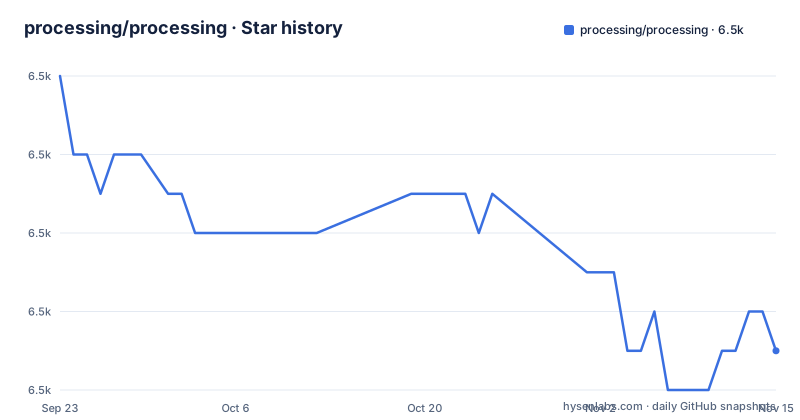
Star history
- processing/processing6,475 ★ · -7
| Repository | 2026-09-23 | 2026-11-15 |
|---|---|---|
| processing/processing | 6.5k | 6.5k |
-7 Stars in the last 53 days, measured from the daily GitHub snapshot. Compare with other projects
Editorial analysis
Everything below the warning is struck through, deliberately
The README opens with a callout box and one sentence that is still live: since Processing 3.5.4 was released in January 2020, development has continued in processing/processing4. Everything underneath sits inside strikethrough, including the sentences that used to say what the repository contained and where to report a bug. The stated reason for moving is housekeeping rather than shutdown. A new repository was chosen so that old files accumulated over the last twenty years could be cleaned out. The effect on anyone arriving from a search is that the useful text has been visually cancelled. Asking this page how to build the source gets you a dead end wrapped in a warning. Two exits remain: a wiki page carrying build instructions, and an issue picker on the 4 repository, which is now where bugs and feature requests are meant to go.
core/, app/, java/ and build/, with done.txt and todo.txt beside them
The tree is small enough to take in one look, and it still describes a build layout from twenty years of accumulation:
app/
build/
core/
java/
Four directories, which is the whole inventory of Java sources and build logic. The legacy text identified the repository as the official source for the Development Environment and for the core libraries that ship with the download, but it never mapped those product names onto these directories, so which one holds which component has to be inferred from the build scripts rather than read off a page. Two plain text files sit at the top level, done.txt and todo.txt, and they are the only status markers left inside the tree. A file named license.txt sits there too, which matters more than it sounds on a project whose repository metadata carries no licence identifier at all. Also still present: a contributing guide, an issue template, and a .github directory.
3.5.4 in January 2020 is the last tag this tree ever produced
Three releases are recorded here and then nothing. Processing 3.5.2 shipped on 2019-01-23, 3.5.3 followed eleven days later on 2019-02-03, and 3.5.4 arrived on 2020-01-17 as the final one. The tag names carry a build number alongside the version, in the form processing-0270-3.5.4 for the last release, which tells you the artefact you fetch is tied to a specific build rather than to a floating branch. That matters because the source tree kept moving after the releases stopped. The last push to master landed on 2026-07-15, so commits still land in this repository while the newest downloadable artefact is more than six years old. Plan around that split: a clone taken today and a tagged download are two different vintages of the same project.
No install command survives here: the download and the build wiki are one hop away
There is no command to copy out of this repository, and inventing one would be the wrong move. What the surviving text offers instead is a location. The download lives at processing.org/download, and compiling the source is delegated to a Build Instructions page in the wiki, with a separate style guidelines page for anyone sending code. Cloning this snapshot gives you exactly this:
README.md
CONTRIBUTING.md
ISSUE_TEMPLATE.md
license.txt
done.txt
todo.txt
Six markdown and text files beside four directories, with nothing that executes on its own. So the honest first-use procedure is not a shell session here. Decide which of the two you actually want. If you want to run Processing, take the application from the download page and skip this repository entirely. If you want to read or modify the 3.5.4 core, clone this tree, open the Build Instructions page, and follow the wiki steps there, because the toolchain they assume is not described anywhere in the files listed above.
Every kind of problem used to have its own tracker, and now one issue picker
The struck-through text preserved a deliberate routing scheme, and reading it explains where the successor repository took over. Runtime bugs went to the main issue list. Reference, website and example problems went to a separate documentation repository. Android Mode had its own tracker, and the Video and Sound libraries had theirs again. The processing.js project was named as unaffiliated, with its own tracker maintained by people who were not this group. Five destinations for five kinds of question. The live text now points bug reports and feature requests to a single new issue link on the 4 repository.
Locked issues and a renumbered import make this tracker untrustworthy
The old text is candid about two ways its own issue list misleads. First, resolved issues were locked after thirty days to cut the noise that thousands of closed reports produce. The stated worry is specific and still valid: a new problem can be lost when it arrives as a comment on an issue that closed years ago. Second, the issue list was imported from the project's previous code hosting service, so the numbering changed under it, and any reference to the old processing-bugs account may point at the wrong discussion. The note expects that mess to clean itself up as bugs get fixed and new reports come in from the new tracker. It is the reason not to treat this list as a record of what is broken. Nothing here can tell you whether a bug you remember from a Processing 3 release is fixed, was never reproducible, or was closed as a duplicate of a report that no longer means the same thing.
No new fix, no test suite, and no licence identifier in the metadata
Three things this repository cannot do, stated plainly. It cannot deliver a fix, because bug reports and patches are both redirected to processing/processing4, and the old invitation to send patches still points at pull requests here. It cannot tell you what regression coverage 3.5.4 shipped with: the legacy note from January 2019 admits the plan to throw together hundreds of unit tests and then says, in the next breath, but not today. With no test directory in the tree, coverage is simply undocumented. And it cannot tell you the licence from its own metadata, because the recorded licence is an unasserted value while the actual terms sit in a file called license.txt at the top level, and the README speaks only of giving the work away for free. If any of that matters to your use, resolve it in the file rather than in the badge.
Editorial conclusion
Read this repository when you need the Processing 3.5.4 source as a historical reference, for instance to read how the build was laid out. Do not adopt it as a dependency to patch, because fixes land in the successor repository and no new release will ever be tagged here. Before you build anything from it, check the two things this tree leaves open: the licence text in license.txt, since the repository metadata carries no licence identifier, and the Build Instructions wiki page, since no build command survives in the README.
Frequently asked questions
How do I install Processing?
Nothing in this repository installs it any more. The surviving text sends you to processing.org/download for the release and to a Build Instructions wiki page for compiling from source, and every line below the opening warning is struck through.
How do I install the Processing IDE?
The Development Environment and its core libraries used to be released from this tree, and that description is now struck through. Bugs and feature requests are directed to the processing/processing4 issue picker instead.
How do I install Processing on Linux?
This repository documents no Linux install procedure at all. The application download is linked from processing.org, and compiling from source is delegated to the Build Instructions wiki page rather than to anything in the tree.
Where do I download Processing?
The download lives on processing.org/download, outside this repository. What remains here is the 3.5.4 source tree from January 2020, with development continued in processing/processing4.
Official sources
Add this badge to your README
If you maintain this project, the badge below links readers to this analysis and shows its maintenance status from the daily GitHub snapshot. Paste the markdown into your README; add ?metric=license or ?metric=stars to the image URL for a different field.

[](https://hysenlabs.com/projects/processing-processing)Star history chart for your README
[](https://hysenlabs.com/projects/processing-processing)Was this useful?