RxDB swaps its storage engine under one API and replicates through three HTTP endpoints
The local-first database that runs on every JS runtime and replicates with your existing backend - no vendor, no lock-in - https://rxdb.info/
At a glance
- What is it?
- RxDB is a local-first, reactive NoSQL database for JavaScript. Queries and single fields can be subscribed to, storage engines are replaceable, and version 17.6.0 was released on 5 October 2026.
- Who is it for?
- Choose RxDB if you are building a JavaScript app that must work offline and keep UI state live, and you can implement three HTTP endpoints on your own backend or use one of the listed replication plugins. Decide on your storage engine first, since LocalStorage, IndexedDB, OPFS and SQLite are different storages, and note the Node.js 20 minimum in package.json.
- Can I use it commercially?
- Yes. Apache-2.0 is a permissive licence: you can use, modify and sell software built on it, as long as you keep its copyright and licence notices.
- Is it still maintained?
- Yes. The repository received new commits within the last day.
- What is it written in?
- Mainly TypeScript, according to GitHub's language statistics.
Answers come from the project's GitHub data, last synced on November 26, 2026, and from our analysis. They are not legal advice.
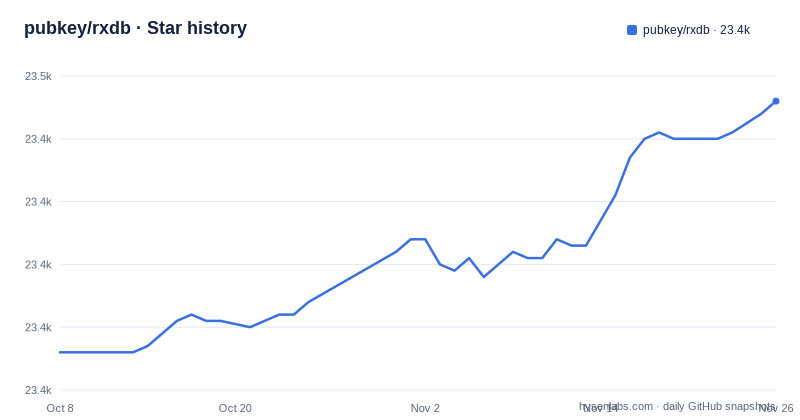
Star history
- pubkey/rxdb23,446 ★ · +40
| Repository | 2026-10-08 | 2026-11-26 |
|---|---|---|
| pubkey/rxdb | 23.4k | 23.4k |
40 Stars in the last 49 days, measured from the daily GitHub snapshot. Compare with other projects
Editorial analysis
Subscribing to a query result or a single field is the reactive part
RxDB stands for Reactive Database. The README calls it a local-first NoSQL database for JavaScript applications, and says reactive means you can subscribe to all state changes, whether that is the result of a query or a single field of a document. Its stated fit is UI-based realtime applications, where a screen should update when data changes underneath it.
The install pulls in RxJS next to RxDB:
npm install rxdb rxjs --saveThat pairing is the design. Streams of query results arrive as observables, which suits Angular, and the README feature list adds Signals for frameworks that use them, plus a TanStack DB collection integration. The package.json declares sideEffects as false and requires Node.js 20 or newer in engines, so bundlers can drop unused plugins and old Node versions are out.
The quick start imports createRxDatabase from rxdb/plugins/core and a storage getter from a separate plugin path. Features come in as plugins you import by path, not as one large default bundle.
The practical effect of the plugin import paths is that you decide per project what ships. A browser app that needs only LocalStorage, schema validation and one replication plugin imports those and nothing else. A Node.js service imports a different storage and perhaps the Server feature. Before you start, write down which storage, which replication plugin and which validation plugin your first release needs, because each is a separate import and a separate documentation page.
Swapping the storage interface is how one codebase runs in browsers and servers
RxDB sits on a storage interface that lets you replace the underlying engine. The README says this increases code reuse, because the same database code runs in different JavaScript environments when you switch the storage settings.
The listed storages are LocalStorage, IndexedDB, OPFS, LokiJS, Dexie.js, in-memory, SQLite, a WebWorker thread, FoundationDB and DenoKV. Each has its own documentation page on rxdb.info. The quick start comments say browsers use the LocalStorage based storage, and other runtimes can use different ones.
If you are looking for alternatives to IndexedDB, RxDB treats IndexedDB as one option among several, and OPFS, SQLite and LocalStorage sit beside it behind the same API. The cost of the flexibility is that you must choose. Read each storage page for its limits before you commit data to one.
The runtimes named are browsers, Node.js, React Native, Capacitor, NativeScript, Flutter and Electron. The examples directory has matching projects for Angular, Electron, Flutter, GraphQL, Ionic, Node, React Native, React, Supabase, Svelte, Tauri, Vite, and Vue.
Replication needs three HTTP endpoints, or one of eight plugins
RxDB's Sync Engine is described as battle-tested and aimed at realtime replication with your existing infrastructure. You do not have to use a specific cloud or backend database. The protocol works by implementing three simple HTTP endpoints, and the replication page on rxdb.info is where to learn their exact contract.
If you would rather not write them, the README names production-ready plugins for GraphQL, CouchDB, Websocket, WebRTC (peer to peer), Supabase, Firestore, NATS and Google Drive. The WebRTC plugin is listed as peer to peer, while the others depend on the service they name.
The repository description says there is no vendor and no lock-in. That holds for the database itself under the Apache-2.0 license. Your backend still has to handle what the endpoints require, and conflict handling is a feature RxDB lists separately, on the transactions, conflicts and revisions page. If two devices edit the same document offline, the conflict resolution behavior you configure decides which write survives, so test it with your own data before shipping.
The examples directory includes a supabase project and a graphql project, which are the closest starting points if your backend is one of those. For a custom backend, start from the replication page and implement the endpoints before wiring any UI, since a database that cannot sync leaves you with a local-only app.
The feature table lists encryption, CRDT and schema validation as separate plugins
The feature section says that since 2018 RxDB has gained a large set of features and plugins, and that every feature you need now or might need later is already there. That second claim is the README's own wording and can't be checked from the repository text.
The features that matter for an app decision are Schema Validation, Compression (key compression), Migration, Encryption, CRDT, Population, Conflict Handling, Middleware, ORM, Attachments, Backup, Logging, Local Documents, State, Server and Storages. Each links to its own page on rxdb.info.
Three of these change how you design data. Schema Validation means documents are described by JSON schema, as the package keywords show. Migration covers moving documents when the schema changes, which you will need as soon as you ship a second version of a collection. Encryption is a plugin, so data is not encrypted unless you enable it.
Performance numbers, bundle size and memory use are what to measure in your own target runtime. The big feature list also means a larger documentation surface than a minimal key-value store would have.
Version 17.6.0 followed 17.5.0 and 17.4.0 at six to seven week intervals
The repository is not archived, with a last push on 2 November 2026. Recent releases are 17.6.0 on 5 October 2026, 17.5.0 on 20 August 2026 and 17.4.0 on 13 July 2026. Those minor versions land roughly five to seven weeks apart. Minor releases that frequent mean you should read CHANGELOG.md before bumping.
The repository root also contains AGENTS.md, CLAUDE.md, .claudeignore, .aiexclude and context7.json, which are files for AI coding tools. The orga directory and docs-src hold the organization material and the source of the documentation site.
The README says RxDB is used by thousands of developers and links the GitHub dependents page, which is the place to check who depends on it. License is Apache-2.0, the homepage is rxdb.info, and the README links a chat, a newsletter and example projects.
Editorial conclusion
Choose RxDB if you are building a JavaScript app that must work offline and keep UI state live, and you can implement three HTTP endpoints on your own backend or use one of the listed replication plugins. Decide on your storage engine first, since LocalStorage, IndexedDB, OPFS and SQLite are different storages, and note the Node.js 20 minimum in package.json.
Frequently asked questions
What are some alternatives to IndexedDB?
RxDB can run on top of LocalStorage, IndexedDB, OPFS, LokiJS, Dexie.js, in-memory, SQLite, a WebWorker thread, FoundationDB and DenoKV through its storage interface.
How do I install RxDB?
Run npm install rxdb rxjs --save. The package.json requires Node.js 20 or newer.
Which backends can RxDB replicate with?
It can replicate with any backend that implements three simple HTTP endpoints, or use plugins for GraphQL, CouchDB, Websocket, WebRTC, Supabase, Firestore, NATS or Google Drive.
Official sources
Add this badge to your README
If you maintain this project, the badge below links readers to this analysis and shows its maintenance status from the daily GitHub snapshot. Paste the markdown into your README; add ?metric=license or ?metric=stars to the image URL for a different field.

[](https://hysenlabs.com/projects/pubkey-rxdb)Star history chart for your README
[](https://hysenlabs.com/projects/pubkey-rxdb)Was this useful?