PufferLib ships its own algorithms, a C codebase, and no install instructions
Puffing up reinforcement learning
At a glance
- What is it?
- PufferLib is an open source reinforcement learning library whose learning algorithm, hyperparameter tuning and simulation methods the project attributes to its own research. The README is short: no install command, no usage example, no API list. Everything a new user needs is delegated to puffer.ai and to a Discord server.
- Who is it for?
- Use PufferLib when you want a reinforcement learning stack whose internals the authors developed themselves and you are willing to read the hosted documentation before touching anything. Do not pick it from the repository alone, because the repository carries no install command, no dependency manifest and no API reference.
- Can I use it commercially?
- Yes. MIT is a permissive licence: you can use, modify and sell software built on it, as long as you keep its copyright and licence notices.
- Is it still maintained?
- Yes. The repository last received commits 31 days ago.
- What is it written in?
- Mainly C, according to GitHub's language statistics.
Answers come from the project's GitHub data, last synced on November 14, 2026, and from our analysis. They are not legal advice.
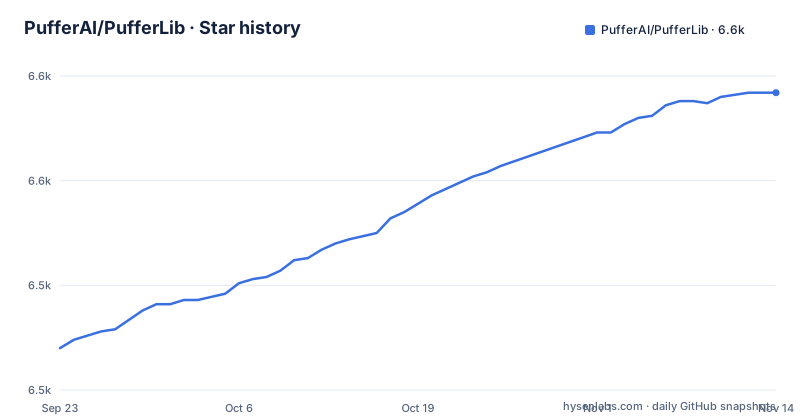
Star history
- PufferAI/PufferLib6,592 ★ · +122
| Repository | 2026-09-23 | 2026-11-14 |
|---|---|---|
| PufferAI/PufferLib | 6.5k | 6.6k |
122 Stars in the last 52 days, measured from the daily GitHub snapshot. Compare with other projects
Editorial analysis
The speed claim and the research claim are the whole pitch
Two sentences carry the argument. PufferLib is described as a fast and sane reinforcement learning library that can train tiny, super-human models in seconds. The second sentence is the differentiator: the included learning algorithm, the hyperparameter tuning and the simulation methods are all stated to be the product of the project's own research, rather than wrappers around existing work. That framing matters for anyone choosing a library, because it tells you what happens when you find a limitation. You are reading the authors' design decisions rather than tuning someone else's defaults.
The rest of the positioning is about the environment rather than the algorithm. Super-human here means beating human performance on a task, and the phrase tiny models narrows the goal again: small networks trained quickly, not large ones trained slowly. No benchmark table, no task list and no numbers accompany either claim, so the two statements cannot be checked from the repository. Treat them as the project's description of itself.
build.sh and profile.sh are the only commands the repository exposes
There is no install line anywhere in the README, and no usage example either. The entire top level of the repository is this:
.gitignore LICENSE README.md SKILL_ISSUES.md build.sh config/ ocean/ profile.sh resources/ src/ tests/ vendor/Two shell scripts are visible, build.sh and profile.sh, and neither is explained. A repository that names a profiling script tells you something about how it expects to be used, since reinforcement learning runs are long enough that people want to know where the time goes, but the README says nothing about how to invoke either one. The rest of the tree is directories you have to explore on your own: src/ for the code, tests/ for the tests, vendor/ for something already vendored, config/ for configuration, ocean/ for something the project never explains, and resources/.
So the practical first step is not a command you can copy. It is opening puffer.ai, reading the documentation there, and coming back to build.sh once you know what it expects.
The default branch is 5.0 and both release tags say experiments
The versioning here is unusual enough to look like an accident until you read the tags together. The default branch is named 5.0, not master and not main. There are two releases: 5.0-experiments, published on 2026-09-13, and a second one labelled simply experiments for 4.0, published on 2026-04-05. Neither tag carries a dot-separated patch number, and neither says stable.
The last push to the default branch is dated 2026-10-14, about a month after the 5.0-experiments tag, and the repository is not archived. Read together, those three facts say the 5.0 line is where the work is happening and that the project labels its own releases as experimental. For a research library that is a reasonable convention, since the algorithm is the contribution and it is expected to move. For a library you intend to pin inside a product, it means you are pinning to a moving target and should record the commit hash rather than a tag.
The licence is MIT and sits at the root as LICENSE, which is the simplest part of the adoption story.
The primary language is C while the search around the name is Python
C is the language recorded for this repository, and the tree is consistent with that: src/ is the code, vendor/ is a vendored dependency tree rather than a language specific lock file, and there is no manifest for a package index in the root listing. No interpreter is named in the README, no minimum version is stated, and no dependency file appears in the top level entries. Whatever PufferLib links against, you have to learn from the hosted documentation.
If your pipeline is Python only, the first thing to confirm on puffer.ai is whether there is a Python surface at all, or whether this is a native library you compile and call.
The README does not answer that, and it does not name a single function, class or command, so nothing in the repository can settle it.
The free tools and the paid environments are separated in one sentence
The commercial half of the project is stated plainly and without a pricing table. All of the tools are free and open source. Then: if you need a high performance environment for your application, the authors build them professionally and offer training plus extended support, with a direct contact handle in the README.
Read carefully, the sentence draws a line between two things that are easy to conflate. The library and its tools are the open part. A production environment built for your application, plus the training and the ongoing support around it, is the paid part. That is a sensible split for a library whose selling point is a fast simulation layer, since the same simulation code is what makes a training run quick and what makes a production environment expensive to maintain.
What you do not get from the repository is any detail on the commercial side. No package names, no service description, no terms. The only route stated is a person to contact.
Support runs through Discord first, and issues come with a social contract
SKILL_ISSUES.md sits in the root, and the README sets out the support rule: find the authors on Discord at the handle given there, post there before opening issues, and the community is where support happens. Documentation is hosted at puffer.ai rather than in the repository, so there is no doc/ directory to browse.
That combination has a practical consequence. There is no local answer to anything. No API reference, no configuration table, no changelog, no examples directory, and no CI configuration visible in the top level listing. The repository is built to be read by someone who already has the documentation open next to it, which is a fine way to work once you are inside the project and a poor way to evaluate it from a distance.
The README also asks for stars to support the project and says new contributors are always welcome, which is the usual way of signalling that outside patches are expected rather than merely tolerated.
Nothing in the tree tells you what the library does with a run
The missing part is the one that decides whether the tool fits. A reinforcement learning library has to tell you how you express an environment, how a policy is defined, how a training run is configured and started, how checkpoints and logs are written, and how results are evaluated. The repository contains config/, resources/, src/ and tests/, so the machinery is there, and none of it is described at the top level. No flags, no function signatures, no file formats, no metric names.
That also means the claims cannot be checked from here. Seconds to train a super-human model is the kind of statement that is either obvious on your hardware or impossible on it, and there is nothing in the repository about the environment, the algorithm configuration or the hardware the seconds were measured on. The three directories that would answer those questions, config/, resources/ and ocean/, are exactly the ones the README leaves unexplained.
So the honest test is small: read puffer.ai first, then decide whether the free tools cover your case, and only then look at whether the paid environment is worth it for your application.
Editorial conclusion
Use PufferLib when you want a reinforcement learning stack whose internals the authors developed themselves and you are willing to read the hosted documentation before touching anything. Do not pick it from the repository alone, because the repository carries no install command, no dependency manifest and no API reference. Confirm the interpreter and dependency expectations on puffer.ai, and ask on Discord before opening an issue.
Frequently asked questions
What is PufferLib?
An open source reinforcement learning library, described as fast and sane, that can train tiny super-human models in seconds. Its learning algorithm, hyperparameter tuning and simulation methods are stated to come from the project's own research.
How to install PufferLib?
The README carries no install command. The repository root lists build.sh and profile.sh without explanation, and the documentation at puffer.ai is where the setup steps live. Support questions go to the project's Discord before issues are opened.
how to use pufferlib
No usage example, API reference or configuration table appears in the README or the top level of the repository, which holds src/, tests/, config/, resources/, ocean/ and vendor/. The hosted documentation at puffer.ai is the only guide the project points to.
Which Python library is best for reinforcement learning?
The repository makes no comparison with other libraries, and its primary language is listed as C rather than Python, with no interpreter or dependency manifest in the root. The README does state that all of the project's tools are free and open source under an MIT licence.
Official sources
Add this badge to your README
If you maintain this project, the badge below links readers to this analysis and shows its maintenance status from the daily GitHub snapshot. Paste the markdown into your README; add ?metric=license or ?metric=stars to the image URL for a different field.

[](https://hysenlabs.com/projects/pufferai-pufferlib)Star history chart for your README
[](https://hysenlabs.com/projects/pufferai-pufferlib)Was this useful?