RedReader is explicitly unofficial, caches past versions of every post, and documents exactly one build command
An unofficial open source Android app for Reddit.
At a glance
- What is it?
- An unofficial Android Reddit client written in Java, distributed through Google Play and F-Droid, and governed by a GPL-3.0 licence with the text kept in the tree. The interesting parts are the cache that keeps post history, the one Gradle task the project documents, and the recipe nobody is told about.
- Who is it for?
- RedReader is a reasonable pick if you want a Reddit client with no ad surface and a local copy of post history, and an unreasonable one if you need a documented API, a client id or a documented build.
- Can I use it commercially?
- Yes, with conditions. GPL-3.0 is a copyleft licence: if you distribute software that includes it, you must release that software's source code under the same licence. Running it internally without distributing it does not trigger that obligation.
- Is it still maintained?
- Yes. The repository last received commits 36 days ago.
- What is it written in?
- Mainly Java, according to GitHub's language statistics.
Answers come from the project's GitHub data, last synced on November 15, 2026, and from our analysis. They are not legal advice.
Star history
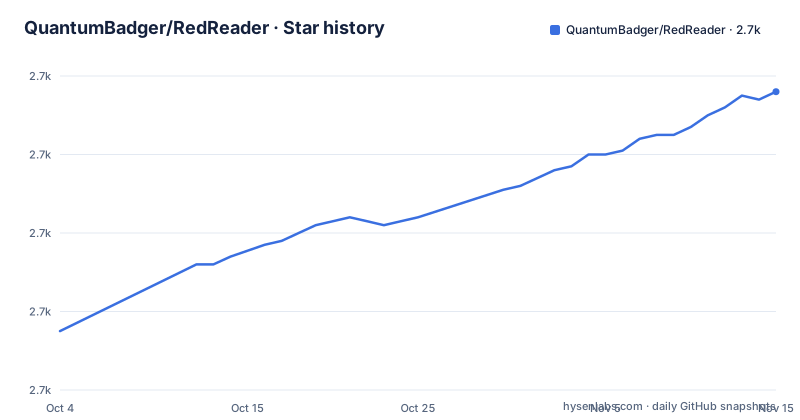
- QuantumBadger/RedReader2,736 ★ · +61
| Repository | 2026-10-04 | 2026-11-15 |
|---|---|---|
| QuantumBadger/RedReader | 2.7k | 2.7k |
61 Stars in the last 42 days, measured from the daily GitHub snapshot. Compare with other projects
Editorial analysis
Unofficial by name, and no homepage in the metadata
An unofficial, open source Android client for Reddit is how the project introduces itself, and the same wording repeats in the repository description, so the first thing any reader learns is that none of this is endorsed by Reddit. The code is Java, the licence is GPL version 3 with the text kept alongside as LICENSE.txt, and the default branch is master rather than main.
The metadata sets no homepage field at all. For a project that already has three working distribution addresses, that is a small omission, but it does mean the repository page has no site of its own to point at.
What the tree does not contain is worth as much as what it does. Across nineteen top level entries there is no client id, no api key and no oauth configuration. The names are the standard Android set, build.gradle.kts, settings.gradle.kts, gradlew, gradlew.bat, gradle/ and src/, plus config/, fastlane/, libs/, proguard-rules.pro, justfile, .editorconfig, .github/, .gitignore, CONTRIBUTING.md, PRIVACY.md, README.md and LICENSE.txt.
Two F-Droid address shapes for one application id
The download section sends you to the Google Play store and to F-Droid, and the store listing uses the application id `org.quantumbadger.redreader` as its last path segment. The same id appears in both links, which makes it the one string worth searching on.
The two F-Droid addresses are not the same shape. The badge near the top of the file points at `https://f-droid.org/packages/org.quantumbadger.redreader/`, plural packages with a trailing slash, while the Downloading section points at `https://f-droid.org/app/org.quantumbadger.redreader`, singular app and no trailing slash. Two generations of the F-Droid URL scheme are living in one file, and anyone following only one of them never learns the other exists.
A third address covers sideloading, because the Google Play APKs are also published on the repository's own releases page. A copy taken from there is the same build the store serves, while the F-Droid copy is built from this source tree. Those two artifacts are not interchangeable once signing is involved.
One documented build command and a recipe that runs four more
Building takes one documented step, and the sentence above it qualifies it by platform:
./gradlew installDebugThat is a debug variant install task, and it is the only build command the project writes down. The build is Gradle based on the Kotlin DSL, so build.gradle.kts and settings.gradle.kts sit at the root beside the wrapper, and gradlew.bat is committed for Windows even though the instruction names only Linux.
The quality gate is a second path the prose never mentions. The justfile at the root defines exactly one recipe, called precommit, and that recipe is a single line:
./gradlew pmd test checkstyle lintFour Gradle tasks in one line: static analysis, unit tests, checkstyle, and the Android lint task. The README points contributors at CONTRIBUTING.md for the rules instead, so the one recipe the repository ships its own tooling around is discoverable only by opening the justfile.
The no tracking line is one bullet, and PRIVACY.md is never linked
The feature list opens with a promise rather than a mechanism: free and open source, with no ads or tracking. The root of the repository does contain a PRIVACY.md, so a policy document exists.
No section of the README links to it. The file references in this project point at CONTRIBUTING.md for contribution rules, at LICENSE.txt for the licence, and at src/main/assets/changelog.txt for the contributor credits. PRIVACY.md appears in none of them. A reader who wants to know what the app collects is told there is nothing to collect, and is handed no address to check that against.
That is a documentation gap rather than a disclosure problem, and it is easy to close: the file is in the root directory, one click from the file list. Until it is linked, the claim and the evidence live in different places, which is not where a reader of an unofficial client has any reason to look.
Past versions of every post are cached, and a swipe commits the vote
The feature most likely to be misread is advanced cache management, described as automatically storing past versions of posts and comments. That is not a request cache in the usual sense of reusing a network response. A comment that gets edited, or a post that gets removed, leaves an earlier copy behind in local storage.
The gesture that drives all of this is a horizontal swipe. Posts can be swiped left and right to perform customizable actions, and the two named in the list are upvote or downvote and save or hide, so the mapping from direction to effect is configuration rather than fixed behaviour. A history cache and a commit-vote gesture sitting on the same screen means one fast flick can leave a permanent local trace and a permanent remote one at the same time, and the documentation does not describe how to review or undo either.
Precaching has three states, and the tablet layout is offered to a phone
Two entries in the feature list are more specific than the rest. Image and comment precaching is optional and has exactly three settings: always, never, or Wi-Fi only. That is the entire configuration surface for it, and the real difference is between the first and the third, which is whether a metered connection is treated as an unlimited one.
The second is the two column tablet mode, described as usable on a phone if it is big enough. A layout written for a tablet is offered to a handset, with no separate phone arrangement described alongside it.
Both point at the same underlying choice, which is to keep the display logic in the app instead of deferring to a responsive page. The build ships a built-in image viewer, a GIF and video player, multiple themes including night mode and an ultra black variant for AMOLED displays, accessibility features with optimization for screen reader use, community translations, and support for Android 5.0 and up. All of that has to run on a five year old platform floor.
Patch numbers hide a five month gap, and credits ship inside the APK
Three recent releases line up like this: v1.25.1 on 2025-12-10, v1.25.2 on 2026-05-10, and v1.26 on 2026-08-15. The middle one is a patch bump, so a reader scanning tags sees a fix, when the gap in front of it is five months and the gap behind it is three. The patch suffix here carries no urgency signal.
The repository is not archived, and the last commit landed on 2026-09-16, a few weeks after the v1.26 tag, so the default branch sits ahead of the newest release. A fastlane/ directory at the root is where Play Store submission automation belongs for a Java Android app, which matches the two store listings the project advertises.
Credits are handled unusually. The Thanks section does not link to a generated contributors page, it points into the app's own assets at src/main/assets/changelog.txt, so the full contributor list travels inside the APK rather than living on the repository site. Translations are hosted on Weblate at hosted.weblate.org/projects/redreader/strings/, and the badge promoting that service is pasted into the file twice, once above the feature list and once inside the Translating section.
Editorial conclusion
RedReader is a reasonable pick if you want a Reddit client with no ad surface and a local copy of post history, and an unreasonable one if you need a documented API, a client id or a documented build. Verify three things before switching: open PRIVACY.md yourself, since the no tracking line is a bullet with no link behind it; read the precommit recipe, because those four Gradle tasks are the real gate on a change; and pin a release tag instead of following master, since the patch numbers here do not mean a fix was days old. The application id org.quantumbadger.redreader is the one string that resolves on both stores.
Frequently asked questions
What is RedReader, and who publishes it?
RedReader describes itself as an unofficial, open source Android client for Reddit. The code is Java, the licence is GPL version 3 with the text kept in LICENSE.txt, the default branch is master, and the Android application id used by both stores is org.quantumbadger.redreader.
Is RedReader free to use?
Yes. It is listed as free and open source with no ads or tracking, published free on the Google Play store and on F-Droid, and the Google Play APKs are also available on the repository's own releases page.
What is org.quantumbadger.redreader?
That is the Android application id, and it is the trailing segment of both distribution links: play.google.com/store/apps/details?id=org.quantumbadger.redreader for the Play listing, and f-droid.org/packages/org.quantumbadger.redreader/ for the F-Droid package page.
How does RedReader compare with Infinity?
The repository does not discuss Infinity or any other third party client. It lists its own differences instead: no ads or tracking, swipe actions for voting and for saving or hiding, automatic caching of past post and comment versions, multiple accounts, optional precaching, a built-in image viewer with GIF and video playback, night and ultra black themes, Android 5.0 and up, community translations, and screen reader support.
Official sources
Add this badge to your README
If you maintain this project, the badge below links readers to this analysis and shows its maintenance status from the daily GitHub snapshot. Paste the markdown into your README; add ?metric=license or ?metric=stars to the image URL for a different field.

[](https://hysenlabs.com/projects/quantumbadger-redreader)Star history chart for your README
[](https://hysenlabs.com/projects/quantumbadger-redreader)Was this useful?