quil's readme names three different numbers as the current version
Main repo. Quil source code.
At a glance
- What is it?
- A graphics library that mixes a Processing style API into Clojure and ClojureScript, delivered through two build tools with five configuration files between them. The version story is the mess worth reading: a build counter rather than a semantic version, a file that disagrees with itself about which number is current, and a two year gap between the newest tag and the last commit.
- Who is it for?
- Use this if you want a Processing shaped drawing API inside a Clojure project, particularly on the scripting side, where the argument translation between the two languages is the whole value proposition. Two things to verify before you start.
- Can I use it commercially?
- Yes, with conditions. EPL-1.0 is a weak copyleft licence: you can use it inside commercial and closed-source software, but if you distribute changes to its own files, you must publish those changes under the same licence.
- Is it still maintained?
- Activity is slowing. The repository last received commits 7 months ago.
- What is it written in?
- Mainly Clojure, according to GitHub's language statistics.
Answers come from the project's GitHub data, last synced on November 24, 2026, and from our analysis. They are not legal advice.
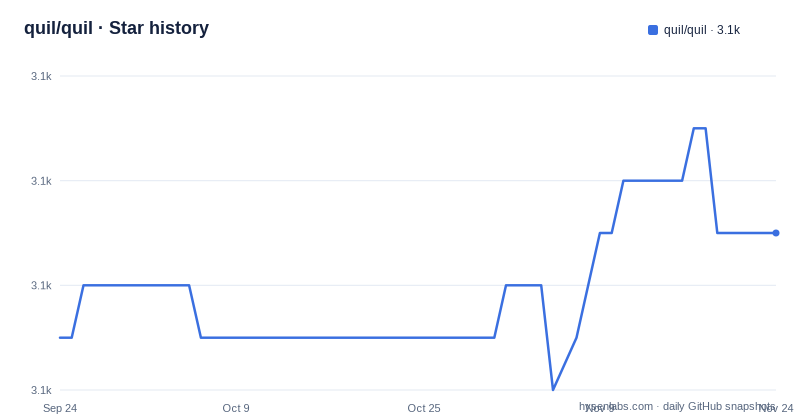
Star history
- quil/quil3,053 ★ · +2
| Repository | 2026-09-24 | 2026-11-24 |
|---|---|---|
| quil/quil | 3.1k | 3.1k |
2 Stars in the last 61 days, measured from the daily GitHub snapshot. Compare with other projects
Editorial analysis
Three version numbers, all presented as current
Read the requirements section and the installation section of the same file and they disagree about what version you are installing. The requirements section states that the current released version is 4.3.1560. The install snippet a few lines below, for the Leiningen dependency map, says 4.3.1563. The Clojure CLI snippet beside it also says 4.3.1563. The newest release on the repository is tagged 4.3.1563 as well. So two of the three numbers agree and one is three behind, and all three are presented as the thing to install. The likely explanation is that the prose was not updated when the version was cut, which is the ordinary reason, and the reason it still matters is that a reader copying the requirements line installs a version three builds older than the one the snippets ask for. Neither of those numbers tells you much on its own, because the third component is a counter: the two visible releases are 4.3.1563 and 4.3.1323, so this scheme increments on every build and carries no compatibility promise.
Two years of work on the branch and no tag since 2024
Two releases are visible in the release list. The newest is 4.3.1563, published in January 2024, and the one before is 4.3.1323 from November 2023, so the counter advanced by a couple of hundred in about two months and then stopped appearing. The default branch received a push on 24 April 2026. So the tree is more than two years ahead of the newest tag, on a scheme where nothing about the number tells you whether the changes are safe for you. That combination, a build counter plus no recent tag, is the reason the version question above matters more here than it would in a project on a semantic scheme. It is also why the release notes file at the repository root, which the readme never links to, is the place to look for what actually changed; a file called release notes being present and unlinked is a small sign that release notes stopped being part of the reading path.
The documented build tool has no project file in the tree
The installation section opens with a Leiningen template command:
lein new quil hello-quiland then says that if you prefer adding libraries by hand you put a dependency into the project map, or into a dependencies file for the Clojure CLI. The development section is written entirely around Leiningen: it tells you to run a compile step first, then either open a sample file in an editor with a Clojure-aware integration and evaluate it, or run that sample as a main. Now look at what is committed. There is a dependencies file for the Clojure CLI, and there is no Leiningen project file at the root. So the route the readme leads with, the template command and the compile step and the editor loop, cannot be run against a fresh clone as it stands, while the Clojure CLI route the readme mentions second is the one the tree is actually set up for. That is an old Clojure habit, where projects accumulated two build tools during a migration and neither was removed, and it is worth an afternoon of your own before you file anything.
Five build configuration files for one library
Count the configuration at the root and there are five files doing build work. A dependencies file for the Clojure CLI, a task file for Babashka, a file for the ClojureScript build tool that drives the live reload loop, a separate development-scoped dependencies file for the scripting target, and a build script written in Clojure beside a build directory. Add two more that exist purely to hold test aliases, one per language, and a configuration directory for the linter, plus an editor-local settings file. None of that is wrong for a project that ships two language targets, since each target genuinely needs its own entry points, but it does mean the build surface is much larger than the readme suggests, and a contributor needs to know which of the five files owns the task they are changing. The two language targets are real rather than aspirational: the source directory is the Clojure one, and the scripting configuration points at its own entry file.
The bundled reference is described as out of date
The documentation section points at four places to look. The hosted reference site is the one to use for current material, the wiki carries installation instructions and an article on the scripting target, and the tutorials for the underlying graphics library are the recommended starting point for anyone new to the field. The fourth is a cheatsheet shipped as a PDF inside the repository, and the readme introduces it with a warning: it may be a little out of date but it still contains most of the functions. That is an honest statement and an unusual one, because most projects either update the cheat sheet or remove it. It is also the most likely thing to mislead a newcomer, because a single PDF that covers most of the API is exactly what a new user will find and trust, and the API is where the naming convention below does its damage. Read the warning as part of the document rather than as a footnote.
The examples are translated from a book, with permission
The examples do not live in this repository, which the description says is the main one. They live in a sibling repository with its own readme explaining how to run them, and there is a separate generated art page pointing at a subset of them. The provenance is stated in one sentence: many of the examples were translated from a book on generative art by a named author, with his kind permission. That sentence is doing real work and it is worth reading twice, because example corpora for graphics libraries are usually lifted wholesale from whatever book they can find. Here it is credited, permission is named, and the source is credited in the file itself rather than in a footnote. The community gallery is also a separate site rather than a directory in this tree. So the surface a user actually sees, the examples and the gallery, lives in three places other than the one they cloned, and the readme is candid about all three.
The scripting target is pinned years behind the graphics one
The compatibility section states that the library supports the standard API of the underlying graphics system, currently version 4.3, and the JavaScript counterpart at version 1.7.0, with a note that the majority of the graphics methods have an equivalent here. The two numbers are the whole compatibility claim and they are of very different ages. Version 4.3 of the graphics library is also the number this project's own releases carry, so that side tracks. Version 1.7.0 of the scripting counterpart has not moved in the years since it was written into the file, which means a user on a current release of that library is calling a subset of what exists. The naming convention is the other half of the porting cost and is stated once: methods written in camel case upstream become hyphenated names here. So the mapping is mechanical and total, and it means every method you know from the graphics library has a different name in this one.
Editorial conclusion
Use this if you want a Processing shaped drawing API inside a Clojure project, particularly on the scripting side, where the argument translation between the two languages is the whole value proposition. Two things to verify before you start. Install through the Clojure CLI rather than the Leiningen route the readme leads with, because the repository ships a dependencies file for the CLI and no Leiningen project file, so the documented first command will not run against a fresh clone. And pin the version yourself rather than copying it from the prose, because the file names three different numbers as current and the third component is a build counter that increments without carrying any compatibility meaning. On the API itself, expect a rename convention to absorb your reading time, since the camel cased names of the underlying library become hyphenated ones here, and expect the bundled reference to be behind the code, which the project itself notes.
Frequently asked questions
What is Quil?
A Clojure and ClojureScript library that provides the Processing and p5.js graphics APIs. It is described as a mix of the two: one hand holds a carefully crafted drawing and animation API, the other a set of language abstractions, and the library binds them together. It runs on the standard Processing API at version 4.3 and p5.js at 1.7.0.
Which versions of Clojure does Quil support?
Clojure 1.10 and ClojureScript 1.10.x. The current released version is stated as compatible with JDK 17 and later, and the readme says it supports Linux on amd64 and aarch64 plus macOS on both Apple silicon and x86_64.
How do I install Quil?
Four routes: a Leiningen template that creates a sample project, a template for the Clojure CLI that creates a sketchbook, or adding the dependency by hand to a Leiningen project map or to a dependencies file for the Clojure CLI. Then require the core namespace. Note that the repository ships a Clojure CLI dependencies file and no Leiningen project file, so the CLI route is the one that works from a fresh clone.
How do I run a Quil sketch?
Write three things: a setup function called once at the start, a draw function called repeatedly until you stop it, and a sketch that names them along with a title and size. The readme also mentions a settings function that turns on anti-aliasing and a convenience macro around the sketch call, so the three concepts it introduces turn out to be five functions in the example.
Official sources
Add this badge to your README
If you maintain this project, the badge below links readers to this analysis and shows its maintenance status from the daily GitHub snapshot. Paste the markdown into your README; add ?metric=license or ?metric=stars to the image URL for a different field.

[](https://hysenlabs.com/projects/quil-quil)Star history chart for your README
[](https://hysenlabs.com/projects/quil-quil)Was this useful?