Quilt is a data package SDK, and the hosted catalog it describes is not in the repository
Quilt is a Scientific Data Management Platform on AWS that helps teams and AI find, trust, and reuse data through deeply versioned, context-rich data packages.
At a glance
- What is it?
- An Apache-2.0 monorepo holding the quilt3 Python SDK, a TypeScript catalog frontend, AWS Lambda services and documentation tooling, whose own readme separates the open source part from an enterprise platform. The most recent tagged release is dated October 2020.
- Who is it for?
- Read this repository as a library and a set of services rather than as the product. What you can install is the quilt3 SDK and CLI for building, versioning and uploading data packages to S3 with your own AWS credentials, plus the catalog frontend and the Lambda services behind it.
- Can I use it commercially?
- Yes. Apache-2.0 is a permissive licence: you can use, modify and sell software built on it, as long as you keep its copyright and licence notices.
- Is it still maintained?
- Yes. The repository received new commits within the last day.
- What is it written in?
- Mainly TypeScript, according to GitHub's language statistics.
Answers come from the project's GitHub data, last synced on October 22, 2026, and from our analysis. They are not legal advice.
Star history
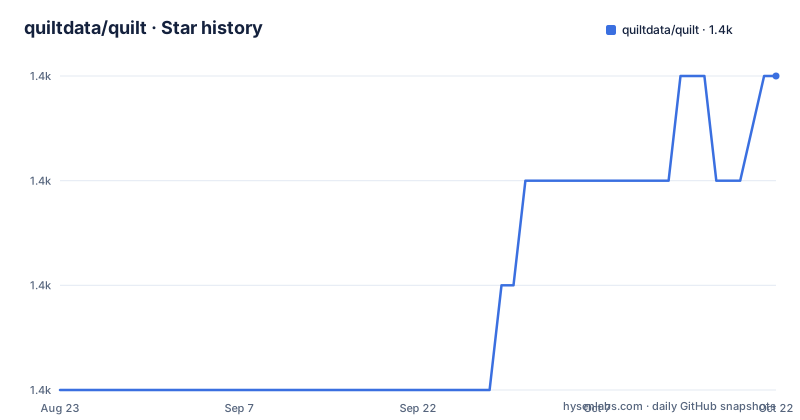
- quiltdata/quilt1,373 ★ · +3
| Repository | 2026-08-23 | 2026-10-22 |
|---|---|---|
| quiltdata/quilt | 1.4k | 1.4k |
3 Stars in the last 60 days, measured from the daily GitHub snapshot. Compare with other projects
Editorial analysis
The newest tag is from October 2020 and the tag naming is inconsistent
The release history has three entries and they are all from 2020: 3.2.1 on 2020-10-15, v3.2.0 on 2020-09-08 described as a package registry refactor, and v3.1.14 on 2020-06-13 described as Python API features, fixes, catalog capabilities and backend optimizations. Commits on the repository are a different story, with the most recent push dated 2026-10-02, so the tag history is not a record of when the code stopped changing.
That gap matters for anyone pinning a dependency. The most recent tag carries no v prefix while the two before it do, so a script that assumes a consistent tag format will pick up the wrong subset, and a repository whose newest release is six years old will not match what a current checkout does. The page does not claim a version policy, and there is a changelog file at the root that is a more honest place to look for what actually changed. The default branch is also master rather than main, which is worth knowing before writing any automation that assumes the modern default.
None of that says the code is unmaintained, since pushes continue. It says the tags are not the signal here, and that a version comparison against a 2020 release tells you nothing about a 2026 checkout.
The page states which half of Quilt is not in this repository
The open source and enterprise section is the most useful paragraph on the page, because it draws the boundary before you read anything else. What this repository provides is the Python SDK and CLI for creating packages, installing them locally and uploading them to S3 with your own AWS credentials, plus the versioning, reproducibility and documentation workflows aimed at data science and bioinformatics workloads.
What it does not provide is named directly: the full hosted search and visualization experience for package discovery and collaboration. The enterprise platform is described as a dedicated AWS-hosted deployment where teams search, share and visualize packages, with multi-user collaboration and governance features layered on top of the open source workflows.
The repository contents make that split visible rather than theoretical. There is a TypeScript catalog frontend in the tree, which is the search and browsing interface, and a set of Lambda services for indexing, previews and events. So the code for the discovery layer is present while the hosted, operated version of it is the commercial part. That is a licensing and packaging decision with practical consequences: an organization that wants the interface needs the platform, and an organization that only needs programmatic packaging can stay on the SDK.
AI is in the opening pitch and absent from the repository map
The positioning sentence says the platform helps teams and AI find, trust and reuse data through deeply versioned, context-rich packages, and the problem statement repeats the theme: AI projects slow down because data lacks structure, lineage and trust. So the case for the product is partly made on behalf of machine consumers.
The repository map that follows names nine paths, and none of them is a model, an indexer for embeddings, a retrieval component or anything else recognisable as AI infrastructure. What is listed is the Python SDK, the catalog frontend, the Lambda services for indexing and previews and events, shared schemas, shared Python utilities, the S3 proxy, three documentation directories and the API documentation generator. Indexing exists, but it is described as indexing for catalog purposes.
That gap is not a criticism of the code so much as a reading instruction. If your plan is to hand this data to an agent, the parts you can rely on here are the package format, its version history, its metadata and lineage, and the fact that the data stays in place in S3. The discovery side, which is what an agent would query, is the part the page assigns to the hosted platform.
The repository map lists nine paths and the tree has ten directories
The map is a lookup table with one row per major component, and it is accurate for nine of the ten directories in the checkout. The Python SDK, its CLI and its tests live under api/python rather than at the root. The catalog frontend is its own top-level project in TypeScript and JavaScript. The Lambda services sit in their own directory, described as indexing, previews and events. Shared schemas and cross-component assets are separated from shared Python utilities, which is a sensible split when services and web code need different shared things. The S3 proxy has its own directory as well.
The tenth directory is quilt3_local, which appears in the checkout but in no row of the table. Given the name, it is presumably related to installing packages locally, which is one of the three things the SDK is said to do, but the map does not say so and no other part of the page mentions it. A contributor working from the map alone would not know it exists.
Everything else at the top level is configuration rather than code, and there is a lot of it: a deep source configuration, an editor configuration, a markdown lint configuration with its own ignore file, a coverage configuration, a renovate configuration, a ruff configuration and a book configuration file. The linting and automation surface is wider than the nine-row map suggests.
The contributor quickstart installs uv and then runs two unrelated toolchains
The four-step quick start is aimed at contributors rather than users, and it splits cleanly in two. Steps one to three are Python:
git clone https://github.com/quiltdata/quilt
cd quilt
git checkout -b my-change# macOS/Linux
curl -LsSf https://astral.sh/uv/install.sh | shcd api/python
uv run poe testSo the test task comes from a task runner invoked through uv rather than from a bare pytest call, which means the task definitions live in configuration rather than in a shell script you can read first. Step four switches ecosystems entirely for the frontend:
cd catalog
npm install
npm start
What the quick start does not cover is everything else in the map. There is no documented command for running the Lambda services, the shared utilities, the Python shared code or the S3 proxy locally, even though those are four of the nine listed components. A contributor touching the backend beyond the SDK will be reading docs/README.md or the contributor guide for the next step, which is where the page sends you.
Two documentation systems, and a tool that validates documentation code blocks
Documentation is not an afterthought here, and the tooling shows it. There is a directory for generating API documentation and a separate one for validating documentation code blocks, which is a tool most projects do not have at all. It exists because a documentation site full of executable examples fails quietly when an API changes, and this repository chose to fail loudly instead.
Alongside that, two documentation systems coexist at the root. One is a gitbook configuration file, which points at a hosted book. The other is a book configuration file, which is a different generator with its own layout. A repository that keeps both is either mid-migration or serving two audiences, and the page does not say which.
The rest of the automation is conventional and thorough: coverage reporting, dependency updates through renovate, ruff for Python linting, a markdown linter with its own ignore list, a static analysis configuration, and an editor configuration. The Apache-2.0 license file sits next to them. None of this is unusual for a company-run open source project, and the combination of a code block validator with two doc generators is the part that suggests documentation is treated as a shipped artifact rather than as notes.
The second link on the page is a webinar registration with an encoded payload
The first thing after the title is a row of links, and two of them are not documentation. One points at a product docs site. The next is a webinar registration URL on a third-party platform whose final path segment is base64, and decoding it yields a small JSON object with a studio slug, an event id and a project id. The slug in that payload spells the studio name differently from the other link on the page, which spells it out in the path of a meeting introduction link.
None of that affects anyone using the software. It does affect anyone judging the page: the two links that look like navigation in the first screen are a webinar sign-up and a meeting, which is what a company project page looks like when the marketing surface sits above the documentation surface.
The rest of the links are the ones a user wants. Product documentation, an open demo catalog that can be browsed without an account, case studies and customer stories, and a Slack community. The demo catalog is the fastest way to see what a package looks like in practice without installing anything, and the enterprise administration document is linked from the top section for anyone evaluating the hosted platform.
Editorial conclusion
Read this repository as a library and a set of services rather than as the product. What you can install is the quilt3 SDK and CLI for building, versioning and uploading data packages to S3 with your own AWS credentials, plus the catalog frontend and the Lambda services behind it. What you cannot get from it is the hosted search, sharing and visualization experience, which the page attributes to a separate enterprise deployment, and that boundary is stated plainly rather than buried. Two checks before committing. Version your dependency against the package registry rather than the GitHub tags, since the newest tag is six years old and its naming is inconsistent, and decide early whether your team needs the enterprise platform, because the discovery and collaboration layer is the part this repository does not deliver.
Frequently asked questions
What does the quiltdata/quilt repository contain?
The quilt3 Python SDK, its CLI and its tests under api/python, a TypeScript web catalog frontend, AWS Lambda services for indexing, previews and events, shared schemas and Python utilities, an S3 proxy service, and tooling for generating and validating documentation.
Does the open source Quilt include the hosted catalog search?
No. The page says this repository does not provide the full hosted search and visualization experience for package discovery and collaboration. That belongs to an enterprise platform deployment, with multi-user collaboration and governance features on top of the open source package workflows.
What is the latest release of Quilt and how are its tags named?
The most recent tags are 3.2.1 from 2020-10-15, v3.2.0 from 2020-09-08 and v3.1.14 from 2020-06-13, so the newest one carries no v prefix while the two before it do. The default branch is master, and the most recent push on it is dated 2026-10-02.
How do I run the Quilt tests as a contributor?
Clone the repository, install the Python task runner with the uv install script, then change into api/python and run the test task through uv. The catalog frontend is started separately with npm install and npm start in the catalog directory. Lambda and proxy services have no command in the quick start.
Which license does Quilt use?
Apache-2.0, with the license file at the repository root. The repository also carries a coverage configuration, a renovate configuration for dependency updates, a ruff configuration and a markdown lint configuration with its own ignore file.
Official sources
Add this badge to your README
If you maintain this project, the badge below links readers to this analysis and shows its maintenance status from the daily GitHub snapshot. Paste the markdown into your README; add ?metric=license or ?metric=stars to the image URL for a different field.

[](https://hysenlabs.com/projects/quiltdata-quilt)Star history chart for your README
[](https://hysenlabs.com/projects/quiltdata-quilt)