Three notebook trees, a Description column of TBD, and no release to pin
A collection of various deep learning architectures, models, and tips
At a glance
- What is it?
- rasbt/deeplearning-models collects deep learning architectures as Jupyter notebooks, with the same model written once per framework across pytorch_ipynb, pytorch-lightning_ipynb and tensorflow1_ipynb. The index tying them together has a Description column filled with TBD, and the repository ships no package, no environment file and no releases.
- Who is it for?
- Read this collection when you want to see one architecture written out end to end in a framework you already use, and expect to own the environment: the root has no requirements file, no setup.py and no pyproject.toml, so the versions your notebook runs against are whatever you install. Do not treat it as a reference implementation to compare a production model against, since the index documents none of its internals and its Description column still reads TBD.
- Can I use it commercially?
- Yes. MIT is a permissive licence: you can use, modify and sell software built on it, as long as you keep its copyright and licence notices.
- Is it still maintained?
- Yes. The repository last received commits 50 days ago.
- What is it written in?
- Mainly Jupyter Notebook, according to GitHub's language statistics.
Answers come from the project's GitHub data, last synced on November 15, 2026, and from our analysis. They are not legal advice.
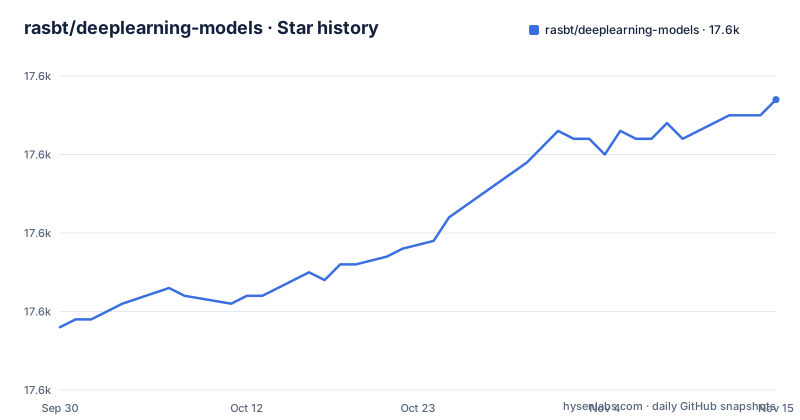
Star history
- rasbt/deeplearning-models17,637 ★ · +29
| Repository | 2026-09-30 | 2026-11-15 |
|---|---|---|
| rasbt/deeplearning-models | 17.6k | 17.6k |
29 Stars in the last 46 days, measured from the daily GitHub snapshot. Compare with other projects
Editorial analysis
One model, three notebook trees, and no stated preference
The repository root holds three notebook directories: pytorch_ipynb/, pytorch-lightning_ipynb/ and tensorflow1_ipynb/, plus a templates/ directory. The same architecture is often implemented more than once, and the index makes that plain by linking the variants in one row. A plain Multilayer Perceptron appears as pytorch-lightning_ipynb/mlp/mlp-basic.ipynb, pytorch_ipynb/mlp/mlp-basic.ipynb and tensorflow1_ipynb/mlp/mlp-basic.ipynb. VGG-16 on CIFAR-10 is linked in all three trees as well.
Coverage is uneven, which is worth knowing before you plan a reading path. The ResNet-18 digit classifier exists only under pytorch_ipynb/cnn/, and so does the single entry in the Concepts section, Replacing Fully-Connected by Equivalent Convolutional Layers, at pytorch_ipynb/cnn/fc-to-conv.ipynb. Other rows carry a plain PyTorch link with no pytorch-lightning counterpart, such as the VGG-16 dogs versus cats classifier.
The third tree carries the most information in its name. tensorflow1_ipynb says TensorFlow 1.x in the directory name itself, so those notebooks belong to the graph-era API, and a reader on a current TensorFlow inherits that difference along with the code. Nothing in the index states which implementation of a model the author considers the reference one.
The Description column is TBD, and the DenseNet table misspells its own header
Each table in the index has the same four columns: Title, Dataset, Description, Notebooks. The Description column reads TBD in row after row, from Perceptron and Logistic Regression through every CNN section. The same placeholder fills the Dataset column wherever the dataset was not filled in, which covers most of the Convolutional Neural Networks tables.
What survives is the title, and the titles are where the actual information sits. "LeNet-5 on CIFAR-10", "ResNet-34 Gender Classifier" and "MobileNet-v3 large on MNIST via Embetter" tell you the architecture, the task and the dataset even when the adjacent columns are empty. The index is usable as a catalogue of what exists, and useless as a description of what any notebook does.
The DenseNet table even renames its third column, spelling the header "Daset" instead of "Dataset", which suggests the tables were assembled by hand rather than generated. That is the practical cost of a hand-maintained index: the entries are good, and the descriptions of them were never written. If you want to know whether a notebook normalizes its inputs or sets a learning rate, the only source is the notebook.
The datasets are MNIST, CIFAR-10, CelebA, QuickDraw and Iris
Read the Dataset column across the tables and the scope is obvious. The traditional machine learning entries run on 2D toy data, MNIST and Iris, the multilayer perceptrons on MNIST, and the convolutional section spreads across MNIST, CIFAR-10, CelebA and QuickDraw, with external links to yann.lecun.com for MNIST, mmlab.ie.cuhk.edu.hk for CelebA and quickdraw.withgoogle.com for QuickDraw.
Several entries are classifiers on a single narrow axis: ResNet-18, ResNet-34, ResNet-50 and ResNet-101 gender classifiers on CelebA, VGG-16 smile and dogs versus cats classifiers, and a set of digit classifiers on MNIST. Those are the datasets that make a notebook runnable in minutes, and they are the reason the collection reads as teaching material rather than as a set of benchmarks.
The index opens with feed-forward and convolutional models: perceptrons, MLPs, CNNs, and the named CNN families from AlexNet through ResNet.
No requirements file means the notebook version is the reader's problem
The top level of the repository is short: LICENSE, README.md, .gitignore, .pep8speaks.yml, the three notebook directories and templates/. There is no requirements.txt, no environment.yml and no lockfile, and no package manifest either.
That has a direct consequence. Nothing in the repository pins the version of PyTorch or TensorFlow a notebook was written against, so a notebook that ran when it was committed may fail on a current install, and the traceback will point at an API that moved rather than at the model. The .pep8speaks.yml entry is a Python style checker, which is the only automated check configured at the root, and it checks formatting rather than execution.
One notebook shows the pattern clearly. Softmax Regression with MLxtend's plot_decision_regions on Iris exists only in pytorch_ipynb/basic-ml/, and it needs a plotting library that no other entry in the index mentions. Discovering that dependency means reading the notebook, or hitting the failed import first. With no environment file to consult, that is the workflow for every notebook in the collection.
There is nothing to install, so the deliverable is a notebook you run yourself
Start from the repository and not from a package index. There is no setup.py and no pyproject.toml at the root, so pip has nothing to install and no entry point to expose; the tracked content is notebooks. The path to a working example runs straight from a file name in the index, such as pytorch_ipynb/cnn/cnn-vgg16.ipynb or pytorch_ipynb/mlp/mlp-fromscratch__sigmoid-mse.ipynb, which is a from-scratch backpropagation implementation with the activation and loss named in the file name itself.
Read the index as a table of contents and open the notebook in Jupyter, in the order the sections suggest: Traditional Machine Learning, then Multilayer Perceptrons, then the Convolutional Neural Networks for Computer Vision sections that run from Basic and Concepts into the named architectures. The tables sort models into families for a reason, since a from-scratch MLP is easier to follow once a plain MLP has been read.
What you get from that path is a working reference for one model in one framework, written to be read. What you do not get is a library, a maintained API, or a version you can point a dependency at.
A from-scratch MLP next to a framework one, and a typo in the TensorFlow file name
The index pairs a hand-written implementation with the framework version more than once. Multilayer Perceptron with Backpropagation from Scratch is linked as pytorch_ipynb/mlp/mlp-fromscratch__sigmoid-mse.ipynb and tensorflow1_ipynb/mlp/mlp-fromscratch__sigmoid-mse.ipynb, and the double underscore in the file name carries the activation and the loss. That is the notebook to open if you want to see the gradient steps instead of calling an optimizer, and it is the wrong notebook to copy into a service.
Naming is not consistent across the trees, and the inconsistency shows up as a typo. The batch normalization entry is linked as pytorch-lightning_ipynb/mlp/mlp-batchnorm.ipynb and pytorch_ipynb/mlp/mlp-batchnorm.ipynb, but the TensorFlow link is mlp-batchtnorm.ipynb, with tn inserted into the word. Both appear as paths in the index, so nothing announces the difference, and a script that walks the index by pattern has to tolerate it.
The from-scratch files also explain the tensorflow1 naming better than any note would. A notebook that spells out backpropagation in the TensorFlow 1.x tree is writing the graph-era API by hand, which is precisely the part of the ecosystem that has since been replaced. Treat that tree as reading material for the math rather than as a starting point for new code.
No releases, so a copied notebook has nothing to pin
The repository has no GitHub releases. The last push was on 2026-09-26, and the project is not archived, so the notebooks do keep changing, but there is no tag, no version number and no changelog to point at. The repository is licensed under MIT, with the licence file at the root.
For a reader that is mostly harmless. For a team that copies a notebook into its own repository, it is a real gap: the copy has no recorded origin version, so when an upstream fix lands there is no way to tell whether your copy predates it. The practical habit is to record the commit you copied from yourself, since the project will not do it for you.
Compare that with the frameworks themselves, where a model class is versioned with the library and shipped with a changelog. That is the difference in approach worth naming: a notebook is a document that shows its work once, a library class is an interface that other code depends on. Useful for learning the shape of a model, and the wrong thing to build a service on.
Editorial conclusion
Read this collection when you want to see one architecture written out end to end in a framework you already use, and expect to own the environment: the root has no requirements file, no setup.py and no pyproject.toml, so the versions your notebook runs against are whatever you install. Do not treat it as a reference implementation to compare a production model against, since the index documents none of its internals and its Description column still reads TBD. Before you copy anything, check which of the three trees it came from, because the tensorflow1_ipynb notebooks belong to the TensorFlow 1.x era, and remember that with no releases published, a copied notebook has no version to pin.
Frequently asked questions
What deep learning model examples does the collection include?
The index covers perceptrons, logistic and softmax regression, multilayer perceptrons with dropout and batch normalization, and a long convolutional section: AlexNet, DenseNet-121, a fully convolutional net, LeNet-5, MobileNet-v2 and v3, Network in Network, VGG-16 and VGG-19, and ResNet-18 through ResNet-101. Most are implemented in both PyTorch and PyTorch Lightning, and several in the tensorflow1_ipynb tree as well.
What is rasbt/deeplearning-models?
It is a collection of various deep learning architectures, models, and tips for TensorFlow and PyTorch, written as Jupyter Notebooks. The repository is MIT licensed and its primary language is Jupyter Notebook.
Why are there three notebook directories in the deeplearning-models repository?
The same model is implemented per framework: pytorch_ipynb/, pytorch-lightning_ipynb/ and tensorflow1_ipynb/ sit side by side, and index rows link the variants together, as with mlp-basic.ipynb and cnn-vgg16.ipynb. Coverage is uneven, so the ResNet-18 digit classifier exists only in pytorch_ipynb/cnn/.
What does the Description column in the deeplearning-models index say?
It reads TBD in most rows, and the Dataset column carries the same placeholder wherever it was left empty, which covers much of the CNN section. The title carries the information instead, and the DenseNet table even spells its header Daset.
Can I pip install the deeplearning-models repository?
There is no setup.py or pyproject.toml at the root, so there is nothing to install as a package. The top level holds LICENSE, README.md, .gitignore, .pep8speaks.yml, templates/ and the three notebook directories, and there is no requirements file either, so dependency versions are whatever you install yourself.
Official sources
Add this badge to your README
If you maintain this project, the badge below links readers to this analysis and shows its maintenance status from the daily GitHub snapshot. Paste the markdown into your README; add ?metric=license or ?metric=stars to the image URL for a different field.

[](https://hysenlabs.com/projects/rasbt-deeplearning-models)Star history chart for your README
[](https://hysenlabs.com/projects/rasbt-deeplearning-models)Was this useful?