React Native Apps: a curated list where the version, commit and star columns stay empty
Curated List of Open Source React Native Apps. Curation curtesy of
At a glance
- What is it?
- React Native Apps is a single README table of open source React Native and Expo apps, curated by one person at Infinite Red, where new submissions are pushed to the top. The interesting part is what the table does not record: in the visible rows the React Native Version, Last Commit and Github Stars columns are blank.
- Who is it for?
- Use this list when you want to see how other people have structured a React Native or Expo application and want the source code to read, not when you need to evaluate, install or compare apps. The entries are selected for being open source, not for being shipped, so a row with only a Github link tells you nothing about whether a build exists for your device.
- Can I use it commercially?
- Not without permission. GitHub finds no licence file in the repository, and without a licence all rights are reserved by default: you may read the code but not reuse it. Check the README, or ask the authors, before using it.
- Is it still maintained?
- Yes. The repository last received commits 12 days ago.
- What is it written in?
- GitHub does not report a main language for this repository.
Answers come from the project's GitHub data, last synced on November 15, 2026, and from our analysis. They are not legal advice.
Star history
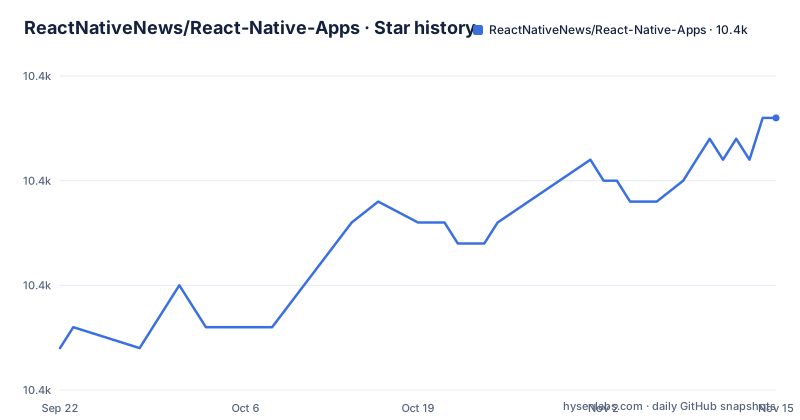
- ReactNativeNews/React-Native-Apps10,403 ★ · +11
| Repository | 2026-09-22 | 2026-11-15 |
|---|---|---|
| ReactNativeNews/React-Native-Apps | 10.4k | 10.4k |
11 Stars in the last 54 days, measured from the daily GitHub snapshot. Compare with other projects
Editorial analysis
The filter is open source only, and a store listing is not required
The scope is stated in one line: the list covers only open source React Native and Expo apps. Those apps do not have to be published to the App Store or anywhere else, and they are there to display work from inside the community and to help other React Native and Expo developers by showing how others build and structure their applications. The consequence is that this is not a catalog of installable software. The Links column of the table shows why that distinction matters, because it holds a mix of Github, App Store, Google Play, APK and website entries, and some rows carry nothing but a repository link. HealthyCropping is listed that way. So from the table alone you cannot tell whether a project ships a binary you can put on a phone, and you would have to open each repository to find out.
Freshest apps get first place, so the row order is a submission log
The contribution policy is unusual enough to read twice. To get a project added you submit a pull request, and the README states that it is totally okay to add it to the top of the list because freshest apps get first place. That makes position a timestamp of submission rather than a ranking. Nothing in the repository defines an order by quality, usage or maintenance, so the first row is the newest arrival and not the strongest example. The consequence for a reader who lands on the page and picks the top entry is that they are picking by arrival time, and the entries they scroll past may be the more instructive ones. It also means the ordering tells you nothing about whether a project is still alive, which is the one thing a newcomer to React Native usually wants to know before reading someone else's code.
The React Native Version, Last Commit and Github Stars columns are empty
The table is built with six columns, Title, Description, React Native Version, Last Commit, Github Stars and Links, and in every row that the README shows, the three middle metadata columns are blank. Passfair, Off Grid AI, Voltip, HealthyCropping, Ischys, Kairo and Baby Nap Track all carry a title, a description and links, and nothing in between. Those columns are exactly the ones that would let you judge a project without visiting it, so the consequence is direct: the list cannot answer the version question it appears set up to answer, and you cannot sort it by recency of work or by popularity. Anyone who lands here looking for a working reference implementation for a particular React Native release has to click through to the repository, one by one.
The whole repository is one README.md, with no license and no checks
The repository has exactly one tracked file at the top level, README.md, and no other entries sit beside it. That has several consequences. No license file sits at the root and no license field appears in the repository, so the descriptions written for each entry carry no stated grant of reuse, and a project that wants to republish the table is left guessing at permission. There is also nothing in the repository that validates the table, no script and no configuration, because there is nowhere to put one. A wrong React Native version, a renamed repository or a dead link therefore survives until a person notices it during review. What does exist is history: the diff of the table is the whole history of the list, which is the most reliable signal the repository offers about which projects were submitted when.
Curation runs through one person at Infinite Red
The list is curated by Gant Laborde, who is described as co-owner and CIO of Infinite Red, and the homepage recorded for the repository is a page on that company's technologies work rather than a project page. Every addition therefore passes through a single editor, and the pull request process is the only route in. The stated criteria are narrow, being open source and being built with React Native or Expo, but the repository does not record how those criteria are applied, what gets turned down, or how long a submission waits. The consequence for a project owner is that adding an entry depends on one person's queue, and the consequence for a reader is that the list reflects one person's taste in architecture as much as it reflects the community.
Two entries expose a hosted web build you can open without a device
Most rows link a repository and little else, which means you need a development setup to see the app at all. A few rows give you something quicker. Voltip and Kairo link an APK from their latest GitHub release, so on Android you can try them without building, and Passfair, Voltip, Ischys and Kairo also link a project website. Off Grid AI and Ischys link App Store entries. Note what the descriptions reveal about stacks in use: Voltip is built with Expo and a Rust core shared with the desktop app through UniFFI, Ischys with Expo, TypeScript and SQLite plus Swift for its Watch app and Live Activity, and Kairo with Expo, Reanimated and Skia plus an Express backend that keeps the API keys off the phone, which is a reminder that a React Native app and a small server are not exclusive choices.
App features range from an online C compiler to wallpaper downloads
The descriptions are short, and together they show how wide the scope of small React Native work is. Off Grid AI is an on-device AI suite that runs LLMs, vision models and Stable Diffusion on the phone with no cloud dependency. HealthyCropping is an offline-first Android app, still in development, that detects coffee, cacao and banana diseases with on-device TensorFlow Lite models. Ischys is a strength training log that keeps everything on the phone, with no account, no server and no ads. Kairo shows stats for nine games in one app, and Baby Nap Track logs a baby's sleep with one tap and says when the next nap should start. The consequence of that range is that a single architecture recommendation will not fit every entry, so treat each repository as its own answer rather than expecting the list to converge on one way to build.
The repository tracks submissions, and the newsletter tracks everything else
For news about React Native itself, the README points somewhere else entirely, to the React Native Newsletter, rather than trying to cover it here. That division is the honest shape of the project. The repository has no GitHub releases and no structure beyond its one file, so its last push, dated 2026-10-30, tells you the table was still being edited at that point and nothing more. It cannot tell you which frameworks are current or which release to target. The consequence for anyone using this as a research starting point is that you get a pointer to source code and a pointer to a newsletter, and every other question, including which version of React Native to build on, you have to answer elsewhere.
Editorial conclusion
Use this list when you want to see how other people have structured a React Native or Expo application and want the source code to read, not when you need to evaluate, install or compare apps. The entries are selected for being open source, not for being shipped, so a row with only a Github link tells you nothing about whether a build exists for your device. Verify three things before you plan around it: that the React Native Version column is filled in for the project you are looking at, since the visible rows leave it blank; that the app you want has a store or web link rather than a repository alone; and that you are reading the current branch, because the repository is a single README.md with no release history to pin. If you need a version comparison or a popularity ranking, this list will not give you either.
Frequently asked questions
what is react native apps
This repository is a curated list of only open source React Native and Expo apps, published as a single README table with Title, Description, React Native Version, Last Commit, Github Stars and Links columns. Its stated purpose is to display community work and show developers how others structure their applications.
Can React Native be used for apps?
The list exists as evidence of that, curating only open source React Native and Expo apps, and the entries run from a strength training log to an on-device AI suite that runs LLMs and Stable Diffusion on the phone. The apps do not have to be published to the App Store to be listed.
how to build react native apps
The repository does not document a build process, it curates projects instead. What it does show is the stack other people chose: Voltip is built with Expo and a Rust core shared with the desktop app through UniFFI, and Ischys with Expo, TypeScript and SQLite.
are react native apps slow
Nothing in this repository measures performance, so it cannot settle that question. It holds descriptions, links and empty version, commit and star columns, which means you would have to open and run each project yourself before drawing any conclusion.
Is React Native still relevant in 2026?
The repository does not make that argument, and it points readers to the React Native Newsletter for news about the framework. What it does show is that submissions are still arriving: the most recent push is dated 2026-10-30, and the policy is to place freshest apps first in the table.
Official sources
Add this badge to your README
If you maintain this project, the badge below links readers to this analysis and shows its maintenance status from the daily GitHub snapshot. Paste the markdown into your README; add ?metric=license or ?metric=stars to the image URL for a different field.

[](https://hysenlabs.com/projects/reactnativenews-react-native-apps)Star history chart for your README
[](https://hysenlabs.com/projects/reactnativenews-react-native-apps)Was this useful?