redis-store for Ruby: Namespaced Redis Backends
Namespaced Rack::Session, Rack::Cache, I18n and cache Redis stores for Ruby web frameworks
At a glance
- What is it?
- redis-store supplies Redis-backed cache, HTTP cache, session, and I18n stores for Ruby applications using Rack, Rails, Sinatra, or I18n. Its main attraction is a shared namespacing and configuration model, although this repository delegates most installation and usage instructions to gem-specific READMEs.
- Who is it for?
- Ruby applications that already use Redis and need several Rack-oriented storage backends are the clearest audience for redis-store. Projects that need a complete setup guide at the repository level, compatibility with an undocumented framework version, or guarantees about distributed failover should look elsewhere or first locate the relevant gem README.
- Can I use it commercially?
- Yes. MIT is a permissive licence: you can use, modify and sell software built on it, as long as you keep its copyright and licence notices.
- Is it still maintained?
- Yes. The repository last received commits 77 days ago.
- What is it written in?
- Mainly Ruby, according to GitHub's language statistics.
Answers come from the project's GitHub data, last synced on October 23, 2026, and from our analysis. They are not legal advice.
Star history
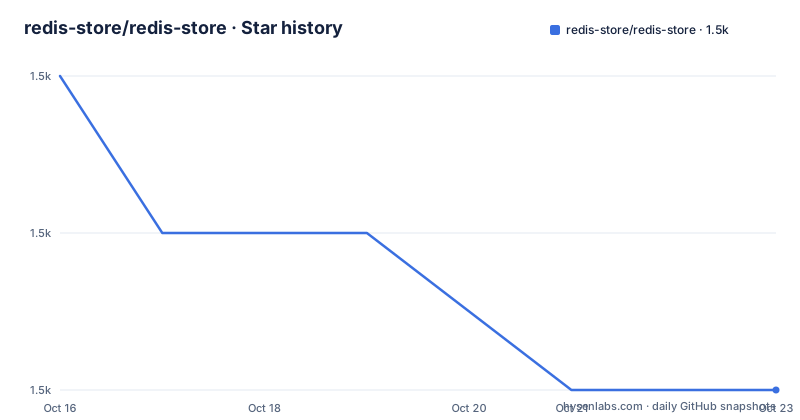
- redis-store/redis-store1,496 ★ · -2
| Repository | 2026-10-16 | 2026-10-23 |
|---|---|---|
| redis-store/redis-store | 1.5k | 1.5k |
-2 Stars in the last 7 days, measured from the daily GitHub snapshot. Compare with other projects
Editorial analysis
Where redis-store Fits in a Ruby Application
redis-store addresses a repeated integration problem in Ruby web applications: storing framework-managed data in Redis. The project family covers four distinct roles. Rack::Session stores session data, Rack::Cache and HTTP Cache stores handle HTTP cache data, and the I18n store holds translation data. The README also identifies Ruby on Rails, Sinatra, and Rack as supported framework contexts. This makes the project a collection of adapters rather than a web framework, Redis client, or cache server of its own.
The intended audience is a Ruby application team that has chosen Redis as shared storage and wants framework-facing stores with consistent capabilities. Namespaces can keep different applications, environments, or data categories from sharing the same Redis keyspace. Object marshalling is listed as a supported feature, which matters when applications store Ruby values rather than plain strings. Timeouts are also part of the stated feature set, which is particularly relevant to caches where entries should eventually expire.
That does not make redis-store a replacement for Redis itself. The README begins with separate Redis installation instructions, so the application still needs a reachable Redis service. It also points readers to the README file of each gem for actual framework configuration. The top-level project describes the family and its common capabilities, but it does not provide a unified configuration example for sessions, HTTP caching, or I18n.
The redis-store Family and Its Data Boundaries
The family is organized around separate gems for Cache, I18n, Session, and HTTP Cache. This separation matters because each framework component has a different expected interface and payload lifecycle. A Rack session store, for example, participates in request session handling, while an HTTP cache store must satisfy Rack::Cache's cache protocol. An I18n store has a different lookup contract again. The repository therefore supplies Redis integration at framework boundaries rather than proposing one undifferentiated Redis abstraction.
According to the README, the stores support single or multiple Redis nodes. That option addresses deployments that distribute Redis across more than one server, but the repository overview does not explain replication, failover, consistency, or node-selection behavior. Those details should not be inferred merely from the phrase multiple nodes. Developers evaluating a multi-node setup need the selected gem's README and implementation-specific behavior before assuming that it provides distributed session durability or automatic recovery.
Namespaces are another common boundary across the stores. In practical terms, a namespace prefixes or otherwise separates Redis keys so that several logical stores can coexist. The README states that namespaces are supported, but the overview does not define the exact key format, collision guarantees, or per-store defaults. A framework developer should inspect the selected store's configuration rather than treating a namespace as a tenant-security mechanism. Namespacing primarily organizes Redis data, while isolation and authorization requirements can extend beyond key organization.
Redis Installation and the Only Repository-Level Setup Sequence
The top-level README does not document installation of the individual `redis-store` gems or show a real session, cache, or I18n use. Instead, it directs users to the README file of each gem. The homepage is `http://redis-store.org/redis-store`, and that is the documented place to find the family-level usage and installation guidance. Inventing a gem name, initializer, or Redis flag would go beyond this repository's documentation.
Redis itself can be installed on macOS with Homebrew. The command below comes directly from the README:
brew install redisThe README says macOS users can use this option. It does not say that Homebrew starts Redis automatically, so a reader should not expect a running server solely because the installation command completed. It also points non-Homebrew users to the Redis download page for source installation instructions.
For developers working on redis-store itself, the repository documents this source checkout and test sequence:
git clone git://github.com/redis-store/redis-store.git
cd redis-store
bundle install
bundle exec rake
This is a contributor or source-development tutorial rather than an application integration example. The clone command retrieves the repository, `bundle install` installs its Ruby dependencies, and `bundle exec rake` invokes the repository's Rake-based test task. The README provides no expected test output, so there is no documented output pattern to compare. The README also records a Snow Leopard exception using `ci/run.rb`, but it does not present that operating system as a supported deployment target for applications.
Versioning and Release Constraints for redis-store
The repository follows Semantic Versioning for the `redis-store` family. For a library that depends on the package, the README gives this dependency range:
s.add_dependency 'redis-store', '>= 1.4', '< 2'This range permits versions from 1.4 up to, but not including, 2.0. It expresses the maintainers' intended compatibility boundary for dependent gems. It does not mean that every application should immediately upgrade to the newest release. An application can still have its own Ruby, Redis, framework, and dependency constraints that must be reconciled with the selected redis-store gem.
The listed releases are `v1.12.0` from 2026-08-07, `v1.11.0` from 2024-08-09, and `v1.10.0` from 2023-10-03. The repository is not archived, and its last push was on 2026-08-07. Those facts indicate recent repository activity, but they do not establish compatibility with every current Redis or Ruby release because the overview does not publish a support matrix.
Upgrading also involves more than changing one version constraint. Because the family covers four stores, an application may depend on more than one member and may use a top-level `redis-store` dependency in libraries. Developers should check the `CHANGELOG.md`, the selected gem's dependency declarations, and framework-specific README before changing versions. The top-level README identifies semantic versioning, but it does not document a migration procedure or rollback process.
Operational Limits and the Need for Gem-Specific Documentation
The largest practical limitation is documentation depth at the repository level. The overview states that namespacing, object marshalling, timeouts, and single or multiple nodes are supported, but it does not provide exact APIs for any of them. It also does not explain serialization compatibility, TTL precision, Redis Cluster behavior, session expiry defaults, cache key normalization, or I18n backend configuration. Each named store may have distinct behavior, so broad family-level capabilities cannot substitute for its gem README.
A particularly important failure mode is assuming that shared Redis storage is automatically equivalent to a durable session system. Redis can provide shared process access, but redis-store's role is limited to adapting framework storage operations. The repository overview says nothing about Redis persistence, replication, failover, backup, or recovery. An application that cannot tolerate lost sessions must evaluate those external Redis guarantees separately.
The project also does not present a competing storage library by name or describe its implementation. That omission prevents a factual product comparison from this source. The practical alternative is therefore architectural rather than a named competitor: keep framework data in the framework's default local storage instead of moving it into Redis. That approach avoids Redis availability as a runtime dependency, but it does not provide cross-process sharing on separate hosts and does not create a common Redis-backed boundary for sessions, HTTP cache, and I18n data. redis-store is the wrong fit when that shared Redis boundary is not required.
MIT Licensing and Project-Specific Adoption Boundaries
redis-store is distributed under the MIT license. The repository includes `MIT-LICENSE`, and the README identifies Luca Guidi as the copyright holder for the 2009 to 2013 release history. This license information matters when evaluating whether the code can be incorporated into another Ruby library or application, but using a license does not answer operational questions such as whether a particular Redis topology meets session durability requirements.
The project has a clear adoption case when a Ruby web application needs Redis-backed implementations for more than one framework concern and already has operational experience with Redis. A team using Rack, Rails, Sinatra, or I18n can evaluate the relevant store without building a custom adapter from scratch. Namespacing also makes the library relevant when several applications or environments share Redis, provided the team defines and tests its own namespace conventions.
The case is weaker for a small application whose local cache or cookie-based session is sufficient. Adding Redis introduces another service to install, secure, monitor, and keep available. The repository overview also delegates installation and framework usage to individual gem READMEs, so adopting the entire family does not remove configuration work. The first adoption check should be the selected store's README, especially its Redis connection setup, namespace defaults, expiry behavior, and supported framework version.
Editorial conclusion
Ruby applications that already use Redis and need several Rack-oriented storage backends are the clearest audience for redis-store. Projects that need a complete setup guide at the repository level, compatibility with an undocumented framework version, or guarantees about distributed failover should look elsewhere or first locate the relevant gem README. Before adoption, verify the selected store's installation instructions, Redis connection settings, namespace behavior, expiration semantics, and the gem version compatible with the application.
Frequently asked questions
Which frameworks and storage roles does redis-store support?
The README lists Redis-backed stores for Rack::Session, Rack::Cache, HTTP Cache, and I18n. It identifies Ruby on Rails, Sinatra, Rack, Rack::Cache, and I18n as relevant framework contexts.
How do I install redis-store in a Ruby application?
The top-level README does not provide an application gem installation command. It directs users to the README file of each gem, while its documented Homebrew command is only for installing Redis on macOS.
What dependency range should a dependent Ruby gem use?
The README recommends `s.add_dependency 'redis-store', '>= 1.4', '< 2'`. The family follows Semantic Versioning.
Official sources
Add this badge to your README
If you maintain this project, the badge below links readers to this analysis and shows its maintenance status from the daily GitHub snapshot. Paste the markdown into your README; add ?metric=license or ?metric=stars to the image URL for a different field.

[](https://hysenlabs.com/projects/redis-store-redis-store)Star history chart for your README
[](https://hysenlabs.com/projects/redis-store-redis-store)Was this useful?