Hummingbirdv2 E203 RISC-V Core and SoC for FPGA and Education
The Ultra-Low Power RISC-V Core
At a glance
- What is it?
- Hummingbirdv2 E203 is an open-source RISC-V processor core and demonstration SoC aimed at students, universities, researchers, and FPGA learners. Its Verilog RTL, simulation directories, APB peripherals, NICE extension, and board support make it useful for education, but the project explicitly warns that commercial-quality verification and support are not warranted.
- Who is it for?
- Hummingbirdv2 E203 is appropriate for learning RISC-V execution, experimenting with a small FPGA SoC, or teaching processor and peripheral integration. It is not a sound default for a commercial product until the buyer has independently reviewed RTL quality, security expectations, board-specific integration, and the support burden implied by the project's own warning.
- Can I use it commercially?
- Yes. Apache-2.0 is a permissive licence: you can use, modify and sell software built on it, as long as you keep its copyright and licence notices.
- Is it still maintained?
- Yes. The repository last received commits 28 days ago.
- What is it written in?
- Mainly Verilog, according to GitHub's language statistics.
Answers come from the project's GitHub data, last synced on October 23, 2026, and from our analysis. They are not legal advice.
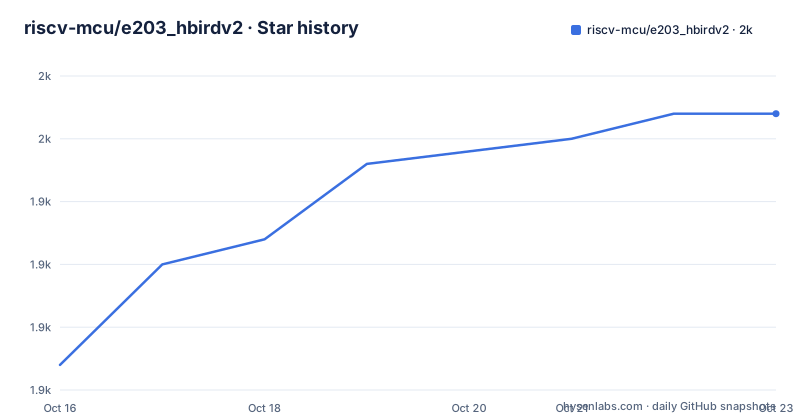
Star history
- riscv-mcu/e203_hbirdv21,951 ★ · +10
| Repository | 2026-10-16 | 2026-10-23 |
|---|---|---|
| riscv-mcu/e203_hbirdv2 | 1.9k | 2k |
10 Stars in the last 7 days, measured from the daily GitHub snapshot. Compare with other projects
Editorial analysis
Why the Hummingbirdv2 E203 project exists
Hummingbirdv2 E203 targets people who need an inspectable RISC-V processor rather than a finished commercial microcontroller. The README describes its main audience as students, universities, research users, and entry-level beginners. That audience matters because the project exposes processor and SoC design in Verilog instead of presenting the CPU only as a binary inside a device. Learners can inspect the RTL, study the processor structure, run the supplied simulation environment, and connect software to a comparatively small system that includes both a core and common peripherals.
The project is an upgraded version of Hummingbird E203 from the `SI-RISCV/e200_opensource` repository. The name distinguishes the new implementation while retaining a recognizable lineage. It is intended for FPGA-oriented instruction and experimentation, with dedicated support named for the Nuclei `ddr200t` and `mcu200t` boards. Those targets reduce some of the distance between source code and physical hardware, although the repository does not claim that every board, toolchain, or FPGA flow is interchangeable.
This is not positioned as a general-purpose commercial MCU family. The README directly addresses commercial use and says that the Apache 2.0 license permits it, but that the feature set is incomplete and that commercial quality, freedom from defects, and service are not warranted. That warning is more informative than the license alone. It tells an engineering team that adoption includes responsibility for validation, integration, and ongoing defect handling.
The available documentation and separate `hbird-sdk` repository also indicate a division between hardware and software development. Hummingbirdv2 supplies the processor, SoC, RTL, testbench, FPGA material, and software development is handled through `hbird-sdk`. The repository therefore fits users who are comfortable moving between processor-level RTL and embedded software, rather than only installing a prebuilt toolchain.
Inside the E203 core and demonstration SoC
At the center of the repository is a RISC-V processor core packaged as `e203_core.core`. A second file, `e203_soc.core`, represents the broader system-on-chip design. The implementation is written primarily in Verilog, and the top-level directory layout separates the RTL under `rtl/`, testbenches under `tb/`, simulation support under `vsim/`, and FPGA-related material under `fpga/`. This structure gives adopters distinct places to inspect the processor, verify the SoC, and prepare a board build.
One of the most specific extension points is NICE, the Nuclei Instruction Co-unit Extension. The README says this was added so users can create customized hardware co-units connected to the E203 core. That mechanism is relevant when a workload requires instructions or accelerator behavior outside the base core. It also adds an architectural integration task: a custom co-unit must follow the extension interface expected by the processor and fit the project's decode and execution model. The repository overview confirms the purpose of NICE but does not provide enough detail here to assert a generic co-unit programming interface.
The SoC integrates GPIO, I2C, UART, SPI, and PWM peripherals through the APB interface. These peripheral implementations came from the PULP Platform and were converted to Verilog in release 0.2.1. APB provides a common register-facing structure for those blocks, which is useful in a learning SoC because software-facing peripherals can coexist around one processor. The documented device set covers common embedded functions, but it should not be interpreted as a complete board support package or a production peripheral portfolio.
Simulation is part of the intended workflow rather than an afterthought. Release 0.2.1 added Icarus Verilog support and GTKWave waveform viewing. Based on the repository layout, a developer can work at RTL level in `rtl/`, use `tb/` for simulation context, and inspect waveform output through the tooling named in the release notes. The README does not document exact invocation commands, waveform file names, constraints, or required tool versions, so those details need to come from the linked documentation rather than be inferred from directory names.
Starting Hummingbirdv2 E203 without inventing setup steps
The project does not include a short command sequence in the README for installing E203, building the SoC, programming an FPGA, or opening the debugger. It directs users to `https://doc.nucleisys.com/hbirdv2/` for the detailed introduction and quick-start documentation. It also links the software toolchain separately at `https://github.com/riscv-mcu/hbird-sdk`. Consequently, there is no justified command such as a package installation, make target, or programming utility that can be reproduced from this repository overview.
A sensible first use begins with obtaining the repository and locating the files that correspond to the intended target. The source and synthesis description lives in `e203_core.core` and `e203_soc.core`. A simulation-oriented developer should then use the documentation to identify the supplied testbench under `tb/` and the Icarus Verilog and GTKWave flow described in the release notes. An FPGA-oriented developer should identify whether the target is the `ddr200t` or `mcu200t` board before following the board-specific procedure under `fpga/`.
The software side must come from `hbird-sdk`. The README does not explain which compiler, debugger, build system, or application examples that SDK selects, so an initial software test cannot be reproduced safely from the hardware repository alone. The linked external documentation is therefore part of the product setup, not optional background reading.
The first useful result should be modest: either the documented simulation produces inspectable RTL activity, or a known FPGA target completes the documented build and programming sequence. Starting with peripheral activity would introduce board, clock, memory, pin, and software variables at the same time. Starting with the simulation path keeps the scope narrower and gives the developer a way to separate processor or RTL issues from board integration issues. The exact commands and expected output must be taken from the official quick-start material because the README does not state them.
NICE, APB peripherals, and realistic adoption boundaries
E203's clearest differentiator among small educational RISC-V projects is the combination of a processor core, a demonstration SoC, NICE, and recognized APB peripherals in one repository. NICE is aimed at custom hardware co-units, while GPIO, I2C, UART, SPI, and PWM give software something concrete to control. That combination can support instruction-set study, teaching exercises, FPGA prototypes, and small demonstrations without requiring a vendor black box.
The boundary is equally clear. The README describes commercial quality and service as unsupported, and it states that the feature set is not full. A prototype that merely blinks an LED or exercises a UART can tolerate an undocumented board-specific issue more easily than a product that must satisfy timing, reliability, lifecycle, or support requirements. Those goals are not equivalent, and the project does not provide evidence for treating them as equivalent.
NICE also requires more than adding a peripheral. A custom co-unit is part of the processor's instruction behavior, so its interface, decoding, timing, and software access path must be designed together. The README does not claim that arbitrary accelerators can be attached without integration work. Teams considering E203 for a specialized instruction should first locate the relevant NICE documentation and inspect an example co-unit in the source tree.
The APB peripherals are suitable for a demonstration SoC, but the repository does not state that they meet the completeness, documentation, or validation expected of commercial peripheral IP. Likewise, adding `mcu200t` or `ddr200t` support does not establish support for every FPGA family. The named boards are concrete targets, not a general portability claim.
Icarus Verilog, GTKWave, and a different alternative
The release history gives E203 a simulation-oriented path through Icarus Verilog and GTKWave. That is useful for a learner who wants to observe processor activity in a wave viewer, and it complements the `rtl/` and `tb/` directories. It does not, by itself, establish functional-coverage completeness, protocol compliance, timing closure, or equivalence with a production implementation. The README names the tools but does not document their exact configuration.
A real alternative is to use a commercial or vendor-supported RISC-V SoC platform with a documented board abstraction layer, production-grade peripheral set, and an established support path. The difference in approach is direct: Hummingbirdv2 exposes the design as Verilog and educational RTL, whereas a vendor platform generally trades source-level access and customization freedom for integration support, documented board behavior, and a more controlled release process. Neither approach is automatically better. E203 suits inspection and experimentation; a supported platform suits teams that need a documented product path more than a small inspectable core.
Another possible alternative is using an existing open-source RISC-V core with a separately maintained SoC or software stack. That can be easier when a team does not need E203's NICE interface or its particular demonstration peripherals. E203's case rests on the combination of an open core, APB-based example devices, simulation support, and the two documented Nuclei board targets. A different core may provide a better fit if the required board, peripheral, toolchain, or accelerator interface differs.
Maintenance, upgrades, and Apache 2.0 obligations
The repository is not archived, and its last push was on 2026-09-25. That indicates recent repository activity relative to its release history, but it does not create a formal maintenance commitment or guarantee that every design artifact has been validated. The repository also has no GitHub releases, while the README lists release notes for 0.2.1 dated February 26, 2021, 0.1.2 dated November 20, 2020, and 0.1.1 dated July 28, 2020. The distinction matters: repository activity and packaged release history are separate signals.
An upgrade can touch RTL, testbenches, simulation scripts, FPGA constraints, board targets, and the separate software SDK. Release 0.2.1 specifically converted peripheral IP from SystemVerilog to Verilog, illustrating that upgrades may change implementation language or tool assumptions even when the visible SoC functions remain similar. Users should therefore treat an E203 revision as a hardware and verification change, not just as updated example code.
The project uses Apache License 2.0. The README says commercial use is permitted, but that language is not a warranty of quality and does not remove the need to review the actual license text and applicable notices. The README does not provide legal advice about patent rights, export controls, third-party components, or obligations for a particular product. Those questions require review of the repository files and the intended deployment rather than inference from the top-level license label.
Editorial conclusion
Hummingbirdv2 E203 is appropriate for learning RISC-V execution, experimenting with a small FPGA SoC, or teaching processor and peripheral integration. It is not a sound default for a commercial product until the buyer has independently reviewed RTL quality, security expectations, board-specific integration, and the support burden implied by the project's own warning. The first verification step should be reproducing the documented simulation or FPGA flow from a clean checkout.
Frequently asked questions
What is Hummingbirdv2 E203 used for?
Hummingbirdv2 E203 is an open-source RISC-V processor core and SoC intended for students, universities, researchers, and entry-level beginners learning processor design, FPGA development, and embedded systems.
Which peripherals are included in the Hummingbirdv2 SoC?
The SoC integrates APB-interface GPIO, I2C, UART, SPI, and PWM peripherals. The README says these implementations came from the PULP Platform and were converted to Verilog in release 0.2.1.
Can Hummingbirdv2 E203 be used commercially?
The README says the Apache 2.0 license permits commercial use, but it also states that the feature set is incomplete and that commercial quality and service are not warranted. Commercial users would need to review the license and validate the implementation for their own requirements.
Official sources
Add this badge to your README
If you maintain this project, the badge below links readers to this analysis and shows its maintenance status from the daily GitHub snapshot. Paste the markdown into your README; add ?metric=license or ?metric=stars to the image URL for a different field.

[](https://hysenlabs.com/projects/riscv-mcu-e203-hbirdv2)Star history chart for your README
[](https://hysenlabs.com/projects/riscv-mcu-e203-hbirdv2)Was this useful?