Digital Infrastructure is a Chinese language admin platform built on three accounts
Digital Infrastructure is a unified, secure management support platform for large government and enterprise digital transformation, built on identity authentication, organizational structure, job roles, application systems, resource roles, data catalogs, and security controls. It follows a three-administrator management model, supports microservices, multi-tenancy, containerization, and domestic (China) tech stacks, lets users quickly build business applications with a code generator, and integrates with many mature internal ecosystem apps.
At a glance
- What is it?
- The README is written in Chinese and describes a government and enterprise management support platform on Spring Boot 2.7.10 and Vue, where separation of duty is enforced by three built-in administrator accounts. Its newest release tag is from December 2024, its permission tables are long, and its source directory listing stops mid branch.
- Who is it for?
- This is a platform to read as a governance design rather than to adopt blind. The three administrator model it enforces is a genuine separation of duty, down to log review chains and subdomain copies of the same three roles, and the authorization model is a role, resource and position matrix with two permission trees over it.
- Can I use it commercially?
- Yes, with conditions. GPL-3.0 is a copyleft licence: if you distribute software that includes it, you must release that software's source code under the same licence. Running it internally without distributing it does not trigger that obligation.
- Is it still maintained?
- Yes. The repository last received commits 2 days ago.
- What is it written in?
- Mainly Java, according to GitHub's language statistics.
Answers come from the project's GitHub data, last synced on November 15, 2026, and from our analysis. They are not legal advice.
Star history
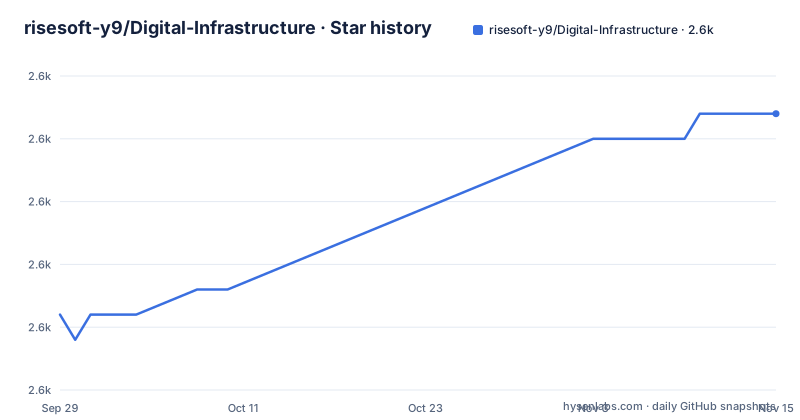
- risesoft-y9/Digital-Infrastructure2,621 ★ · +8
| Repository | 2026-09-29 | 2026-11-15 |
|---|---|---|
| risesoft-y9/Digital-Infrastructure | 2.6k | 2.6k |
8 Stars in the last 47 days, measured from the daily GitHub snapshot. Compare with other projects
Editorial analysis
The page is in Chinese, and three accounts are created by default
The README is written in Chinese throughout, and the repository description is a Chinese paragraph, so an English reading of this project starts as a translation exercise. The tagline at the top describes it as a Java rapid development framework with a Spring Boot and Vue frontend and backend separated.
The platform is aimed at digital transformation in large government and enterprise organisations. Its stated foundations are identity authentication, organisation structure, positions and job ranks, application systems, resource roles, a data catalog and security control, with microservices, multi tenancy, containerisation and domestic platform support named as design goals, plus a code generator for building business applications.
What defines it is the three administrator model. The platform creates three accounts on install: a system administrator who builds the infrastructure and the organisation, a security confidentiality officer who assigns permissions and reviews logs, and a security auditor who reviews the logs of the other two. Everything else on the page is arranged around those three roles.
Log review is chained so no single account sees the whole picture
The log permissions are where the separation of duty becomes concrete, and the arrangement is not symmetric. The security confidentiality officer reviews the login and operation logs of ordinary users and also the logs of the security auditor. The security auditor in turn reviews the logs of the system administrator and of the security confidentiality officer.
So the auditor sees the other two officials but not the ordinary users, while the security officer sees the ordinary users and the auditor but not the system administrator. Nobody but the auditor watches both officials at once, and the person who grants permissions is themselves watched by the person who audits.
There is a fourth log surface, the platform audit log, which records key operations and the specific data differences behind them. The backend dependency list includes a data diff library at version 6.13.0, which is the component that makes field level change records possible. Sub organisations get their own copies of the three roles, so the same chain repeats one level down.
Authorization is a role, resource and position matrix with two permission trees
Resources are the things a permission can attach to, and in this platform they are menus and buttons, defined freely inside an application. Roles come in two kinds: application roles that belong to a subsystem, and public roles that sit outside every system. The system administrator builds both, along with multi level application system directories.
The security officer then binds them. Application role association and public role association attach roles to resources. Application resource authorization attaches resources to roles, organisations and positions. Data catalog authorization does the same for catalogued data, bound to organisation, position and role. The page describes the result as a role, resource and position authorization matrix that can be adjusted dynamically.
Over all of it sit two permission trees, a resource tree and a role tree, viewable as lists or trees, so an administrator can inspect what any person actually holds. The data catalog itself is catalogued with a tree of organisation department, data classification and time period template, which is what later makes data level authorization expressible.
The source directory listing stops in the middle of a branch
The page prints a source layout, and it is worth reading closely because it ends unfinished. The common module lists a Spring Data JPA configuration package, a common object model, a nacos encryption and decryption package, database operation utilities, a tenant dynamic datasource package, a general utility package and a common configuration package. The example module lists a Redis cache example, a Spring Data JPA example, a Spring Data Elasticsearch example and a file service example. Then the block stops on a bare branch connector with nothing after it.
The root listing tells a longer story: ten modules carrying the same prefix, covering a bill of materials, dependencies, an identity code module, a module directory, a parent, a starter and support. So the page names two of them and the repository carries ten.
The rest of the root is infrastructure: three forge directories side by side for Gitea, Gitee and GitHub, a source header file, a lombok configuration file, a style directory, a vue directory and a root pom. Three hosted forge configurations for one project is a mirror strategy, and it is consistent with the domestic platform support the description claims.
Deployment assumes a separate login server and one capacity number
The deployment notes are four lines and one of them is a capacity claim. The platform expands in parallel as microservices, supports containerised deployment, and requires a single sign-on server to be deployed separately, since the login module is a component rather than a library. Cloud tenant mode is named as the operating model for large scale distributed deployments.
The capacity claim is that a single instance, in a domestic platform environment, can comfortably handle 2000 users on a virtual machine with four cores and 8GB of memory. No measurement, workload description or test condition is attached to it, so it is best read as a sizing hint from the vendor rather than a benchmark.
The functional notes add that the built-in single sign-on module can be replaced by another single sign-on system, which is the integration point most organisations will care about, since identity usually predates the platform.
The version tables contain skew inside a single list
The backend table pins Spring Boot, Spring Data JPA and Spring Data Redis all at 2.7.10, then lists Spring Kafka at 2.8.11 in the same column, followed by nacos at 2.2.1, druid at 1.2.16, Jackson at 2.13.5, a diff library at 6.13.0, lombok at 1.18.26 and logback at 1.2.11. So the Spring components are not on one version, and the logback row links to documentation for 1.3.0-alpha4 while the table pins 1.2.11.
The frontend table pins vue at 3.3.2, vite4 at 4.4.9, vue-router at 4.0.13, pinia at 2.0.11, axios at 0.24.0, typescript at 4.5.4 and core-js at 3.20.1, and that table ends partway through its last row, with the link cut off mid attribute.
Read together, these are the versions a deployment inherits. axios at 0.24.0 and the 2.7 Spring line are the two an integrator is most likely to collide with, and neither table says which are hard requirements and which can be overridden.
The newest tag is from December 2024, and two releases share one day
The release history has a shape worth noting. v9.6.7 was published on 2024-12-30, and v9.6.6 and v9.6.5 were both published on 2024-09-05, less than two hours apart. That is a maintenance release train rather than a feature cadence, and it stopped at the end of 2024 while the default branch has continued to receive commits, the last of them dated 2026-09-29.
The repository is GPL-3.0 with a LICENSE file at the root and a CHANGELOG beside it. There is no statement on the page about which forks or domestic database engines are supported in practice, even though domestic platform support is one of the headline claims.
Two smaller seams: the badge block at the top points at a Gitee repository named for a different project, while the stated source address is this repository, and the introduction links to a system online demo at an anchor on the same page where no matching section appears.
Editorial conclusion
This is a platform to read as a governance design rather than to adopt blind. The three administrator model it enforces is a genuine separation of duty, down to log review chains and subdomain copies of the same three roles, and the authorization model is a role, resource and position matrix with two permission trees over it. What to check before committing is the delivery channel. The newest tag is v9.6.7 from 2024-12-30 while the branch has moved on, the pinned Spring line is 2.7.10 with one Kafka library ahead of it, and the documentation is Chinese only, so an international team is reading a translated summary of a system whose authorization tables run to dozens of screens. The single sign-on server is also a separate deployment you will be running.
Frequently asked questions
What is the risesoft-y9 Digital-Infrastructure platform?
It is a management support platform for digital transformation in large government and enterprise organisations, built on identity authentication, organisation structure, positions, application systems, resource roles, a data catalog and security control, with a Spring Boot backend and a Vue frontend.
What is the three administrator model in Digital-Infrastructure?
The platform creates three default accounts: a system administrator who builds infrastructure and organisation, a security confidentiality officer who assigns permissions and reviews logs, and a security auditor who reviews the logs of the other two. Sub organisations get their own copies of the three roles.
Which languages does Digital-Infrastructure support?
The README is written in Chinese, including the repository description and all feature tables. The source address given on the page is the GitHub repository for this project, while the badge block links to a differently named repository on Gitee.
What technology does Digital-Infrastructure run on?
The backend table pins Spring Boot, Spring Data JPA and Spring Data Redis at 2.7.10, Spring Kafka at 2.8.11, nacos at 2.2.1, druid at 1.2.16, Jackson at 2.13.5 and logback at 1.2.11. The frontend table pins vue at 3.3.2, vite4 at 4.4.9, pinia at 2.0.11 and axios at 0.24.0.
How is Digital-Infrastructure deployed?
It expands in parallel as microservices, supports containerised deployment and cloud tenant mode, and requires a single sign-on server to be deployed separately because the login module is built in but can be replaced by another single sign-on system.
What is the newest Digital-Infrastructure release?
v9.6.7, published on 2024-12-30. The two releases before it, v9.6.6 and v9.6.5, were both published on 2024-09-05, while the default branch has been committed to as recently as 2026-09-29. The repository is licensed GPL-3.0.
Official sources
Add this badge to your README
If you maintain this project, the badge below links readers to this analysis and shows its maintenance status from the daily GitHub snapshot. Paste the markdown into your README; add ?metric=license or ?metric=stars to the image URL for a different field.

[](https://hysenlabs.com/projects/risesoft-y9-digital-infrastructure)Star history chart for your README
[](https://hysenlabs.com/projects/risesoft-y9-digital-infrastructure)Was this useful?