alpha_vantage 3.0.0 Deprecated Three Features and the Extras Key Is Misspelled
A python wrapper for Alpha Vantage API for financial data.
At a glance
- What is it?
- A Python wrapper over a free market-data API whose release history is the clearest documentation available: a major version that removed API surface, a deliberate decision to mirror upstream column names, an output format that two classes refuse, and an optional dependency declared under the wrong key.
- Who is it for?
- alpha_vantage fits a Python project that wants equity, forex and crypto data from one free key with json, pandas or csv output and does not mind that its dataframes inherit the provider's column names. It does not fit a codebase that treats dataframe schemas as its own, or one that assumes output_format behaves identically across every class, because two classes refuse csv outright and the naming decision was made upstream.
- Can I use it commercially?
- Yes. MIT is a permissive licence: you can use, modify and sell software built on it, as long as you keep its copyright and licence notices.
- Is it still maintained?
- Yes. The repository last received commits 121 days ago.
- What is it written in?
- Mainly Python, according to GitHub's language statistics.
Answers come from the project's GitHub data, last synced on November 24, 2026, and from our analysis. They are not legal advice.
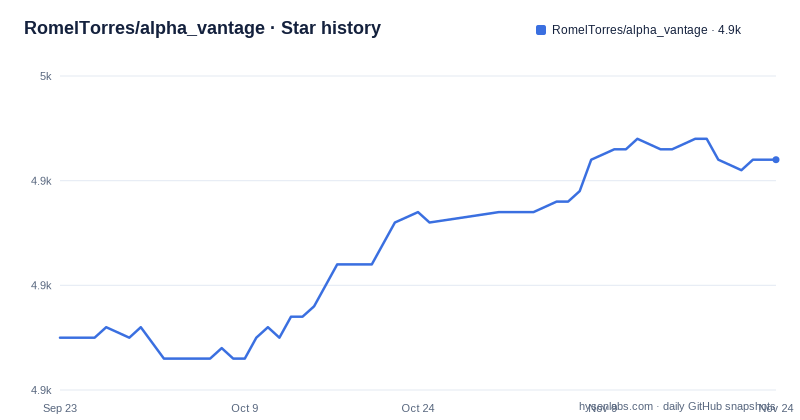
Star history
- RomelTorres/alpha_vantage4,942 ★ · +17
| Repository | 2026-09-23 | 2026-11-24 |
|---|---|---|
| RomelTorres/alpha_vantage | 4.9k | 4.9k |
17 Stars in the last 62 days, measured from the daily GitHub snapshot. Compare with other projects
Editorial analysis
Version 3.0.0 added coverage and removed three features in the same note
The news section is the most informative documentation in this repository, and the 3.0.0 entry reads as a coverage expansion while quietly cutting API surface. It states that from 3.0.0 onwards all options, commodities and economic indicators are supported, along with additional features in alpha intelligence and fundamental data. In the same sentence it says that all sector performance, extended intraday and the FCAS crypto rating have been deprecated. So a major version number here carries three removals. That combination matters for anyone upgrading from the 2.x line: a call that worked against sector performance or extended intraday no longer resolves, and because the entry frames the change as added coverage, a skim of the release list does not warn you. The same note records two additions worth knowing about, support for the month parameter on technical indicators, and the entitlement feature, plus the claim that the release is friendly for porting from IEX Cloud, which was shut down in 2024.
Column names are whatever the provider returns, by design
One release note explains a schema decision that will affect your code more than any feature. From 1.8.0 onwards the column names of the dataframes changed, and they are now exactly what the provider gives back in its JSON response. The note is explicit that in previous versions the numbers in the headers were removed, and that long term it is better to have the data exactly as the provider produces it. The reasoning is defensible: the dataframe is a faithful view of the response rather than a re-normalized one. The consequence is that your code is coupled to someone else's naming. When the provider renames a field, or changes a numeric suffix, your columns change with it and there is no mapping layer in this library to absorb the difference. Any code that selects columns by name, or that has a schema assertion in a test, is now a test of the provider's vocabulary as much as of your own logic.
output_format is per class, and two classes refuse csv entirely
Results can come back as json dictionaries, which is the default, as a pandas dataframe if pandas is installed, or as csv, and the format is chosen with a single output_format argument that applies to all the API calls in the given class. The qualification in that sentence is the one to notice. Some API calls do not support the csv format, and the two named are ForeignExchange and TechIndicators, because the endpoint itself does not support the format for those calls. So the format switch is not global. The practical pattern is to keep format selection next to the call site, or to restrict csv to the classes that support it, and to treat the two exceptions as part of the API surface rather than as bugs.
The pandas extra is declared under a key the installer ignores
pandas stopped being a hard dependency in 1.6.0, which is why the install section gives two commands, one for the package alone and one that adds pandas explicitly. The packaging file tries to express the same idea as an extra:
    install_requires=[
        'aiohttp',
        'requests'
    ],
    extras_requires={
        'pandas': ['pandas'],
    },
The key is spelled extras_requires, with an s after extra, where the installer looks for extras_require. The effect is that the extra is never registered, so a request for the pandas extra resolves to nothing and you get the base package without pandas. Nothing in the documented install path breaks because of this, since the README already tells you to install pandas as a separate step, but it means the one command that would have been convenient does not work and you would have to notice the typo to understand why. Two smaller details sit in the same block: the long description falls back to a plain sentence if README.md cannot be read at build time, and the package list excludes helpers, test_alpha_vantage and images.
Two HTTP stacks are required whether or not you use either feature
The install requirements list aiohttp and requests, both unconditionally, and each one is there for a reason that appears elsewhere in the history. Asyncio support arrived in 2.2.0, and aiohttp is the client that makes it possible, so a caller who never awaits anything is still installing an async HTTP library. The other one has a longer history: from 1.9.0 onwards urllib was substituted by Python's requests library, described as thread safe, so requests is the default path. The result is that every installation carries two HTTP stacks, one for the synchronous calls that make up almost all usage and one for the async path. That is a modest cost in a container image and a real consideration in a constrained environment, and it also means the async support is available to you without any extra step rather than being an optional install. Error handling was addressed separately in 2.1.0, where logging of bad API calls was made more apparent.
The key can come from the environment, and retries are a constructor argument
Two constructor arguments shape how a client behaves before any data is requested. The key can be passed directly or supplied through the ALPHAVANTAGE_API_KEY environment variable, so a deployment can keep the credential out of source:
from alpha_vantage.timeseries import TimeSeries
ts = TimeSeries(key='YOUR_API_KEY')
# Get json object with the intraday data and another with  the call's metadata
data, meta_data = ts.get_intraday('GOOGL')
The second is the retries counter, which exists to minimize connection errors when the API cannot respond in time. Its default is five and it can be raised or lowered as needed, per object. That last detail is the one to watch: because the counter belongs to the instance rather than to a module-level setting, two objects created in the same program can retry differently, and a call site that constructs its own client silently opts out of whatever policy another call site configured. If the key comes from rapidAPI instead, the same constructor takes an additional flag, rapidapi set to true, so the credential type is also an object-level decision.
Classifiers claim Python 2.7 support while the default branch is develop
The packaging metadata has drifted in both directions. The version is 3.0.0 and the project status is classified as Production/Stable, which is a strong claim for a library whose newest release is dated 2024-07-17 while the last recorded push is 2026-07-26. The language classifiers list Python 2.7 and then 3.4 through 3.8, with nothing for any interpreter released since 3.8, even though the code base includes asyncio support and takes an extras-style install path. Those classifiers are what an index shows a user, so a project on a current interpreter is told that no supported configuration exists. The repository's own tooling shows the same age in a different form: continuous integration is configured through a .travis.yml, static analysis through a .deepsource.toml, and the test requirements name nose as the runner alongside aioresponses and requests_mock. The default branch is develop rather than master, which matters for anyone following the clone instructions, since a plain clone lands on the working branch.
Editorial conclusion
alpha_vantage fits a Python project that wants equity, forex and crypto data from one free key with json, pandas or csv output and does not mind that its dataframes inherit the provider's column names. It does not fit a codebase that treats dataframe schemas as its own, or one that assumes output_format behaves identically across every class, because two classes refuse csv outright and the naming decision was made upstream. Before you depend on it, check three things: which of the features deprecated in 3.0.0 your code still calls, since sector performance, extended intraday and the FCAS crypto rating are gone, which output format each of the classes you use actually supports, and whether you will need pandas installed yourself, since it is not a hard dependency and the extras entry in the packaging file is spelled in a way the installer ignores.
Frequently asked questions
what is alpha vantage api
Alpha Vantage delivers a free API for real time financial data and the most used finance indicators in a simple json or pandas format, and this module implements a Python interface to that free API. It covers stock data and cryptocurrencies, and the provider's API documentation holds the full list of available calls.
how to install alpha vantage python
Run pip install alpha_vantage. To get pandas support, install pandas as well with pip install alpha_vantage pandas, since pandas stopped being a hard dependency in version 1.6.0. To install from source, clone the repository and run pip install -e alpha_vantage. The packaging file requires aiohttp and requests.
what is alpha vantage api key
It is a free key requested from the provider's API key support page, then passed to a class such as TimeSeries(key='YOUR_API_KEY'), or held in the ALPHAVANTAGE_API_KEY environment variable so it stays out of source. A rapidAPI key can be used instead, in which case the same constructor is also given rapidapi=True.
Is Alpha Vantage free to use?
The project describes it as a free API for real time financial data and finance indicators, and this module implements an interface to that free API using a free key. The README also notes that sector performance, extended intraday and the FCAS crypto rating were deprecated in version 3.0.0.
Official sources
Add this badge to your README
If you maintain this project, the badge below links readers to this analysis and shows its maintenance status from the daily GitHub snapshot. Paste the markdown into your README; add ?metric=license or ?metric=stars to the image URL for a different field.

[](https://hysenlabs.com/projects/romeltorres-alpha-vantage)Star history chart for your README
[](https://hysenlabs.com/projects/romeltorres-alpha-vantage)Was this useful?