roncoo-education: the backend half of a three-repository education platform
Roncoo Education is a full-featured online education system covering video-on-demand, livestreaming, exams, question banks and tasks. The open-source edition is a streamlined version of the commercial product, aiming to be an online training system, remote teaching platform, learning management system and knowledge-paywall system for any industry.
At a glance
- What is it?
- roncoo-education is the Spring Cloud Alibaba half of a Chinese online education system whose portal and admin console live in two other repositories. What the page publishes is a feature description and a license story; what it withholds is the setup material, the commercial terms and the feature comparison.
- Who is it for?
- This is a backend to judge, not a system to install today. The code side is a conventional multi-module Spring Cloud Alibaba layout with a gateway, a Feign module for service calls and shared code, and the front end is two other repositories that have to be cloned alongside it.
- Can I use it commercially?
- Yes, with strict conditions. AGPL-3.0 is a network copyleft licence: if people use a modified version over a network, for example as a hosted service, you must offer them its source code under the same licence.
- Is it still maintained?
- Yes. The repository last received commits 9 days ago.
- What is it written in?
- Mainly Java, according to GitHub's language statistics.
Answers come from the project's GitHub data, last synced on November 15, 2026, and from our analysis. They are not legal advice.
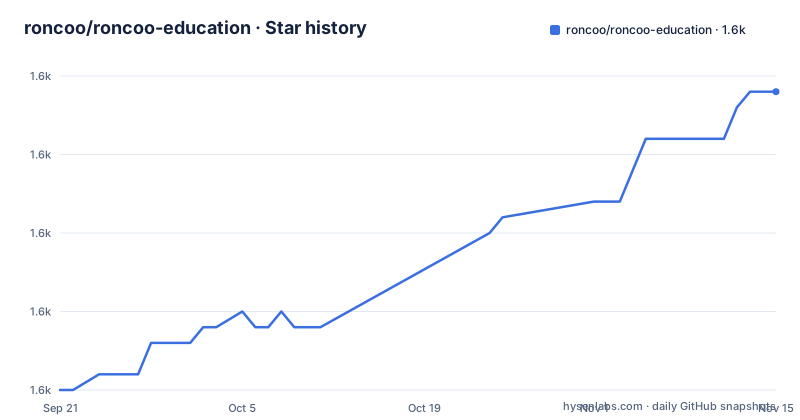
Star history
- roncoo/roncoo-education1,574 ★ · +19
| Repository | 2026-09-21 | 2026-11-15 |
|---|---|---|
| roncoo/roncoo-education | 1.6k | 1.6k |
19 Stars in the last 55 days, measured from the daily GitHub snapshot. Compare with other projects
Editorial analysis
Three repositories, and this one is only the backend
The README is written in Chinese, and the project it introduces is spread over three codebases. This repository holds a root `pom.xml` and four module directories: `roncoo-education-common`, `roncoo-education-feign`, `roncoo-education-gateway` and `roncoo-education-service`. Nothing in that list draws a page.
The other two repositories are named in the file. `roncoo-education-web` is the portal, built on Nuxt3, and `roncoo-education-admin` is the management console, built on Vue3. Both are published in parallel on Gitee, GitHub and Gitcode, under the `roncoocom` account on the first and the third and `roncoo` on the second. The project calls its architecture a separated front end and back end, and that separation is literal here: a clone of this repository gives a gateway and four server-side modules, while the interface a user would actually touch sits somewhere else. Evaluating the system means pulling three codebases before anything renders.
The comparison table has four rows and no text in any of them
The project presents itself as the open source edition, a reduced implementation cut out of a commercial product, and the page reserves a place for exactly that comparison. What sits in that place is an HTML table with four rows and two columns in which every cell is empty. No label occupies the left column, no value occupies the right, and there is no caption above it. Nothing anywhere says which capabilities the commercial edition holds and this one does not.
This is the structural gap in the whole file. The other sections describe what the system does, and the usage notes describe who may use it, but the one artifact that could have drawn a boundary between the free edition and the paid one renders as four empty rows. A reader who wants to know whether they are missing something gets no signal from the table, only the general statement that this repository is the simplified implementation.
AGPL-3.0 in the license field, a mobile number in the usage notes
The license field records AGPL-3.0, and a LICENSE file sits at the root. The usage notes at the top of the README add three conditions that the identifier does not carry. Use is permitted for personal study, graduation projects, teaching cases and public interest work. Commercial use is restricted: anyone who wants it is told to make contact on 18302045627, with a note that the number also reaches the owner on WeChat. And selling the code or the accompanying material, in any form and under any name, is prohibited.
Two documents describing the same repository therefore take different positions on money. The license identifier names a widely used copyleft license that commercial users can act on under its own terms, while the notes impose a contact requirement and an outright ban on sale. The page does not say which one governs, does not point at a separate commercial licence, and does not describe the reduced scope that would explain why the open source edition is worth less than the product it came from. For anyone planning a paid course business, the phone number and the license field are both inputs, and neither settles it alone.
The SQL script and the deployment guide sit behind a WeChat account
The closing line of the README says that following the official WeChat account gets you more learning material: SQL scripts, deployment tutorials and frequently asked questions. That sentence is the entire setup path. None of the three is published in the repository. The root listing is a `.gitignore`, a `CHANGELOG.md`, a `LICENSE`, the `README.md`, a `distribution/` directory, a `pom.xml` and the four module directories. There is no schema file, no sample configuration, no container definition and no ordered list of steps.
The stack printed a few lines earlier makes that absence heavier rather than lighter. MySQL8, Nacos, Seata, Mybatis and Druid all need configuration before a service starts, and Nacos is a registry and configuration server rather than a library, so something has to be running there before the services come up at all. A first run depends on files announced on a social account and absent from version control, and a reader without access to that account cannot get from this repository to a running system.
The description names five capability areas, the overview names two
The one-line repository description is a list of areas: on-demand course video, live streaming, examinations, a question bank and task handling, offered as what it calls a distributed online education system for any industry. It also states that the open source edition is a reduced implementation of the commercial one.
The project overview section covers a much smaller surface. It describes course playback that supports access to several video cloud providers, and course attachment management that supports access to several storage cloud providers, then concludes that this is enough to help a person or a company stand up a lightweight online education platform. Live streaming, examinations, the question bank and tasks are not mentioned again anywhere in the file. The description reads like a catalogue of the commercial product while the body describes the subset that was ported, and the distance between those two lists is precisely what the empty comparison table leaves unstated.
Four modules named by role, one release tag from 2025
The modules are named after their job rather than their domain: `common` for shared code, `feign` for service to service calls, `gateway` for the entry point, and `service` for the business modules. That split matches the stack the README prints, Spring Cloud Alibaba2025 with MySQL8, Nacos, Seata, Mybatis and Druid, where a service registry, a distributed transaction coordinator and a connection pool all have to be accounted for before the code starts. A Feign module sitting beside a gateway is what a multi-service deployment looks like from the repository's side.
Release history is thin. There is exactly one tag, v25.0.0-RELEASE, dated 2025-09-01, and the default branch `master` was last pushed on 2026-08-13, about eleven months later. So the branch has moved well past the only published release, with no tag in between to mark where. The root does carry a `CHANGELOG.md`, which is where an answer to that question would live, and a `distribution/` directory whose contents the root listing does not reveal. No test module appears at the root, so the four named directories plus those files are the whole visible surface.
The badge strip is five empty links and the first one is plaintext http
The page opens with a nested pair of divs holding five anchors, and each one has an empty body. In a working badge block every anchor wraps an image; here there is nothing between the opening and closing tags, so the strip renders as five unlabelled links or as nothing at all depending on the surrounding styling. The destinations still carry information: `http://spring.io/projects/spring-boot`, `https://spring.io/projects/spring-cloud-alibaba`, `https://cn.vuejs.org/`, `https://element-plus.org/` and `https://nuxt.com/`. The first is plaintext http while the other four are https, and the Vue link points at the Chinese site rather than the international one.
The technology list worth reading is printed later as plain text, and it is more specific than the strip: Vue3, Nuxt3, Vite8, Vue-Router, Element-Plus, Pinia and Axios on the front end, and Spring Cloud Alibaba2025, MySQL8, Nacos, Seata, Mybatis and Druid on the back. The versions are in the prose, while the decorative block at the top adds only dead links and one mixed-protocol inconsistency.
The AI writing feature names no model, no endpoint and no setting
The project overview adds a paragraph about integrated AI writing. It claims streaming output, generating course introductions and teaching outlines in real time, and says more capabilities will be added later and asks readers to keep following along. No model is named, no vendor, no endpoint, no configuration key and no feature flag appear anywhere in the file. Nothing in the root listing points at where the integration lives either, since the four directories are `common`, `feign`, `gateway` and `service` and none of those names suggests it.
The multi-provider claims follow the same pattern. The overview says course playback supports access to several video cloud providers and that attachment management supports several storage cloud providers, but no provider is ever named, and there is no adapter directory, no configuration sample and no interface file in the listing to indicate which ones exist. Two of the three headline capabilities therefore have no artifact attached to them anywhere in the repository, and both are stated as things the system already does.
Editorial conclusion
This is a backend to judge, not a system to install today. The code side is a conventional multi-module Spring Cloud Alibaba layout with a gateway, a Feign module for service calls and shared code, and the front end is two other repositories that have to be cloned alongside it. Three checks come before anything else. First, the license conflict: the license field records AGPL-3.0 while the usage notes restrict commercial use to a conversation on a mobile number and prohibit selling the code, and that has to be settled with whoever maintains this before any paid deployment. Second, the feature boundary, because an empty comparison table and a narrow overview mean live streaming, exams, the question bank and tasks cannot be assumed to exist in this repository. Third, the provenance of the setup files, since the schema and the deployment guide are announced on a social account rather than versioned anywhere. For a graduation project or a teaching case, the three usage conditions cover it and the code is readable.
Frequently asked questions
What does roncoo-education contain, and where is the front end?
This repository holds the Spring Cloud Alibaba side: a root pom.xml plus the common, feign, gateway and service modules. The portal and the management console are separate repositories, roncoo-education-web on Nuxt3 and roncoo-education-admin on Vue3.
Can roncoo-education be used for a commercial online course business?
The usage notes allow personal study, graduation projects, teaching cases and public interest work, require anyone wanting commercial use to contact 18302045627, and prohibit selling the code or material. The license field records AGPL-3.0, and the page does not say which governs.
How do I deploy roncoo-education?
The closing line of the README points to the project's WeChat account for SQL scripts, deployment tutorials and frequently asked questions. The repository itself lists no schema file, no sample configuration and no container definition.
Which version of roncoo-education is released?
There is one tag, v25.0.0-RELEASE, dated 2025-09-01, and the default branch master was last pushed on 2026-08-13, so the branch sits about eleven months past that release.
Does roncoo-education cover live streaming and exams?
The repository description names on-demand video, live streaming, exams, a question bank and tasks, while the project overview covers only course playback and attachment management. The HTML table meant to separate the two is empty.
What technology stack does roncoo-education use?
The front end is listed as Vue3, Nuxt3, Vite8, Vue-Router, Element-Plus, Pinia and Axios. The back end is listed as Spring Cloud Alibaba2025, MySQL8, Nacos, Seata, Mybatis and Druid.
Official sources
Add this badge to your README
If you maintain this project, the badge below links readers to this analysis and shows its maintenance status from the daily GitHub snapshot. Paste the markdown into your README; add ?metric=license or ?metric=stars to the image URL for a different field.

[](https://hysenlabs.com/projects/roncoo-roncoo-education)Star history chart for your README
[](https://hysenlabs.com/projects/roncoo-roncoo-education)Was this useful?