A Rakefile is a Ruby program, and that is still the design argument
A make-like build utility for Ruby.
At a glance
- What is it?
- rake is the make-like task runner Ruby projects have shipped with for two decades. The README is an RDoc file, its user manual lives in doc/ as RDoc sources, and its own credits explain which features arrived as patches from other people.
- Who is it for?
- rake is worth using when a project already speaks Ruby, because the build file is source code that your editor can jump through, your test suite can load, and your team can refactor. It is worth avoiding when the build is mostly a shell of compile steps, since the places where a Rakefile usually needs to drop to `sh` are the places where it stops buying you anything.
- Can I use it commercially?
- Yes. MIT is a permissive licence: you can use, modify and sell software built on it, as long as you keep its copyright and licence notices.
- Is it still maintained?
- Yes. The repository last received commits 5 days ago.
- What is it written in?
- Mainly Ruby, according to GitHub's language statistics.
Answers come from the project's GitHub data, last synced on November 14, 2026, and from our analysis. They are not legal advice.
Star history
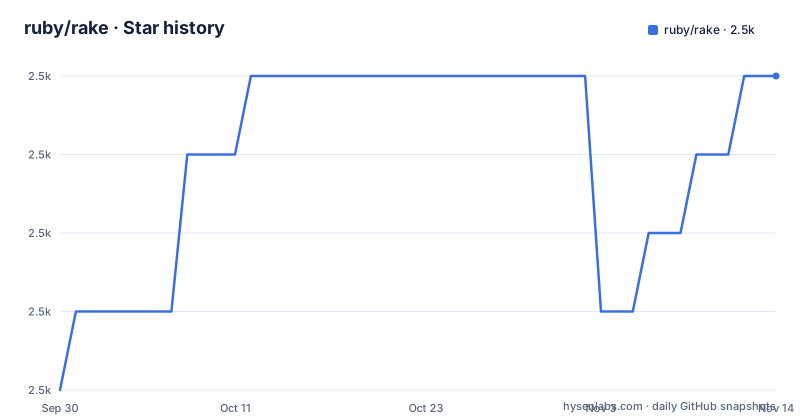
- ruby/rake2,465 ★ · +4
| Repository | 2026-09-30 | 2026-11-14 |
|---|---|---|
| ruby/rake | 2.5k | 2.5k |
4 Stars in the last 45 days, measured from the daily GitHub snapshot. Compare with other projects
Editorial analysis
A Rakefile is a Ruby program, and that is the whole argument
The description is one sentence: a make-like program implemented in Ruby, with tasks and dependencies written in standard Ruby syntax. The feature list then argues the case in its own words, and the first item is not a capability but an absence. No XML files to edit, and no quirky Makefile syntax to worry about, with the parenthesis about whether that was a tab or a space left in. What replaces the syntax is an ordinary Ruby literal, which is the reason a Rakefile can be loaded by a test, refactored with the rest of the source, and given comments that a real parser will keep:
task default: %w[test]

task :test do
  ruby "test/unittest.rb"
end
The `default` task here does nothing itself. It has one prerequisite, `test`, and invoking it causes the other task to run.
The prepackaged task library has been moved out of the gem
One bullet describes a library of prepackaged tasks to make building rakefiles easier, and then immediately subtracts from it. Tasks for building RDoc, tasks for building gems and tasks for publishing to FTP used to be included in rake, and the parenthetical says they are now available in RDoc, RubyGems and rake-contrib respectively. So the bundled library shrank and the replacements live in three different places, one of which, rake-contrib, is named in a sentence of explanation rather than in any resource link. For a Rakefile written years ago and still copied between projects, that is the line where the breakage appears: `Rake::RDocTask` and friends were part of the standard library of this tool once, and now they are not.
Rule patterns and recursive rules arrived as outside patches
The credits section is unusually specific about where features came from. Jim Weirich is named as the original creator. Ryan Dlugosz is credited with the initial conversation that sparked the project. Nobuyoshi Nakada is credited with the initial patch for rule support, and Tilman Sauerbeck with the recursive rule patch. Eric Hodel is credited with aid in maintaining rake, and Hiroshi SHIBATA as maintainer of Rake 10 and later. Read against the feature list, which claims rule patterns to synthesize implicit tasks and flexible FileLists, the credits show that the two features everyone associates with a build tool in Ruby arrived as submitted patches rather than as core design, which is a fair reason to read the rule documentation before trusting it on a large tree.
The manual is RDoc source, and no option list appears in the README
The README in the root is README.rdoc, and it does not contain the manual. Four links go into the doc directory as RDoc references: the command line usage, the guide to writing Rakefiles, the original announcement, and a glossary. The command line reference is the answer to the only instruction the README gives about options, which is to type `rake --help`. So the option surface of a tool that most people meet through its options is documented one directory away in a format that has to be rendered before it reads. The glossary in that list is the one most build tools do not bother with. Alongside the prose sit `History.rdoc` for the changelog, `rake.gemspec`, a `Gemfile`, a `Rakefile` of its own, and a `.rubocop.yml`.
The license text is pulled in at build time and the prose hedges it
The license section contains an RDoc include directive, `:include: MIT-LICENSE`, rather than the license text itself, so the words a reader sees are assembled at render time from a separate file that does sit in the root. The surrounding prose calls it an MIT-style license, twice, and the metadata block underneath repeats that wording while naming Jim Weirich as the author and copyright holder. The repository metadata reports the license as MIT. So the identifier is MIT, the prose says MIT-style, and the copyright is attributed to a named individual rather than to the Ruby project that now hosts the repository. None of that is a contradiction, but it is three different phrasings of the same grant.
The stated floor is Ruby 2.0.0 while the gem sits at version 13
The metadata block states that rake requires Ruby 2.0.0 or later. That is the number written in the documentation, and it is the number a reader will act on. The releases tell the other half of the story: v13.4.0 and v13.4.1 were both published on 2026-04-14, about half an hour apart, and v13.4.2 followed on 2026-04-16. A gem on its thirteenth major series still documenting a 2.0.0 floor means the compatibility claim has been carried forward for a decade without being restated in terms of anything a current Ruby user would recognise, and nothing in the tree gives a tested version range instead.
The repository moved after February 2014 and old URLs still resolve
The historical section explains that rake was created by Jim Weirich, who passed away in February 2014, that the repository was originally hosted at github.com/jimweirich/rake, and that after his passing it moved to ruby/rake. A link to his last commit and a note thanking him close the file. For anyone following an old reference, the practical consequence is that a decade of URLs, gemspec repository fields and CI configurations point at the personal namespace and reach the tool through a redirect. The credits also still frame maintenance by major version, naming the maintainer of Rake 10 and later, which dates the governance statement even though the last recorded push is dated 2026-09-28.
Running rake with no arguments runs the default task and echoes each command
The usage example shows what a bare invocation prints, and the shape of that output is worth noticing because it is a make convention rather than a Ruby one:
% rake
(in /home/some_user/Projects/rake)
ruby test/unittest.rb
....unit test output here...
The `(in ...)` line prints the directory rake resolved the Rakefile from, then each task's command is echoed before it runs, which is how a make user recognises the output. Alongside that the feature list claims parallel execution of tasks, and the linked documents cover the command line, writing Rakefiles, the original announcement and a glossary, with no document among them dedicated to the parallel mode. The seven part external article series linked in the resources is where multi-task parallelism is treated at length.
Editorial conclusion
rake is worth using when a project already speaks Ruby, because the build file is source code that your editor can jump through, your test suite can load, and your team can refactor. It is worth avoiding when the build is mostly a shell of compile steps, since the places where a Rakefile usually needs to drop to `sh` are the places where it stops buying you anything. Two things to settle before you rely on it. Check the Ruby floor, because the manual states 2.0.0 or later while the gem itself is at version 13.4, so nothing in the documentation tells you what is actually tested. And check where your build dependencies live now: RDoc tasks, gem tasks and FTP publishing were removed from the core and are said to live in RDoc, RubyGems and rake-contrib, so a Rakefile copied from an older tutorial may reference tasks this gem no longer defines. The last recorded push is dated 2026-09-28 and the newest tag is v13.4.2 from 2026-04-16.
Frequently asked questions
What does rake do?
It is a make-like build utility implemented in Ruby, where tasks and dependencies are specified in standard Ruby syntax inside a Rakefile. It supports task prerequisites, rule patterns that synthesize implicit tasks, FileLists, prepackaged tasks, and parallel execution of tasks.
what is ruby rake
Rake is the task runner distributed as the rake gem, installed with gem install rake. Running the command with no options executes the default task in the Rakefile in the current directory, and rake --help lists the available options.
Which Ruby version does the rake gem require?
The documentation states Ruby 2.0.0 or later. The gem itself is on its thirteenth series, with v13.4.0 and v13.4.1 published on 2026-04-14 and v13.4.2 on 2026-04-16.
Does rake still ship RDoc and gem build tasks?
No. Tasks for building RDoc, building gems and publishing to FTP were formerly included in rake and are now said to be available in RDoc, RubyGems and rake-contrib respectively, so a Rakefile relying on the old bundled tasks needs a different source for them.
Where is the rake command line documentation?
In the doc directory of the repository rather than in the README. Four RDoc references are listed: the command line usage, the guide to writing Rakefiles, the original announcement, and a glossary. The rendered documentation is published at the project's homepage.
Official sources
Add this badge to your README
If you maintain this project, the badge below links readers to this analysis and shows its maintenance status from the daily GitHub snapshot. Paste the markdown into your README; add ?metric=license or ?metric=stars to the image URL for a different field.

[](https://hysenlabs.com/projects/ruby-rake)Star history chart for your README
[](https://hysenlabs.com/projects/ruby-rake)Was this useful?