Metastream archived its own source, and the default branch shows it
Watch streaming media with friends.
At a glance
- What is it?
- The repository is three entries deep and holds no code, the last open source version lives on a branch called archive, and the one documented integration is an anchor tag with a url parameter.
- Who is it for?
- Treat v0.10.4 on the `archive` branch as the end of the line for self hosted work rather than a starting point. The hosted app is what the README points people to, and nothing in this repository states what it costs, what license v0.10.4 carries, or how any of the three session modes are enforced.
- Can I use it commercially?
- Not without permission. GitHub finds no licence file in the repository, and without a licence all rights are reserved by default: you may read the code but not reuse it. Check the README, or ask the authors, before using it.
- Is it still maintained?
- Yes. The repository last received commits 130 days ago.
- What is it written in?
- GitHub does not report a main language for this repository.
Answers come from the project's GitHub data, last synced on November 15, 2026, and from our analysis. They are not legal advice.
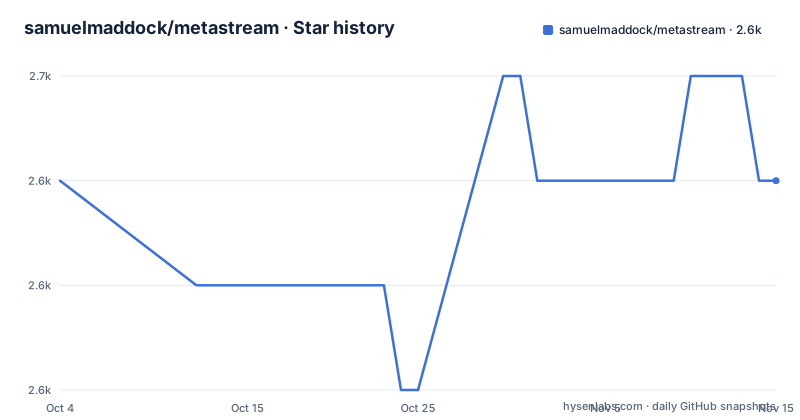
Star history
- samuelmaddock/metastream2,649 ★ · +0
| Repository | 2026-10-04 | 2026-11-15 |
|---|---|---|
| samuelmaddock/metastream | 2.6k | 2.6k |
0 Stars in the last 42 days, measured from the daily GitHub snapshot. Compare with other projects
Editorial analysis
The default branch holds three entries and none of them are source
The top level of the repository is `.github/`, `README.md` and `resources/`. There is no `src/`, no `package.json`, no lockfile, and no LICENSE file on the branch you get by default. That matters for anyone arriving looking for a browser extension or a phone app, because a plain clone of master yields documentation, a screenshot folder, and CI configuration, with nothing to run. The README's own archive note says the last open source version is v0.10.4 and that it sits on the `archive` branch instead, so the code this project is known for is deliberately off the branch you land on. Anyone planning to build on it has to switch branches first, and anyone judging the current state from master alone is looking at an empty shell.
The archive note is dated August 2024 while master took a push on 2026-07-08
The README states that as of August 2024 Metastream has discontinued publishing under open source and is no longer accepting contributions, and it puts the last open source version on the `archive` branch. The recorded last push on the default branch is 2026-07-08, close to a year after that note, and the branch still carries no code. So the two facts do not line up: something moved in the repository after open source publication stopped, and it was not source. Treat the August 2024 statement, not the push date, as the answer to whether new code is coming. With contributions closed, a fork is the only route left for anyone who wants to change something.
Three releases in four years, and the last one closed the series
The release list holds three entries: v0.10.2 on 2020-07-08, v0.10.3 on 2021-03-07, and v0.10.4 on 2024-08-18. The gaps are uneven, eight months and then three and a half years, and v0.10.4 is also the version the archive note names as the final open source one. That makes the August 2024 tag a boundary rather than a stepping stone, since there is no fifth version on record. The numbering barely moves either, three releases with no minor version bump across the whole list, so the history gives you no picture of a package being versioned on a schedule.
The website integration is one anchor tag carrying a url parameter
For site owners, the entire documented integration is a single line of HTML. It sends the user to the hosted app at app.getmetastream.com with the media address in a `url` query parameter:
<a href="https://app.getmetastream.com/?url=https://youtu.be/3bNITQR4Uso">Watch in Metastream</a>There is no embed snippet, no script tag, and no API section anywhere in the README. The framing sentence says to add watch party support by redirecting the user to Metastream, and redirect is the accurate word: the sample anchor carries no `target` and no `rel`, so a click leaves your page for the app in the same tab and the only way back is the browser's own back button. If you need the party to open beside your content, or your site to keep control of the session, this repository does not describe how.
Public, private, and offline sessions are named but never defined
The feature list puts three session modes on one line, public, private, and offline, and nothing after that line explains what separates them. The README does not say who may join a public session, whether a private session needs a key or an unguessable link, or what an offline session does that a private one does not. That gap sits directly under the part of the product people evaluate first, because a watch party tool gets chosen by who can get in and by what happens when the connection is poor. The only access control described anywhere in the repository is per user playback permission managed by the host, which describes the host's power rather than any of the three modes.
Cue points come from a description field the source site controls
One feature depends on text nobody at Metastream writes: timestamp cue points parsed from the media description. Whatever the source page puts in its description field is what the parser sees, so the chapter markers a group receives are inherited from the site hosting the video, and a page with an empty or oddly formatted description yields no markers. The same pass through shape shows up in auto fullscreen of embedded media. The collaborative media queue and the real time chat are the parts the project does own, and neither gets any detail beyond its line in the list, so nothing here answers what a host can see or what a peer can change.
The host controls who plays, and kicking is the only admin action named
Two lines in the feature list define the whole authority model: per user playback permissions, managed by the host, and basic host administrative functionality, kicking peers. The README does not say whether a kicked peer can return under a new name, whether a session carries a password, whether the permission list survives if the host leaves, or whether anything is written down when a peer is removed. Transport gets one line too, supporting WebRTC peer to peer connections, with no fallback described for the case where no peer connection can be established. Those are the questions a group organizer asks first, and this repository answers none of them.
Two browser engines are named, and a license is named nowhere
Browser support is stated as Chromium and Firefox, with no fallback language and no mention of Safari or a mobile client. The top level has no LICENSE file, and nothing in the repository names a license, while the archive note discusses open source publishing without quoting terms. So the code on the `archive` branch reaches you with no license text beside it in this tree, and anyone planning to fork or redistribute v0.10.4 has to establish the terms from that branch before doing anything with it. The only support route the README names is a Discord invite link that appears there with no label and no surrounding text.
Editorial conclusion
Treat v0.10.4 on the `archive` branch as the end of the line for self hosted work rather than a starting point. The hosted app is what the README points people to, and nothing in this repository states what it costs, what license v0.10.4 carries, or how any of the three session modes are enforced. Before you build on it or send users to it, check the branch for license text, confirm the app host still answers, and plan on maintaining any fork yourself, since contributions are closed and the default branch has no code to patch.
Frequently asked questions
How does Metastream run a watch party across different sites?
Playback is coordinated inside the app rather than by any per site integration, with WebRTC peer to peer connections listed as the transport, alongside real time chat, a collaborative media queue, and timestamp cue points parsed from the media description.
Is Metastream safe to put in front of a group of viewers?
Nothing in the repository describes a security model. What it does state is that per user playback permissions are managed by the host and that the host can kick peers, while the default branch carries no code, no LICENSE file, and no named license to inspect.
Does Metastream have an app for Android, iPhone, a TV, or a remote control?
No such client is described anywhere. Browser support is named as Chromium and Firefox, the top level holds only `.github/`, `README.md` and `resources/`, and the single code sample points at a web app on app.getmetastream.com with the media address passed in a `url` parameter.
What are the best MetaStream alternatives?
The repository names none. What it does record is that open source publishing stopped as of August 2024, that v0.10.4 on the `archive` branch is the last open source version, and that contributions are no longer accepted, so that branch is the only code path the project points to.
Is Metastream free to use?
No pricing appears in the repository and no terms are stated for the hosted app. It does say open source publication was discontinued as of August 2024 with v0.10.4 as the final open source version, and the top level carries no LICENSE file, so licensing has to come from the `archive` branch.
Official sources
Add this badge to your README
If you maintain this project, the badge below links readers to this analysis and shows its maintenance status from the daily GitHub snapshot. Paste the markdown into your README; add ?metric=license or ?metric=stars to the image URL for a different field.

[](https://hysenlabs.com/projects/samuelmaddock-metastream)Star history chart for your README
[](https://hysenlabs.com/projects/samuelmaddock-metastream)Was this useful?