LuaN1aoAgent v2 replaced the runtime and dropped the v1 numbers with it
LuaN1aoAgent is a fully autonomous AI-driven penetration testing agent powered by graph-based cognitive reasoning.
At a glance
- What is it?
- A TypeScript agent for authorized security research, split into a Planner, an Executor and an Observer that ends every turn through a structured tool call. The rewrite refuses to inherit v1's measurements, which leaves the headline claims without published evidence.
- Who is it for?
- LuaN1aoAgent v2 is worth reading if you are designing an agent whose conclusions have to be auditable, because the separation of planning, execution and projection is the part that generalizes. Two things have to be settled before you run it.
- Can I use it commercially?
- Yes, with strict conditions. AGPL-3.0 is a network copyleft licence: if people use a modified version over a network, for example as a hosted service, you must offer them its source code under the same licence.
- Is it still maintained?
- Yes. The repository last received commits 5 days ago.
- What is it written in?
- Mainly TypeScript, according to GitHub's language statistics.
Answers come from the project's GitHub data, last synced on November 22, 2026, and from our analysis. They are not legal advice.
Star history
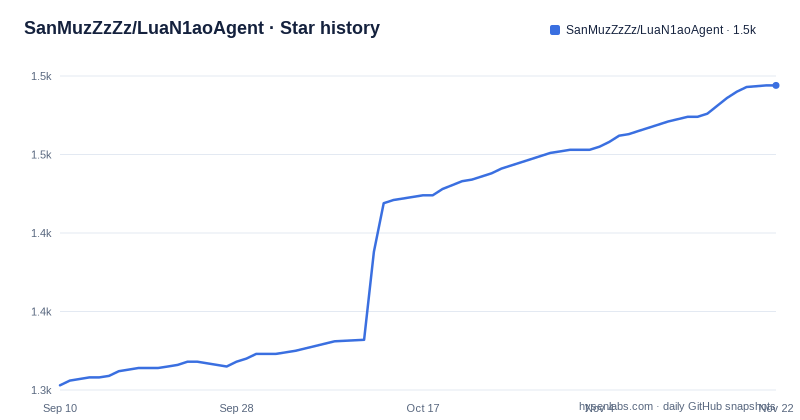
- SanMuzZzZz/LuaN1aoAgent1,494 ★ · +191
| Repository | 2026-09-10 | 2026-11-22 |
|---|---|---|
| SanMuzZzZz/LuaN1aoAgent | 1.3k | 1.5k |
191 Stars in the last 73 days, measured from the daily GitHub snapshot. Compare with other projects
Editorial analysis
v2 discarded the v1 measurements along with the Python runtime
The repository is explicit that the current release is not a continuation of the previous one. It states that v2 is not an in-place refactor of the Python v1 runtime, and that it is a new implementation with different configuration, persistence, Agent lifecycle and observability contracts. Version 2.0.0 and a legacy 1.0.0 tag were both published on the same afternoon in July 2026, so the split is deliberate rather than a slow drift.
The same note covers the evidence. Benchmark results reported by v1 are not automatically attributed to v2, and v2 benchmark results will be published only after reproducible reruns on a frozen release. Since no such numbers appear in the repository, the careful reading is that this project has a measurement gap by choice, not by oversight.
That is defensible, and arguably more honest than carrying a headline number forward across an incompatible runtime. It also means anyone evaluating the rewrite has no published figure to compare, and the only measurements available are the ones they produce themselves. The last push to the repository is dated 15 September 2026.
Every role leaves through a structured terminating tool
Four named tools end a turn, and none of the roles returns free text as its result. The Planner submits through `planner_submit`, the Executor through `task_result_submit`, the Supervisor through `control_submit`, and the Projector through `graph_delta_submit`. A role that fails to emit its terminating call has not finished, whatever it said in between.
planner_submit
task_result_submit
control_submit
graph_delta_submit
Session handling is deliberately uneven between the roles. The Executor receives a bounded TaskEnvelope, reuses the same persisted session lineage and workspace across every epoch of one task, and keeps different tasks isolated. Each Observer invocation instead starts a fresh session with no shared hidden model history. The reason is that the Observer writes to the graph, and letting it carry context forward would let unrecorded impressions leak into persisted conclusions.
The cost of that choice is that Supervisor and Projector reasoning is recomputed from scratch on every pass rather than resumed. The Projector runs asynchronously precisely so this does not stall the Executor loop.
A confirmed Vulnerability node cannot be written without an evidence reference
The reasoning graph separates what was seen from what was concluded, and the separation is enforced rather than advisory:
flowchart LR
    Evidence[Evidence] -->|supports / contradicts| Hypothesis[Hypothesis]
    Hypothesis -->|confirms| Vulnerability[Vulnerability]
    Vulnerability -->|exploited by| Exploit[Exploit]
    Evidence -. observed on .-> Endpoint[WebEndpoint / Service]
Hypotheses stay distinct from confirmed vulnerabilities, and successful exploits are a third node type again. Confirmed Vulnerability nodes and successful Exploit nodes cannot be written at all without evidence references attached, and reasoning nodes and edges keep references to the events that support them. The Projector converts normalised observations into graph deltas on its own, linking each conclusion back to concrete entities in the operation graph.
The Executor side of the same principle is about context size. Large outputs are preserved as immutable artifacts rather than folded into the agent's context, while intent, tool input, tool output, usage, errors and the final task result are all recorded. So a run can be inspected after the fact without replaying the model that produced it.
The Planner patches nodes and edges instead of rewriting a checklist
Planning is expressed as five graph operations, and those five names are the entire planning language available to the Planner: `create_tasks`, `patch_task`, `replace_dependencies`, `set_task_status` and `set_node_status`. There is no operation for regenerating a plan from scratch, which is the mechanism behind the local adaptation claim: incoming evidence patches the affected tasks and dependencies instead of discarding the whole plan.
Scheduling is deterministic in the way a wave is admitted. Only ready tasks enter an admitted wave, and independent tasks inside it may run concurrently. The Planner reconciles ready tasks against available capacity after graph changes and after task handoffs, rather than waiting for an entire parallel wave to finish. Every Planner command carries a reason and can cite the graph nodes or events behind it.
The dividing line is between what a person reasons about and what the agent does. Goals, tasks, milestones, blockers and scope live in the task graph. Low-level tool actions stay in an append-only execution log. That separation is what lets a graph be inspected as a plan, rather than as a transcript.
The smallest token budget belongs to the role that must emit a structured submission
The example environment file documents budgets per role, and it documents a failure mode for them. The note says to keep max completion tokens well above 8192, because reasoning models burn reasoning tokens inside the completion budget and a small cap truncates structured submissions. The global default is 32768, and the per-role fallback when no override is set is:
#LLM_MAX_TOKENS=32768#LLM_CONTEXT_WINDOW=128000So Planner, Executor and Projector each fall back to 16384, and the Supervisor falls back to 4096. The role with the smallest budget is the one whose output is a `control_submit` call deciding whether to continue, checkpoint, stop or hand control back. Truncation there removes the ability to decide, and the example file names truncation as the reason to raise the number.
Thinking level is a separate dial, taking off, minimal, low, medium, high or xhigh, and the wire format for it varies by vendor: one option sends a structured thinking object and is verified against one specific model, others are named for other vendors, and one maps to the reasoning_effort style.
One provider key can serve several roles under a FIFO cap of three
Roles do not have to share a model vendor. Each of Planner, Executor, Supervisor and Projector accepts its own model, token ceiling and thinking level, falling back to shared values when unset. A per-role base URL and API key register a dedicated provider for that role, so the Executor can be pointed at a backup endpoint while the Planner stays where it is.
That flexibility introduces a concurrency rule. The example file documents a FIFO admission limit shared by roles using the same provider, defaulting to three:
#LLM_PROVIDER_MAX_CONCURRENT=3Worth noting is what the shared key means in practice. When several roles are configured against one provider, the limit applies across all of them rather than per role, so adding a role does not add capacity. Two further settings shape the wire format: the API type is either openai-completions, which is the default, or openai-responses, and a base URL pasted as a full endpoint has its trailing chat/completions or responses segment normalised away.
The package, the repository and the two images spell the name three ways
The repository is called LuaN1aoAgent. The package it builds is called luaniao-security-agent, and the two container images are tagged luanniao-executor and luanniao-network. Three spellings, one project, and nothing in the install path resolves the ambiguity for you.
"build:executor-image": "docker build -t luanniao-executor:latest executor-image",
"build:network-image": "docker build -t luanniao-network:latest network-image",
The build scripts make a second point. The top-level build compiles the server and the web bundle and nothing else. The traffic proxy is a separate script, and it is written in Go:
"build:traffic-proxy": "mkdir -p traffic-proxy/bin && go build -C traffic-proxy -o bin/traffic-proxy .",So a TypeScript project needs a Go toolchain for that component, and the two container builds are opt-in rather than part of a normal build. The test script runs the build again before the suite, with forced exit:
"start": "node dist/src/cli.js",
"web": "node dist/src/web-server.js"
Licensing is AGPL-3.0, spelled AGPL-3.0-only in the package metadata, and the package is marked publishable rather than private. For anyone intending to wrap this in a hosted product, that combination is the first thing to read.
Editorial conclusion
LuaN1aoAgent v2 is worth reading if you are designing an agent whose conclusions have to be auditable, because the separation of planning, execution and projection is the part that generalizes. Two things have to be settled before you run it. The project publishes no v2 benchmark numbers, so any performance statement you make about it is your own. And three dependencies resolve to whatever latest happens to be, so a build that worked last month is not pinned to anything.
Frequently asked questions
What does LuaN1aoAgent actually do out of the box?
It is an autonomous agent for authorized security research, built on the Pi SDK in TypeScript, and it separates responsibility into a Planner, an Executor and an Observer. The project also carries a web interface, a traffic proxy and two container images alongside the runtime.
Can LuaN1aoAgent report a finding without evidence?
No. Confirmed Vulnerability nodes and successful Exploit nodes cannot be written without evidence references, and hypotheses are kept distinct from confirmed findings. Every reasoning node and edge preserves references to the events supporting it.
Does LuaN1aoAgent publish benchmark numbers for v2?
Not yet. The project states that v1 benchmark results are not automatically attributed to v2, and that v2 results will be published only after reproducible reruns on a frozen release. No v2 figures appear in the repository.
How do you set up the model access for LuaN1aoAgent?
Copy the example environment file and fill in an API key, a base URL, a default model and an API type of openai-completions or openai-responses. Per-role variables then let Planner, Executor, Supervisor and Projector each override the model, token ceiling, thinking level, base URL and key.
What are the practical prerequisites for building LuaN1aoAgent?
Node.js and TypeScript for the server and web bundle, a Go toolchain for the traffic proxy, and Docker if you want the executor and network images. The top-level build script compiles only the server and the web bundle, so the proxy and images are separate steps.
Official sources
Where developers are discussing it
Posts on Hacker News, dev.to and Lobsters that link to this repository, found by our scan of those communities. 1 in the last 30 days; newest first.
- Beyond ARTEX: 45 Agentic Attack Frameworks, What They Hunt For, and How to Find Themdev.to · Nov 17, 2026 · 2 points · 0 comments
Add this badge to your README
If you maintain this project, the badge below links readers to this analysis and shows its maintenance status from the daily GitHub snapshot. Paste the markdown into your README; add ?metric=license or ?metric=stars to the image URL for a different field.

[](https://hysenlabs.com/projects/sanmuzzzzz-luan1aoagent)Star history chart for your README
[](https://hysenlabs.com/projects/sanmuzzzzz-luan1aoagent)Was this useful?