LINQKit for composable LINQ and ORM expressions
LINQKit is a free set of extensions for LINQ to SQL and Entity Framework power users.
At a glance
- What is it?
- LINQKit extends LINQ with expression composition, expandable queries, visitors, and predicate-building helpers for LINQ to SQL and Entity Framework. Its current packages favor supported .NET targets, but older releases must be retained for legacy frameworks.
- Who is it for?
- LINQKit is appropriate for C# applications that dynamically compose or rewrite expressions passed through LINQ to SQL or Entity Framework queries. It is unnecessary for straightforward local filtering and unsuitable without version changes for removed targets such as .NET Framework 4.5 and `netstandard1.3`.
- Can I use it commercially?
- Yes. MIT is a permissive licence: you can use, modify and sell software built on it, as long as you keep its copyright and licence notices.
- Is it still maintained?
- Yes. The repository last received commits 15 days ago.
- What is it written in?
- Mainly C#, according to GitHub's language statistics.
Answers come from the project's GitHub data, last synced on November 7, 2026, and from our analysis. They are not legal advice.
Star history
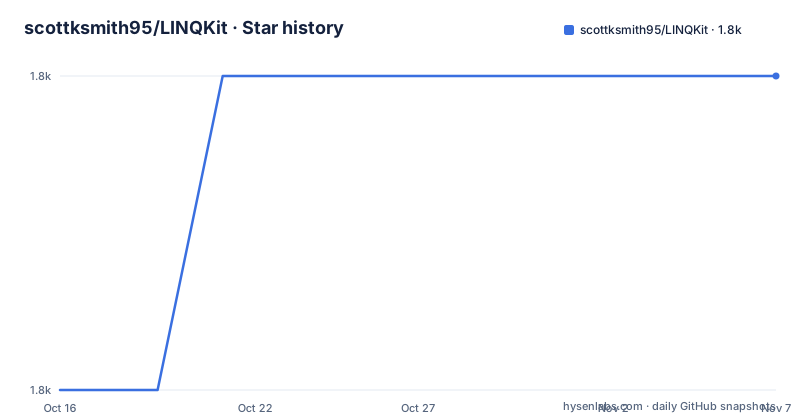
- scottksmith95/LINQKit1,836 ★ · +1
| Repository | 2026-10-16 | 2026-11-07 |
|---|---|---|
| scottksmith95/LINQKit | 1.8k | 1.8k |
1 Stars in the last 22 days, measured from the daily GitHub snapshot. Compare with other projects
Editorial analysis
LINQKit's role in expression-heavy LINQ queries
LINQKit targets C# developers who build LINQ queries for LINQ to SQL or Entity Framework and need to construct or reuse expression trees. Its central problem is that ordinary C# delegates and expression trees are not interchangeable everywhere. A strongly typed predicate may work for in-memory collection filtering, while an ORM provider expects an expression that it can translate into SQL. LINQKit adds a set of extensions around that boundary.
The documented components are an extensible implementation of `AsExpandable()`, a public `ExpressionVisitor` base class, `PredicateBuilder`, and the `Linq.Expr` and `Linq.Func` shortcut methods. Together, these address expression reuse, expression-tree traversal, runtime predicate construction, and delegate or expression creation. This is a specialized library rather than a general-purpose replacement for LINQ. It is most relevant when query logic must be assembled dynamically while remaining connected to an expression-based provider.
The intended audience is described as LINQ to SQL and Entity Framework power users. That wording matters. Developers who only filter a local collection do not need LINQKit's expression machinery, while developers who depend heavily on provider translation may find its query-construction facilities useful. The README does not present LINQKit as a general-purpose wrapper around `IQueryable` and does not claim that it removes the need to understand SQL translation or provider limitations.
AsExpandable, expression visitors, and query assembly
LINQKit's query model is built around expression trees. The README identifies separate workflows for plugging expressions into `EntitySets` or `EntityCollections`, using expression variables in subqueries, combining expressions, and optimizing queries. Those topics indicate that the library is concerned with passing composable expression fragments into ORM query operators rather than merely executing prebuilt predicates.
`AsExpandable()` is described as an extensible implementation. The README explains that the wrapper rewrites invocation expressions into simpler expression trees, including stripping the illustrated `Compile()` call before the provider sees it. The resulting expression still must be supported by the provider. The public `ExpressionVisitor` class supplies the base type for custom traversal or rewriting. This gives applications a place to define expression-processing behavior rather than requiring every transformation to be assembled through one fixed helper.
`PredicateBuilder` serves the separate problem of building predicates dynamically. That is useful when filtering terms come from configuration, form input, or other runtime data. `PredicateBuilder`'s presence as a named component explains why LINQKit covers both static expression reuse and changing query criteria.
The package split matters here. `LinqKit.Core` has no Entity Framework dependency, while `LinqKit` and `LinqKit.EntityFramework` depend on `EntityFramework` 6.5.1 or later. Projects that need only core expression facilities can avoid pulling in that ORM dependency by selecting the core package.
Package selection across LINQKit and EF Core
LINQKit is distributed through several NuGet packages, and choosing one by name alone is unsafe. The aggregate `LinqKit` package targets `net462`, `netstandard2.1`, .NET 8.0, and .NET 10.0, and depends on `EntityFramework` 6.5.1 or later. `LinqKit.EntityFramework` has the same dependency and a similar target list. By contrast, `LinqKit.Core` targets `net462`, `netstandard2.0`, `netstandard2.1`, .NET 8.0, and .NET 10.0 without an Entity Framework dependency.
There are version-specific `LinqKit.Microsoft.EntityFrameworkCore` packages. The README links earlier lines for EF Core 1 through 7 to older package releases and states that those packages are no longer built from the repository. Dedicated packages are listed for EF Core 8, 9, and 10, with the EF Core 10 package depending on `Microsoft.EntityFrameworkCore` 10.0.0 or later and targeting .NET 10.0.
The current release line also narrows supported targets. LINQKit 1.4 removes .NET Framework 3.5, 4.0, and 4.5, portable class libraries, UWP, and `netstandard1.3`. Its listed minimum classic target is `net462`. The README specifically says the `net9.0` build of the EF Core 9 package was removed, so .NET 9 projects use its `net8.0` build. These are compatibility decisions, not installation instructions. A legacy application must select the older release named by the README rather than assume the newest package will resolve.
Installing LINQKit and making a first ORM query
The README points users to NuGet packages but does not provide a `dotnet add package` command, package version flag, or installation tutorial. For that reason, this review does not manufacture a shell command. The concrete installation source is the linked NuGet package page for the package matching the project's ORM and target framework.
For a current application, the first decision is whether it needs core LINQ capabilities or an Entity Framework adapter. The package matrix lists `LinqKit.Core` without an ORM dependency, `LinqKit` and `LinqKit.EntityFramework` against Entity Framework 6.5.1 or later, and version-specific `LinqKit.Microsoft.EntityFrameworkCore` packages for newer EF Core generations. The selected package must contain a compatible target and must not require a framework removed from the current release line.
A first real use begins by adding that package to the application, importing the relevant LINQKit namespace, and using `AsExpandable()` at the point identified by the README's expandable-query examples. The repository also contains `examples/`, including projects such as `examples/ClassLibraryWithEF` and `examples/Demo`. Those entries provide project-specific places to inspect for integration patterns. The README itself also shows `objectContext.Products.AsExpandable().Where(predicate)` for an Entity Framework dynamic-predicate example. Verify translation against your actual provider and package version.
If the goal is dynamic filtering rather than expandable queries, the documented component is `PredicateBuilder`. If the goal is custom tree traversal or rewriting, the public `ExpressionVisitor` is the relevant base class. Those are separate entry points in LINQKit's API surface.
Where LINQKit can become the wrong abstraction
LINQKit is a poor fit for ordinary local collection filtering. The library targets expression-driven ORM scenarios, and its extensions add concepts that a simple `IEnumerable<T>` or direct `IQueryable<T>` query may not need. Adding expression visitors or dynamic predicate construction for a stable query would increase conceptual and dependency cost without solving a stated local problem.
Compatibility is the sharper boundary. The current releases do not build for .NET Framework below 4.6.2, portable class libraries, UWP, or `netstandard1.3`. Applications on those targets must remain on the previous package versions identified in the README. The EF Core 1 through 7 packages are preserved as earlier releases but are no longer built from the repository. An EF Core 10 application must also use the package line built for Microsoft.EntityFrameworkCore 10 rather than assuming cross-version interchangeability.
The README does not document provider-translation guarantees, parameterization rules, SQL output, migration behavior, transaction handling, or rollback. It also provides no comparative performance data. Those points cannot be inferred from the existence of `AsExpandable()` or from the repository's example folders. LINQKit can assemble and transform expressions, but the README does not establish that every resulting provider can translate every resulting expression to SQL.
Maintenance, licensing, and upgrade decisions
The repository is not archived, and the last push was on 2026-10-04. Release 1.4.0 was published on the same date, following releases 1.3.11 and 1.3.10. This confirms recent repository activity and a current release aligned with the reduced framework set. It does not, by itself, prove compatibility with every application or ORM configuration.
Upgrade effort depends heavily on the current target. Moving to LINQKit 1.4 can require changing an application away from .NET Framework 3.5, 4.0, 4.5, portable class libraries, UWP, or `netstandard1.3`. The README supplies retention paths for legacy projects: LINQKit and LinqKit.EntityFramework 1.3.11, LinqKit.Core and LinqKit.Z.EntityFramework.Classic 1.2.11, and the earlier 8.1.x, 9.0.x, and 10.0.x lines for relevant EF Core packages. Staying on an older line avoids the removed targets, but also means accepting an older package baseline.
The project uses the MIT license. That permits use, modification, distribution, and reuse under the license's stated conditions, including preservation of its notice and disclaimer. This is a technical summary, not legal advice. Repository-level CI files and package release notes are present, but the README does not describe their full procedures.
The closest documented alternative inside LINQKit's own package structure is `LinqKit.Core`. It offers the core extensions without depending on `EntityFramework`, but it is not described as a full Entity Framework integration package. For projects that need no ORM adapter, that dependency boundary is the decisive difference.
Editorial conclusion
LINQKit is appropriate for C# applications that dynamically compose or rewrite expressions passed through LINQ to SQL or Entity Framework queries. It is unnecessary for straightforward local filtering and unsuitable without version changes for removed targets such as .NET Framework 4.5 and `netstandard1.3`. Verify the EF or EF Core generation, choose between `LinqKit.Core` and the adapter package, and confirm that the required target exists before adoption.
Frequently asked questions
Which LINQKit package should an EF Core project use?
Use the `LinqKit.Microsoft.EntityFrameworkCore` package that matches the project's EF Core generation. The repository lists separate packages for EF Core versions 1 through 10, and the lines for 1 through 7 are earlier releases that are no longer built from the repository.
Can LINQKit be used without Entity Framework?
The `LinqKit.Core` package has no Entity Framework dependency. The `LinqKit` and `LinqKit.EntityFramework` packages depend on `EntityFramework` 6.5.1 or later, so package selection affects the dependency introduced into the application.
Can LINQKit still target .NET Framework 4.5 or netstandard1.3?
Not in the current release line. The README says those targets and several others were removed, with .NET Framework 4.6.2 now the minimum classic target for the listed current packages. Projects on removed targets must remain on the prior releases identified in the README.
Official sources
Add this badge to your README
If you maintain this project, the badge below links readers to this analysis and shows its maintenance status from the daily GitHub snapshot. Paste the markdown into your README; add ?metric=license or ?metric=stars to the image URL for a different field.

[](https://hysenlabs.com/projects/scottksmith95-linqkit)Star history chart for your README
[](https://hysenlabs.com/projects/scottksmith95-linqkit)Was this useful?