scottslowe/learning-tools: A Practical Infrastructure Learning Repository
A collection of tools and files for learning new technologies
At a glance
- What is it?
- scottslowe/learning-tools is a directory of examples and learning resources for infrastructure technologies, aimed at existing IT professionals. It is useful as a map into topic-specific examples, but it is not documented as a single installable Python package.
- Who is it for?
- Adopt this repository as a topic index if you want a broad collection of infrastructure examples and need help locating resources for a particular technology. Do not choose it when you need one tested installation path, a unified command-line interface, or current documentation covering every included area.
- Can I use it commercially?
- Yes. MIT is a permissive licence: you can use, modify and sell software built on it, as long as you keep its copyright and licence notices.
- Is it still maintained?
- Activity is slowing. The repository last received commits 6 months ago.
- What is it written in?
- Mainly Python, according to GitHub's language statistics.
Answers come from the project's GitHub data, last synced on October 24, 2026, and from our analysis. They are not legal advice.
Star history
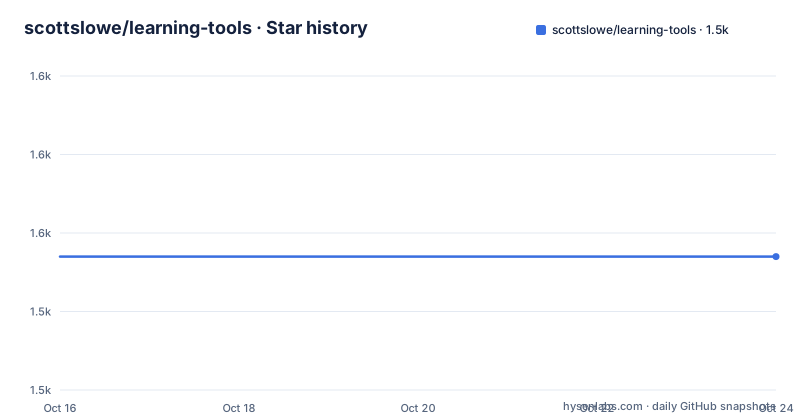
- scottslowe/learning-tools1,547 ★ · +0
| Repository | 2026-10-16 | 2026-10-24 |
|---|---|---|
| scottslowe/learning-tools | 1.5k | 1.5k |
0 Stars in the last 8 days, measured from the daily GitHub snapshot. Compare with other projects
Editorial analysis
What scottslowe/learning-tools Covers
scottslowe/learning-tools addresses a practical problem for existing IT professionals who are moving into unfamiliar infrastructure technologies and need concrete files to study. The README explicitly says the repository is aimed at people who need help coming up to speed with new technologies, products, or open source projects. That target audience distinguishes it from a beginner-only course: it assumes an existing IT background and presents examples alongside the subject area.
The repository is broad rather than narrow. Its documented subject areas include Ansible, CentOS Atomic Host, Consul, CoreOS Linux, Debian GNU/Linux, Docker, etcd, Fedora Linux, Golang, Kubernetes, KVM, LXC and LXD, network operating systems, OpenStack, Open vSwitch and OVN, Packer, Photon OS, Pulumi, rkt, SSH, Terraform, Ubuntu Linux, and Vagrant. The top-level layout also includes directories for AWS, Flatcar, and Traefik. These names indicate the range of topics, but the README does not claim that every directory is equally complete or that all files form one coordinated environment.
The central benefit is discoverability within a mixed infrastructure portfolio. An engineer can enter a directory that corresponds to a named technology and read its own `README.md`, rather than searching a generic repository that mixes unrelated code. The collection is best understood as a curriculum assembled through examples and environment files. The MIT License permits reuse of the licensed content, subject to its terms, but that license does not itself guarantee that an individual example is compatible with every external service or current product version.
Directory-Based Learning Instead of One Package
Based on the repository layout, learning happens through topic directories rather than through a single executable abstraction. Top-level entries such as `ansible/`, `consul/`, `docker/`, `golang/`, `kubernetes/`, `pulumi/`, `terraform/`, and `vagrant/` correspond directly to technology areas. The README instructs readers to find more information in the `README.md` inside each area. This makes the repository resemble a set of small manuals supported by files.
The data flow is therefore not an application request that enters one API and produces one response. A learner navigates to a subject directory, reads its instructions, and inspects files placed there for that technology. For a topic involving configuration management, the relevant boundary is the Ansible directory. For infrastructure-as-code resources, the repository separates Terraform and Pulumi into different directories. For container infrastructure, Docker and rkt also remain separate areas. This separation can reduce accidental coupling between examples, although the top-level README does not describe dependencies or an execution order.
Python is listed as the repository's primary language, but the public description does not present the repository as a Python library. It contains resources for many technologies, and several directories concern configuration formats, shell commands, or infrastructure definitions rather than Python application code. Users therefore should not infer that cloning the repository and importing a top-level Python module is the intended workflow. The README gives no package metadata, supported Python version, entry point, or common test command. The repository's architecture is educational and file-oriented, not package-oriented.
Getting the Repository and Beginning a Topic Study
There is no documented installation procedure in the README. It does not provide an install command, Python package name, release artifact, setup module, or application start command. For this repository, the relevant first action is obtaining the repository and then choosing one topic directory. The README gives a GitHub URL for its contributing guidelines, but it does not document setup steps for learners, so no installation code is included here.
A first real use should be narrow: choose one documented technology area, open its local `README.md`, and identify the files that README describes. For example, a learner interested in infrastructure as code should start with `terraform/`, while someone studying Pulumi should begin with `pulumi/`. The top-level README says the Pulumi resources are primarily with Golang. That distinction matters because a learner expecting a general Python Pulumi tutorial will not find that promise in the repository description.
The learner should treat each directory as a separate study topic. Before executing a file, check the technology named by that directory, the external system it may target, and any credentials or endpoints described by its documentation. The README does not establish that all files work as a single coordinated setup, and it does not publish an expected output for a first exercise. This is a real limitation: there is no repository-wide verification path that would let a new user confirm successful setup across the collection.
Topic Boundaries Across Containers, Networking, and IaC
The directory separation exposes several different learning approaches. Docker, rkt, Kubernetes, and LXC and LXD sit in separate areas, so the collection does not present container creation and orchestration as one unified workflow. Consul and etcd each have dedicated directories and are both described in the README as distributed key-value stores. That parallel organization can help a learner compare two technologies without conflating their files, but the top-level documentation does not provide a comparison, migration guide, or common exercise.
Networking and virtual infrastructure are similarly divided. `netos/` covers network operating systems such as JunOS, EOS, and Cumulus, while `ovs-ovn/` concerns Open vSwitch and Open Virtual Network (OVN). `kvm/`, `openstack/`, and `vagrant/` belong to separate virtualization or environment tools. These boundaries are useful for focused study, but they also mean that learners studying a full deployment must decide themselves how the pieces connect.
Terraform and Pulumi demonstrate another clear separation. Both appear as top-level topic areas, yet the README specifically describes Pulumi as primarily with Golang. The repository does not claim that the directories offer equivalent coverage. Likewise, the documented Golang area should not be interpreted as a general Golang curriculum unless its directory files say so. The collection works best for answering a narrow question, such as where to inspect Terraform resources or which files concern Consul. It is less suitable for asking for one integrated path spanning networking, containers, provisioning, and cloud services.
Maintenance, Compatibility, and License Limits
The repository is not archived, and the last push was on 2026-04-23. It also has no GitHub releases. Those facts matter for adoption decisions because a repository can contain recent commits while still lacking a stable release sequence. The README does not define a semantic-versioning policy, compatibility matrix, changelog, or upgrade procedure. A directory may therefore change independently according to the examples and documentation it contains.
Several subject names also imply infrastructure contexts whose behavior can depend on external components. AWS, Kubernetes, OpenStack, Consul, etcd, and network operating systems can involve services or environments outside a local checkout. The README does not document credentials, disposable accounts, supported product versions, or the cleanup procedure for any such environment. Based on the repository layout and README, it is not possible to state that all examples are safe to execute against an existing system. Learners should inspect each directory's instructions and avoid treating collection membership as evidence that an example has been validated for production.
The MIT License gives the repository a permissive licensing baseline, but it should not be read as an update guarantee or a compatibility promise for referenced third-party products. There is also no release upgrade path to follow. Maintenance activity must therefore be assessed by examining the files relevant to the chosen subject rather than by expecting a repository-wide release process.
Why a Focused Repository May Fit Better
The clearest alternative is to use a focused repository for the single technology being studied. For example, a Terraform-only repository can provide a coherent sequence for that tool without requiring a reader to move among unrelated areas. An official product guide may offer a narrower but more direct description of configuration and operations for one platform. The actual difference is scope: scottslowe/learning-tools collects examples across many technologies, while a focused alternative organizes one topic with fewer unrelated directories.
Another alternative is a product-specific sandbox or course. That changes the learning model from reading repository files to following a tool's own tutorial or running a prepared environment. It can be preferable when the learner needs a defined beginning and end point. scottslowe/learning-tools is more attractive when someone already knows which technologies they want to compare and values access to heterogeneous examples in one place.
This collection is the wrong tool if the requirement is a maintained Python dependency. There is no documented package installation or library API. It is also a poor fit for production automation assembled as a whole, because the README describes learning tools and does not define a deployable system, supported integration boundary, or repository-wide validation procedure. Its value comes from the examples it gathers, not from a promise that the entire collection forms one coherent stack.
Editorial conclusion
Adopt this repository as a topic index if you want a broad collection of infrastructure examples and need help locating resources for a particular technology. Do not choose it when you need one tested installation path, a unified command-line interface, or current documentation covering every included area. Before using an example, inspect its directory README and supporting files, then check compatibility with the infrastructure and operating-system versions in your environment. The repository is not archived, and its last push was on 2026-04-23, but the absence of GitHub releases means there is no published release stream for upgrade planning.
Frequently asked questions
Is scottslowe/learning-tools an installable Python package?
No package installation or Python setup procedure is documented. The repository describes a collection of topic-specific tools and files, with Python listed as its primary language.
Which technologies can I find in scottslowe/learning-tools?
Documented areas include Ansible, Consul, Docker, etcd, Golang, Kubernetes, Pulumi, Terraform, Vagrant, AWS, KVM, OpenStack, and several Linux and networking topics.
Where should I start when using scottslowe/learning-tools?
Choose the directory for one technology and read its `README.md`. The top-level README directs learners to directory-level documentation but does not define a common first exercise or repository-wide setup check.
Official sources
Add this badge to your README
If you maintain this project, the badge below links readers to this analysis and shows its maintenance status from the daily GitHub snapshot. Paste the markdown into your README; add ?metric=license or ?metric=stars to the image URL for a different field.

[](https://hysenlabs.com/projects/scottslowe-learning-tools)Star history chart for your README
[](https://hysenlabs.com/projects/scottslowe-learning-tools)Was this useful?