Free AI Tools: a price list that documents its own deletions as carefully as its additions
Curated list of free and low cost AI tools, LLM APIs, IDEs, agents, and infrastructure for building real AI apps
At a glance
- What is it?
- Free AI Tools is a curated index of free and low-cost LLM APIs, AI IDEs, CLI coding tools and infrastructure, shipped as a README with a companion site. Its distinguishing feature is not coverage but volatility tracking: it records the date each vendor changed billing, and it removes entries as soon as a free tier stops being free.
- Who is it for?
- Free AI Tools is useful as a starting map and as a record of how fast the free tier market moves, and it is not usable as a configuration you pin. Three habits will get you further than memorising the table.
- Can I use it commercially?
- Yes. MIT is a permissive licence: you can use, modify and sell software built on it, as long as you keep its copyright and licence notices.
- Is it still maintained?
- Yes. The repository last received commits 35 days ago.
- What is it written in?
- Mainly TypeScript, according to GitHub's language statistics.
Answers come from the project's GitHub data, last synced on November 15, 2026, and from our analysis. They are not legal advice.
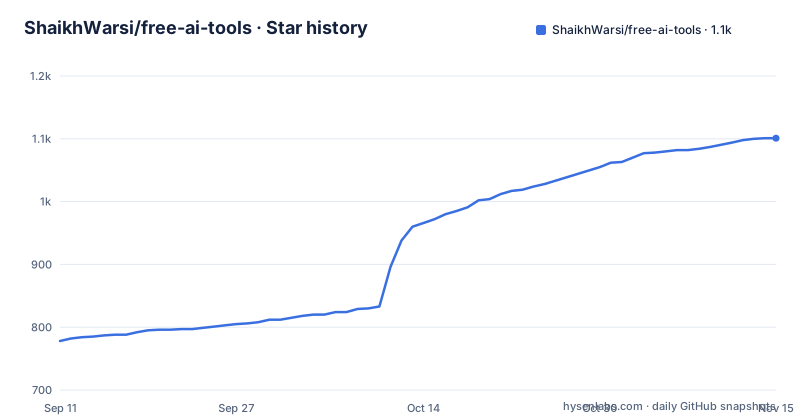
Star history
- ShaikhWarsi/free-ai-tools1,101 ★ · +323
| Repository | 2026-09-11 | 2026-11-15 |
|---|---|---|
| ShaikhWarsi/free-ai-tools | 778 | 1.1k |
323 Stars in the last 65 days, measured from the daily GitHub snapshot. Compare with other projects
Editorial analysis
The deliverable is a README, and the only code is the website
The repository holds four things: a README, a CONTRIBUTING file, a licence, and a `website/` directory. There is no package manifest, no test suite, no release history and no GitHub releases. The TypeScript label on the repository comes entirely from that website directory, which serves the browsable version at FreeAiToolsList.vercel.app. So there is nothing to install and nothing to import; the artefact a developer consumes is prose in a README, and the site exists to make a long document navigable. That framing matters for judging freshness, because a document has no version handshake. There is no way to ask which revision of a price you read, so the dates in the update log are the only provenance available.
Entries can carry a [verify] marker instead of a confident number
Most price lists present a number as fact. This one has an escape hatch: entries marked `[verify]` need confirmation. The reasoning is spelled out in a warning near the top. In early 2026 the major providers, naming OpenAI, Anthropic and Google, restricted flagship reasoning and professional models such as GPT-5.5 Pro, Claude Fable 5 and Gemini 3.1 Pro to paid tiers. Free tiers now receive highly optimised or lighter variants instead, with GPT-5.5 Instant, the Claude Sonnet and Haiku line, and Gemini Flash named as what the free tier actually gets. A marker that says a row is unconfirmed is more useful than a stale figure, and it is unusual to see a curated list carry its own uncertainty forward into every table cell.
One June 2026 pass removed nine providers and added three
The 2026-06-16 update is the most informative entry in the log because of what it deleted. Removed from the free LLM providers were Cohere, on the grounds that it is non-commercial only; GitHub Models, which requires a Copilot subscription; SambaNova and Hyperbolic, which are trial-only; HuggingFace at roughly $0.10 per month; Vercel at $5 per month; Mistral Codestral; Together AI; iFlow, whose key lasts seven days; and the Perplexity API. Six providers removed, or nine counting the paired entries, against three additions on the same day: OpenCode, AWS Kiro and the Xiaomi MiMo Token Plan. The removal reasons are the useful part. Several have nothing to do with price, since a licence term or a subscription dependency disqualifies an entry just as effectively as a paywall.
Billing models change faster than model names do
A dated block records pricing and billing changes rather than a static table, and the dates are dense. Windsurf moved to a quota-based model on March 18 with Pro at $20, Teams at $40, and a new Max tier at $200. Trae moved to a five-tier token system on February 24, from Lite at $3 up to Ultra at $100. Qoder's 50 percent launch promotion ended on April 30, leaving Pro at $20, Pro+ at $60 and Ultra at $200. GitHub Copilot moved to usage-based billing through GitHub AI Credits on June 1, adding a Max tier at $100. Anthropic added four model tiers, and the Xiaomi MiMo V2.5 Pro API was permanently cut by 99 percent on May 26, landing at $0.435 and $0.87 with cache at $0.0036. A single quarter turned four vendors' pricing units over.
The 550+ figure counts models and sub-services, not distinct tools
The stated size of the collection needs reading carefully. The count becomes 550 or more when you add up all the models and the sub-services of all the tools provided, which means it is a sum of constituent parts rather than a count of products. Two vendors with a broad model catalogue and many tiers will contribute disproportionately to the headline number compared with a single-model tool. The same caution applies to the cheaper-than-anything claim in the summary, expressed as $0.08 to $0.50 per million tokens, which describes the cheapest tier of the cheapest entries. None of this makes the number dishonest, but it does mean 550 is not a figure you can compare against a competitor's 300.
The quick comparison mixes rate units and compresses wide ranges into one cell
The summary table is the part most people will read, and it uses two different units in the same column. NVIDIA NIM is listed with 46 models and 40 requests per minute. OpenRouter has 25 models at 50 per day, rising to 1,000 per day with a $10 top-up. Groq has 20 or more models at between 1,000 and 14,400 requests per day, a fourteenfold spread inside one cell. Google AI Studio has 9 models at 5 to 500 requests per day. All four are marked as not requiring a credit card, which is the property the table is really selling. The compression is unavoidable in a table this width, but it means a per-minute rate and a per-day quota cannot be compared by reading across the row.
The stated premise is that free tiers are shared property and easily lost
The framing throughout is scarcity rather than abundance. The goal is stated as helping developers build AI applications without paying $200 a month, and the selection criteria exclude what the list calls five-requests-then-paywall offers, favouring tools developers actually use in production and models described as SWE-bench verified rather than toys. A contributor note asks that issues and pull requests not add paid or expensive personal projects, and a user note asks people not to abuse the services, on the grounds that doing so risks losing them for everyone. Positioning is explicitly against `awesome-ai` as a general list, `ai-collection` for marketing focus, and `toolify` as affiliate-heavy, with stars and sharing as the support mechanism in place of affiliate revenue.
Editorial conclusion
Free AI Tools is useful as a starting map and as a record of how fast the free tier market moves, and it is not usable as a configuration you pin. Three habits will get you further than memorising the table. Treat every `[verify]` marker as unresolved and check it against the vendor before you depend on it. Re-read the pricing section before each planning cycle, because the dated entries in it are the actual signal and the headline free-tier counts are the part most likely to be stale. And notice what has left: nine providers were dropped in a single pass, several for reasons that have nothing to do with price, such as a licence limited to non-commercial use or a requirement to hold another subscription. A list this willing to delete is more honest than one that never does, and it is also a list that will be different the month after you read it.
Frequently asked questions
How many tools does the Free AI Tools list actually cover?
It states 550 or more, but that figure is reached by adding up all the models and the sub-services of all the tools provided. It is a sum of constituent parts rather than a count of distinct products, so catalogues with many tiers inflate it relative to single-model tools.
What does the [verify] marker mean in the Free AI Tools list?
It marks entries that need confirmation rather than asserting a figure. The list explains the reason in a warning: in early 2026 major providers moved flagship reasoning and professional models to paid tiers, so free tiers now serve lighter or optimised variants instead.
Which free LLM API providers does the list compare without a credit card?
Among the rows in the quick comparison table: NVIDIA NIM with 46 models at 40 requests per minute, OpenRouter with 25 models at 50 per day or 1,000 per day with a $10 top-up, Groq with 20 or more models at 1,000 to 14,400 per day, and Google AI Studio with 9 models at 5 to 500 per day. All four are marked as needing no credit card.
Which providers were removed from the free-ai-tools list as no longer free?
A 2026-06-16 pass removed Cohere for non-commercial-only terms, GitHub Models because it requires Copilot, SambaNova and Hyperbolic as trial-only, HuggingFace at about $0.10 a month, Vercel at $5 a month, Mistral Codestral, Together AI, iFlow with a seven-day key, and the Perplexity API.
Does the Free AI Tools repository contain any installable software?
No. The repository holds a README, a CONTRIBUTING file, a licence, and a `website/` directory that serves the browsable list at FreeAiToolsList.vercel.app. There is no package manifest, no test suite, and no GitHub releases, so the usable artefact is the document itself.
Official sources
Where developers are discussing it
Posts on Hacker News, dev.to and Lobsters that link to this repository, found by our scan of those communities. 0 in the last 30 days; newest first.
- Free-AI-tools – Curated list of free and low cost AI toolsHacker News · Oct 15, 2026 · 1 points · 0 comments
Add this badge to your README
If you maintain this project, the badge below links readers to this analysis and shows its maintenance status from the daily GitHub snapshot. Paste the markdown into your README; add ?metric=license or ?metric=stars to the image URL for a different field.

[](https://hysenlabs.com/projects/shaikhwarsi-free-ai-tools)Star history chart for your README
[](https://hysenlabs.com/projects/shaikhwarsi-free-ai-tools)Was this useful?