Sharetribe Go: a branch called latest, three license claims, and a compose file that needs a network that does not exist
Sharetribe Go is Sharetribe's old source-available marketplace software, which was also available as a hosted SaaS product. Sharetribe Go is no longer actively maintained.
At a glance
- What is it?
- Sharetribe Go is the old source-available marketplace software on Rails, with the README stating outright that it is no longer maintained. The install guide checks out a branch rather than a release tag, the license is named three different ways across the repository, and the compose file joins a network it expects to find already there.
- Who is it for?
- Sharetribe Go is worth reading as a worked example of a Rails marketplace rather than as a foundation for a new one, because the successor product named in its own README is a hosted builder, and the code here is being kept as source-available material rather than as a supported dependency. Anyone planning to run it should settle four things first.
- Can I use it commercially?
- Check first. The repository uses a licence we do not classify automatically, so read its LICENSE file before any commercial use.
- Is it still maintained?
- Yes. The repository last received commits 10 days ago.
- What is it written in?
- Mainly Ruby, according to GitHub's language statistics.
Answers come from the project's GitHub data, last synced on November 15, 2026, and from our analysis. They are not legal advice.
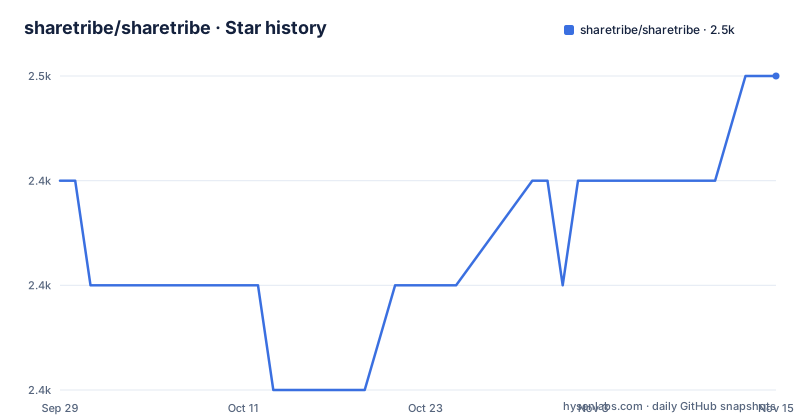
Star history
- sharetribe/sharetribe2,450 ★ · +1
| Repository | 2026-09-29 | 2026-11-15 |
|---|---|---|
| sharetribe/sharetribe | 2.4k | 2.5k |
1 Stars in the last 47 days, measured from the daily GitHub snapshot. Compare with other projects
Editorial analysis
The install guide asks for a branch named latest, not a release tag
Step one of the development setup says to clone the repository and check out the latest release, and then the command it gives is a branch name:
git clone [email protected]:sharetribe/sharetribe.git
cd sharetribe
git checkout latest
Nothing else in the file mentions a tag. The release history in the repository metadata is v12.0.0, then v13.0.0 on 2026-02-17, then v14.0.0 on 2026-05-06, and there is a `VERSION` file, a `RELEASE.md` and an `UPGRADE.md` at the root, so the project has both a branch convention and a tag convention. A branch named latest is a moving reference rather than a version you can pin, which means two people following the same instructions a month apart can get different code while believing they installed the same release.
The rest of the setup is a fixed sequence of commands: `bundle install`, then `npm install && ( cd client && npm install )`, then copying `config/database.example.yml` to `config/database.yml` and `config/config.example.yml` to `config.yml`, then `bundle exec rake db:create db:schema:load`. After that the guide has you build a Sphinx index, start the Sphinx daemon, launch the development server with `foreman start -f Procfile.static`, and open a second console for the background worker with `bundle exec rake jobs:work`. Six root directories hold Procfiles with names like `Procfile.client-hot` and `Procfile.spec`, so the choice of process set is a file argument rather than a convention.
The README says the project is unmaintained, and three files describe the license three ways
The first bold line of the file is a notice rather than a description: Sharetribe Go is no longer actively maintained. The repository summary repeats it, calls the software old and source-available, and says it was also available as a hosted SaaS product. The successor is named as The New Sharetribe, with a page explaining what that means for Sharetribe Go, and the file's own pitch is to use the SaaS version instead if you want a marketplace without writing code.
The licensing is where the file, the repository and the JavaScript side disagree. The README says the code remains source-available under the Sharetribe Community Public License. The repository records no license at all, while a `LICENSE` file does sit at the root of the tree. And `package.json` declares `"license": "MIT"` for the asset build. Three sources, three answers, and the file itself uses the word source-available rather than open source, which is a distinction the rest of the ecosystem does not always make. Nothing in the repository text available here resolves which terms govern which files, so a team that needs to know has to ask rather than infer from any one of them.
The maintenance status is a matter of record rather than tone. The last push to the default branch is dated 2026-05-11, one week after the v14.0.0 tag, and the two releases before it are v13.0.0 in February and v12.0.0 in May 2025. A project can be unmaintained by its own declaration and still have commits, and the dates are the part worth checking when you plan to depend on it.
The image installs Node by hand, verifying the tarball against ten release-team keys
The Dockerfile starts from `ruby:3.4.8-bookworm`, runs an `apt-get dist-upgrade`, and then builds a Node installation by hand rather than using an official Node base image. It fetches ten release-team GPG keys in a loop, from `keys.openpgp.org` with a fallback to `keyserver.ubuntu.com`, downloads `node-v18.16.0-linux-x64.tar.xz` together with `SHASUMS256.txt.asc`, decrypts the signature, checks the tarball against it with `sha256sum -c`, unpacks it into `/usr/local` and symlinks `nodejs`. The verification is the careful part; the key list is the fragile one, because those keys belong to the people who signed that specific Node release and the set is frozen in the file.
Two details contradict each other. `ENV REFRESHED_AT 2023-02-01` records when the image was last refreshed, while the base image is Ruby 3.4.8, a generation later than that date, so the stamp no longer tracks what the image contains. And the file still uses the `MAINTAINER` instruction, which Docker deprecated in favour of `LABEL`, along with a person who receives it.
The Node version also has to agree with the rest of the project. The stack section lists Node 18.16 for compiling JavaScript assets, `package.json` declares the same version under `engines`, and the repository carries `.node-version` and `.nvmrc` beside `.ruby-version`. The JavaScript runtime is only an asset compiler here: React and jQuery are the front end, Mercury is the what you see is what you get editor, and `react_on_rails` is what joins them, with server rendering through Passenger.
The compose file attaches both services to an external network named sharetribe
Two services are defined, and both build from the same context with the same environment file. The web service publishes port 3000 and inherits its command from the image. The worker service sets three ImageMagick limits and then overrides the command:
  worker:
    build: .
    env_file: .env
    environment:
      - QUEUES=default,paperclip,mailers
      - MAGICK_MAP_LIMIT=64MiB
      - MAGICK_MEMORY_LIMIT=256MiB
      - MAGICK_TIME_LIMIT=30
    command: bundle exec rake jobs:work
The queue list is the interesting part, because it names the three places background work happens: the default queue, paperclip for image processing, and mailers. Those are the same three concerns the stack section names with gems, `paperclip` for image upload management and the mail configuration for the Mailcatcher section, so the compose file is where the asynchronous half of the application becomes visible.
The network block is the part that bites:
networks:
  default:
    external:
      name: sharetribe
An external network is not created by the compose run, it has to exist already. Anyone who clones the repository and runs the stack on a laptop has to create a network with that exact name first, and a failure to do so surfaces as a network error rather than as a build problem. The compose file is also declared with the `version` key, which current compose versions warn about, and the repository ships a second file, `docker-compose.app.yml`, alongside it, plus a `Vagrantfile`, `convox.yml` and `fig.yml` for three other ways to run the same application.
ImageMagick is bounded in the worker only, while search runs through Sphinx with its own index step
ImageMagick is a stated requirement of the project, installed on a Mac with `brew install imagemagick`, and it is what processes the images that `paperclip` manages. The three limits in the compose worker exist because image conversion is the operation that can exhaust a container: a 64MiB map limit, a 256MiB memory limit and a 30 second time limit. They are set on the worker and on nothing else. The web service in the same file carries no ImageMagick limits at all, so a request path that triggers image work in the web process is unbounded by that configuration.
Search is the other subsystem with its own moving parts, and it is not the database doing the querying. Sphinx is a listed requirement, version 2.1.4 having been used successfully with newer versions expected to work, installed with MySQL support enabled. Two rake tasks bracket it, `bundle exec rake ts:index` to build the index and `bundle exec rake ts:start` to run the daemon, and both sit between creating the schema and starting the server in the setup sequence. If the MySQL server is configured for SSL, the guide points at `config/thinking_sphinx.yml` and the `mysql_ssl_ca` lines that have to be uncommented with a proper certificate chain, so a local MySQL with SSL enabled needs an extra step that a default install does not.
Email has the same shape. Mailcatcher is installed as a gem and started on its own, and the mail settings for it go into `config/config.yml` as `smtp_email_address: "localhost"` on port 1025, with the web interface at `http://localhost:1080`. Nothing in the compose file starts Mailcatcher, so email in a containerised run is not part of the stack you get by default.
package.json declares MIT, two dependencies, and a script that deletes webpack output
The JavaScript side of a Rails application that compiles its assets is small enough to read in full. The manifest declares Node 18.16 as its engine, lists two dependencies, `check-node-version` and `codemirror`, declares two cache directories for `node_modules` and `client/node_modules`, and defines one script:
"clean": "rm -f app/assets/webpack/*"That is the whole surface. `check-node-version` is a runtime dependency rather than a development one, which is the mechanism behind the repeated statements that the Node version matters and that other versions are not guaranteed. `codemirror` at 5.x is the editor component, which fits the Mercury what you see is what you get editor named in the stack section. And the single script is a `rm` against the webpack output directory, so it is a shell command in a manifest that declares `"license": "MIT"` for a repository whose own file calls the software source-available.
The rest of the tooling is Ruby side. `.rubocop.yml` sits next to a `.rubocop_todo.yml`, which is the usual arrangement for carrying existing offences as a baseline, `.rspec` configures the test runner, a `Guardfile` and an `autotest/` directory cover file watching, and `zeus.json` records a parallel test server configuration. Feature tests have their own stack in the gem list, capybara with selenium-webdriver and cucumber-rails alongside rspec-rails and factory_bot, and `spec/`, `test/` and `features/` are three separate top level directories for them. Continuous integration is a `.circleci/` directory, and the file it is entered from is a badge at the top of the README.
Editorial conclusion
Sharetribe Go is worth reading as a worked example of a Rails marketplace rather than as a foundation for a new one, because the successor product named in its own README is a hosted builder, and the code here is being kept as source-available material rather than as a supported dependency. Anyone planning to run it should settle four things first. The license, which is named three ways in one repository: source-available under the Sharetribe Community Public License in the README, no license at all in the repository metadata with a LICENSE file sitting at the root, and MIT in the JavaScript package.json. The version to check out, since the install guide asks for a branch named latest while releases are tagged v12, v13 and v14. The database, since only MySQL has been tested and no other engine is guaranteed. And the local network, since the compose file attaches to an external network named sharetribe that has to exist before the stack starts, and the web service in it carries none of the ImageMagick limits the worker sets. For a new build, the successor product is the path the project itself points at.
Frequently asked questions
is Sharetribe open source
Sharetribe Go describes itself as source-available rather than open source, remaining under the Sharetribe Community Public License. The repository records no license while a LICENSE file sits at the root, and the JavaScript package.json separately declares MIT.
What is Sharetribe Go?
It is Sharetribe's old marketplace software, which was also available as a hosted SaaS product, and the repository states that it is no longer actively maintained. The successor is The New Sharetribe, a hosted marketplace builder.
What technology stack does Sharetribe Go use?
Ruby 3.4.8 with Rails 8.1.2 and MySQL 8.4, React with jQuery on the front end, Node 18.16 for compiling JavaScript assets, Heroku as the server, Amazon S3 for image hosting, and delayed_job for background work. Deployment uses a custom script rather than Mina or Cap3.
How do I set up Sharetribe Go locally?
Clone the repository, check out latest, run bundle install and npm install in both the project root and the client directory, copy the example database and config files, then create the schema with bundle exec rake db:create db:schema:load. Only MySQL has been tested, so no other database is guaranteed to work.
Does Sharetribe Go need Sphinx for search?
Yes. Sphinx is a listed requirement, with version 2.1.4 having been used successfully and MySQL support enabled. You build the index with bundle exec rake ts:index and start the daemon with bundle exec rake ts:start.
Which background job runner does Sharetribe Go use?
delayed_job. Locally you invoke it with bundle exec rake jobs:work, and the compose file runs the same command as its worker service with QUEUES set to default,paperclip,mailers.
Official sources
Add this badge to your README
If you maintain this project, the badge below links readers to this analysis and shows its maintenance status from the daily GitHub snapshot. Paste the markdown into your README; add ?metric=license or ?metric=stars to the image URL for a different field.

[](https://hysenlabs.com/projects/sharetribe-sharetribe)Star history chart for your README
[](https://hysenlabs.com/projects/sharetribe-sharetribe)Was this useful?