blitzstrike's package is 2.4.132 and its only release tag is v1.0.0
⚡ Blitz Strike — a universal MCP penetration-testing toolbelt. Structured methodology: reconnaissance & attack-surface mapping, source-to-sink analysis, and live validation. 57 escalation chains, 130-tool catalog, intelligence data layer. One server, every agent.
At a glance
- What is it?
- An MCP server that packages a three-tier security-audit methodology into callable tools, built around one idea: a scanner hit is a hypothesis and only a controlled live test settles it. The validation design is the most interesting part of the project, and the packaging has two lockfiles, a benchmark alias that runs the test suite, and a version number nothing matches.
- Who is it for?
- blitzstrike suits a team doing authorized testing that has been burned by pattern-matching scanners producing findings nobody could reproduce, because the whole design is aimed at that specific failure. Read the validation tier before anything else, since its value depends entirely on your ability to run live tests inside the authorised scope, and expect to install external tooling and supply asset-search credentials before the 130-tool catalogue is fully available.
- Can I use it commercially?
- Yes. MIT is a permissive licence: you can use, modify and sell software built on it, as long as you keep its copyright and licence notices.
- Is it still maintained?
- Yes. The repository last received commits 12 days ago.
- What is it written in?
- Mainly TypeScript, according to GitHub's language statistics.
Answers come from the project's GitHub data, last synced on November 15, 2026, and from our analysis. They are not legal advice.
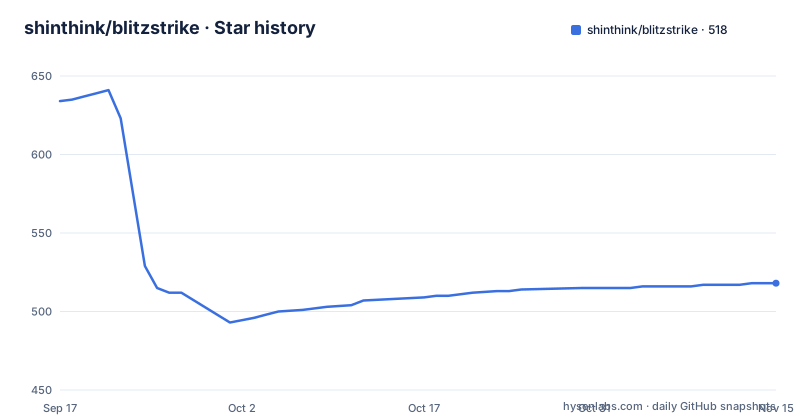
Star history
- shinthink/blitzstrike518 ★ · -116
| Repository | 2026-09-17 | 2026-11-15 |
|---|---|---|
| shinthink/blitzstrike | 634 | 518 |
-116 Stars in the last 59 days, measured from the daily GitHub snapshot. Compare with other projects
Editorial analysis
A scan hit is a hypothesis, a live test is the verdict
The project's stated reason for existing is a methodology complaint, and it is worth repeating precisely because it is the design brief for everything else.
Two failure modes are named. The first is false positives produced by surface-level pattern matching, where a scanner reports a dangerous pattern without any evidence that anything can reach it. The second is unverified findings: issues reported without live confirmation, which is how a report acquires findings nobody can reproduce and then loses credibility.
The response is a three-tier structure, with each tier mapped to a phase of a conventional assessment rather than to a category of vulnerability.
The first tier does reconnaissance and attack-surface mapping at scale, enumerating exposed entry points, dangerous sinks and authentication boundaries. The second does static analysis and data-flow tracing, following a source to a sink and enriching what it finds against a graph of escalation chains, and its stated job is to confirm that a sink is reachable, unauthenticated and exploitable rather than merely present. The third performs live verification, enforces scope, and orchestrates so that a finding is confirmed before it is ever reported.
The sequencing rule is the point: nothing is reported until the third tier confirms it. A full engagement is designed to run from scope enforcement to report-ready findings in a single call.
That is a defensible position for authorized work, and the emphasis on scope enforcement inside the tool rather than in a policy document is the part most worth noticing.
The validation tier is a controlled experiment
The mechanism the third tier uses is described as two things: marker reflection and a negative control.
Both are standard experimental hygiene applied to security testing, and applying them here is the substantive engineering claim of the project.
A negative control establishes that the check does not fire when it should not. Marker reflection establishes that the check is capable of seeing a signal at all, by planting a known marker and confirming it is detected. Together they mean a positive result is evidence rather than an artifact: the test is known to work, and it is known to be quiet on a case where nothing is wrong.
The same discipline appears one tier earlier. The precision sink search reports a hit only when it falls inside a function body rather than anywhere in the file, and it flags each hit as guarded or unguarded, which is a direct attack on the pattern-matching failure mode since a sink behind an authorization check is not the same finding as an unguarded one. The deeper trace tool returns a function's body along with the sinks and the authorization gates in scope, so the reader can see why one is reachable and the other is not.
Beyond the three tiers the project also ships narrow capability packages: a smart-contract audit described as deterministic with an executable proof harness, a logic-bug prober built on sibling enumeration and differential access-control testing, a watchlist for known weakness and vulnerability identifiers alongside detection of sinkholed domains, and an out-of-band proof path.
Every one of those is described as producing proof rather than a match.
The model plans, the tools do the work
The division of labour is stated as a slogan and it is the clearest description of the architecture.
The language model is the brain: it plans, routes, delegates and judges. The toolbelt is described as the deterministic hands, the knowledge and the guardrails. So the model decides what to look at and in what order, and the tools decide what counts as a hit.
That split is what makes the validation tier meaningful. If the model were also writing the rules that decide whether a finding exists, the guardrail would be the same thing it is guarding against. Keeping the decision in deterministic code and the sequencing in the model is a reasonable division.
The classification step is automatic. A uniform resource locator goes to the live pipeline and a filesystem path goes to the source pipeline, with no flag to set. From there the documented cycle is reconnaissance, analysis, verification, review and report.
What steers the model is described as bundled doctrine: instruction documents, skills, and a next-step field attached per step. The work is then fanned out across whatever sub-agent facilities the host runtime provides.
One caveat is worth stating. The determinism is in the tools, not in the plan. A model asked to audit the same target twice may route differently, and the per-step guidance is what keeps that variation inside the intended path rather than eliminating it.
One hundred and thirty tools means sixty-three binaries you must supply
The zero-install quickstart is real for the server itself and misleading about the catalogue.
Two commands are presented as the fast path: one to verify the environment and one to register the server with every agent client found on the machine. Neither requires a clone or a build, because the package is distributed through the usual JavaScript package runners and compiled to a single executable per platform.
# Zero-install — works from any MCP client, no clone, no build
npx -y blitzstrike doctor        # verify the environment
npx -y blitzstrike install       # auto-register with every detected agent CLI
What the environment check then reports is the real dependency picture. The tool catalogue line reads 63 of 130 installed, with 67 described as on-demand. So a full setup expects sixty-three external security binaries present on your machine already, and a further sixty-seven that are fetched when a technique needs them.
Those on-demand items are heavy: there is a dedicated command for fetching datasets on demand, and what it fetches is named as payloads and templates. Nothing is fetched until you ask.
The check also reports on credentials, specifically for an external asset-search service, and on whether the bundled data layers are present. Every reported problem is said to carry a fix line so you do not have to work out the remedy.
So the honest summary of the quickstart is that the server installs in seconds and the toolbelt takes considerably longer to become complete.
The package is at 2.4.132 and the release history has one entry
The version numbers do not line up, and the reason they are readable at all is the convention being used.
There is exactly one release, a first major version tagged three weeks before the last push. The package manifest, meanwhile, declares version 2.4.132. Under ordinary semantic versioning that is a fourth major line at the one-hundred-and-thirty-second patch of its second minor, which means the patch component is being used as a build counter.
That works, because the toolchain is compiled per release and a build counter is genuinely useful for a tool that is republished often. But it produces a specific confusion: the newest artifact on the package registry is not the newest tagged release, and neither is the newest commit. Anything that pins a release tag, including a lockfile in a consuming project, pins something considerably older than what users get by default.
The same care about internal consistency is visible in the counts. Three places declare the methodology size, and they agree: fifty-seven escalation chains and a hundred-and-thirty-tool catalogue appear in the project description, the package description and the documentation. The catalogue check adds up correctly too, since sixty-three installed plus sixty-seven on demand is a hundred and thirty.
So the numbers are disciplined and the release history is not. It is worth asking which of those two a user is expected to trust.
Two lockfiles and a benchmark that runs the tests
The stated reason for choosing one language runtime and one toolchain is explicit: a single static executable per platform from the compiler, zero-install distribution through the package runners, first-class access to the protocol's own SDK for that language, and one toolchain covering development, test, build and compile.
Against that, the repository contains two lockfiles for two different package managers.
The scripts are where the inconsistency shows up again. There is a test script that runs a verification file, a separate browser verification script, and a script named for benchmarking that runs exactly the same command as the test script. So the documented way to benchmark the project runs the test suite instead.
The benchmark directory makes the intent clear even if the wiring does not: it contains two separate benchmark runner files alongside a corpus and an enterprise directory, both of which are shipped in the published package. So the benchmarks exist, are written, and are included in the distribution, and the entry point that would run them invokes something else.
Two smaller details are worth noting. The build marks the browser automation library as external rather than bundling it, which is the right call for a package that will be installed alongside the browser binaries it drives. And the publish hook runs type checking and a build before anything is published, so at least the ordering guarantee is enforced automatically.
Install merges instead of overwriting, and one agent platform ships first class
The configuration installer is careful in a way most installers are not.
It looks for the configuration files that already exist on the machine and in the project, across several named clients, and merges its own server entry into each one in that client's native format. The guarantee is explicit: it never overwrites existing server entries. With a preview flag it prints what it would write without touching anything, and with no client detected it prints a snippet for manual pasting.
There is a matching client-configuration reference for people wiring it by hand, listing the filename each runtime expects, from the desktop client's JSON file through project-local files to a YAML key for one client and a native configuration for two others.
The tension is in the top-level layout. The pitch is one server for every agent, and nine clients are named as detected. But one directory holds sub-agent definitions for a single named platform, as a first-class shipped artefact alongside the skills and the instruction material.
Two more shipped directories are worth understanding. A manuals directory with an index file supplies what the documentation calls the relevant tool manual, attached to every result, which is a form of inline documentation for the external binaries rather than for the server's own code. And separate directories hold the data layer, the payload and template sets, and the identifier watchlists.
For a tool that writes configuration into other people's applications, the merge guarantee and the preview flag are the two features worth having.
Editorial conclusion
blitzstrike suits a team doing authorized testing that has been burned by pattern-matching scanners producing findings nobody could reproduce, because the whole design is aimed at that specific failure. Read the validation tier before anything else, since its value depends entirely on your ability to run live tests inside the authorised scope, and expect to install external tooling and supply asset-search credentials before the 130-tool catalogue is fully available.
Frequently asked questions
What is blitzstrike?
It is an MCP server written in TypeScript that packages a three-tier security-audit methodology into callable tools: reconnaissance and attack-surface mapping, static source-to-sink tracing, and live validation. A whole engagement runs from scope enforcement to report-ready findings in one call.
How does blitzstrike reduce false positives?
It separates the decision to investigate from the decision to report. The analysis tier traces reachability and flags sinks as guarded or unguarded, and the validation tier confirms a finding with a negative control and a marker reflection before anything is written up, so a reported issue has been demonstrated rather than pattern-matched.
Do I need root or any special privileges to use blitzstrike?
The visible documentation does not state a privilege requirement. It does state scope enforcement as part of the validation tier, and that live verification happens against the target, so what you need is authorisation for whatever you point it at rather than elevated local access.
What does installing blitzstrike do to my other agent configs?
The install command detects existing client configuration files and merges its own server entry into each in that client's native format, and it is stated never to overwrite existing server entries. A dry-run flag previews without writing, and with no client detected it prints the snippet for manual pasting.
How many external tools does blitzstrike need?
The environment check reports the catalogue as 63 of 130 installed with 67 on demand. So a complete setup expects sixty-three external binaries already present, and the remainder are fetched when needed, through a command that pulls payloads and templates on request rather than at install time.
What is the latest blitzstrike release?
There is exactly one release, v1.0.0, tagged 2026-09-12. The package manifest declares version 2.4.132, so the package registry version and the only release tag do not match, and the patch component is being used as a build counter.
Official sources
Add this badge to your README
If you maintain this project, the badge below links readers to this analysis and shows its maintenance status from the daily GitHub snapshot. Paste the markdown into your README; add ?metric=license or ?metric=stars to the image URL for a different field.

[](https://hysenlabs.com/projects/shinthink-blitzstrike)Star history chart for your README
[](https://hysenlabs.com/projects/shinthink-blitzstrike)Was this useful?