knockoff is a frozen snapshot whose successor is closed
Chrome extension that filters pseudo-brand junk out of Amazon. Buy from real, established brands.
At a glance
- What is it?
- A browser extension that filters trademark-squat brands out of Amazon search results, with the brand list bundled rather than fetched. The repository is the last openly built version, and the README says plainly that development has moved somewhere you cannot read and that pull requests here will not ship.
- Who is it for?
- Use this if what you want is a way to see past random-string brands in Amazon results, and read it as a browser store extension rather than as software you maintain. Three things to know.
- Can I use it commercially?
- Check first. The repository uses a licence we do not classify automatically, so read its LICENSE file before any commercial use.
- Is it still maintained?
- Yes. The repository last received commits 121 days ago.
- What is it written in?
- Mainly JavaScript, according to GitHub's language statistics.
Answers come from the project's GitHub data, last synced on November 15, 2026, and from our analysis. They are not legal advice.
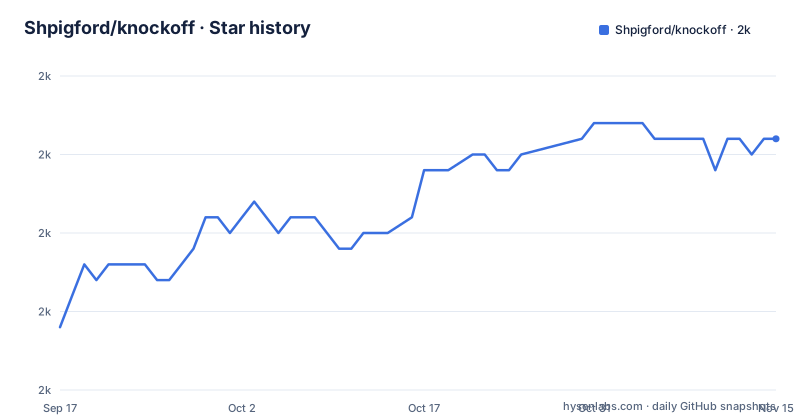
Star history
- Shpigford/knockoff2,031 ★ · +12
| Repository | 2026-09-17 | 2026-11-15 |
|---|---|---|
| Shpigford/knockoff | 2k | 2k |
12 Stars in the last 59 days, measured from the daily GitHub snapshot. Compare with other projects
Editorial analysis
The open build is the last one, and the next one is not readable
The most important paragraph in this repository is a note near the top, and it changes how everything else should be read.
It states that this is a frozen public snapshot, that active development has moved to a private repository, and that future versions are no longer built in the open. It then adds the reason that framing exists: because nothing here contacts a server, and loaded as-is the build makes zero calls to any extension server.
The consequences are stated plainly too. This build will not receive further updates. For the maintained, auto-updating version you install from the browser stores. And the editing section says pull requests here will not ship to the published extension, though they take effect immediately in a local build.
That last sentence is the honest one. Contributing is not pointless for your own fork, but it is pointless for the product anyone else installs.
The release history supports the framing. All three published versions are dated the same afternoon, within about eighty minutes of each other, and the most recent push is four days after the last one. There is no development trail here to follow.
The root cause is a registry acting as a marketplace gate
The explanation of why Amazon results are full of these brands is more precise than you might expect, and it is worth reading closely.
The page names examples, then explains the mechanism: these are trademark registrations filed as random strings, and they were registered in order to unlock Amazon's Brand Registry. The sellers behind them have no company, no warranty and no reputation, and they sell commodity goods.
So the sequence is: a trademark application is the key to selling under your own brand name on the marketplace, and the cheapest possible key is a random string nobody will ever claim. The registry gate that exists to protect buyers from impersonation is being satisfied literally and cheaply.
That framing matters because it explains why the listings look the way they do. A brand name that is five to nine capital letters with no vowels is not a design failure, it is the residue of whatever string happened to be available at the trademark office when someone decided to start selling.
It also explains why the extension exists at all. Detecting the business model is easier than detecting the individual company, and the project takes that route.
A six stage pipeline where the first match wins
Brand resolution is a table of six ordered checks, and the page says explicitly that the first match wins. That ordering is the design.
Your own allowlist comes first and is never filtered. Your own blocklist comes second and is always filtered. Then a seed list of notorious pseudo-brands. Then a list of established Chinese-owned brands, which returns a known verdict, or a flagged verdict if you enable a setting for it. Then roughly five thousand established brands plus a bundled community allowlist. Then name heuristics for anything left over. A listing with no brand at the front of its title at all is its own verdict.
Two consequences. Your lists beat the project's, in both directions, so a mistake in your own blocklist is unrecoverable from the built-in data. And heuristics are last, which means a brand on the known list never gets heuristic treatment at all.
The Chinese-brand stage is the one worth arguing with. The whole premise is that random strings are a signature of squatting, and plenty of legitimate Chinese consumer brands have exactly that signature. Shipping them as known by default is the defensible choice. Offering a setting to flip them is a reasonable escape hatch, and it is worth knowing the switch exists before you wonder why a real brand slipped through.
The known-brand list always vetoes the heuristics
This is the safety property of the whole design, and it is stated as an override rather than a feature.
Unknown brands are scored on the linguistic signature of a squatted name. The signals are all-caps strings between five and nine characters, vanishing ratios of vowels, consonant runs that cannot be pronounced, letter pairs that do not occur in English, non-Latin characters, and random internal capitalisation of the kind that reads as a capital in the middle of a word. A high score flags, a middling score marks as suspect.
What stops that from being a false-positive machine is the override. The known-brand list always vetoes the heuristics, and the page gives three real brands that would otherwise look suspicious under those rules.
So the heuristic stage can only ever flag something nobody has heard of. That inverts the usual risk: instead of a clever scorer quietly hiding things, the failure mode is a brand nobody added. It also means the cost of running the extension safely is the maintenance of the list, which is the trade the project is asking you to accept.
The scoring lives in one file, described as deliberately readable and easy to tune for your own build, and there is no build step at all.
The strictest level is an allowlist, and the list never refreshes
There are three filter levels and the third one changes the nature of the tool.
Relaxed filters known pseudo-brands plus your own blocklist. Standard, which is the default, adds names that merely look suspicious and listings with no brand at the front of the title. Strict adds anything not on the known-brand list, which the page describes as allowlist-only.
So under strict, a brand that opened for business last month is filtered, because nobody has added it to a list that was last updated when the repository was frozen.
That combines badly with the self-contained design. The brand lists ship as files in the repository, the page says there is no daily refresh, and the bundled snapshot is described as the whole list. Under the default level that is fine, since heuristics only add suspicion. Under strict it is a real hazard, because absence from a frozen snapshot is indistinguishable from absence in the world.
The same applies to any brand new since the freeze, in every mode, in the local build. The store version updates its lists; the repository build does not. Those two are not the same product over time.
Three server switches ship blank, and the server is not published
The self-contained design is implemented as three constants, and naming them makes the architecture legible.
There is a URL for brand lists, a URL for configuration, and a report endpoint. All three are declared at the top of the main content script and all three ship blank. Point them at a host you control and you get on-demand list refresh, configuration pushes and structured reporting.
The page is explicit that the server itself is not part of this repository. So what you have here is the client and the switches, with nothing behind them.
Each switch has a documented fallback, which is what makes blank values safe rather than broken. Lists come from the bundled files. Configuration comes from the bundled file, which the page calls authoritative. And reporting, rather than posting to an endpoint, opens a prefilled issue on the forge. The structured version of that report, if you wire an endpoint, would carry the brand, the verdict, the product identifier, the marketplace and the extension version, and the page says it contains no personal data.
That is a well designed separation: the extension is useful with no infrastructure at all, and the network features are opt-in per feature.
Safari keeps its own copy of the extension and a script to reconcile it
Chrome and Firefox get a two-step load-unpacked flow and nothing else. Safari is a different project.
Because Safari cannot load an unpacked extension, the page has you open a bundled native app project in Xcode, run a specific scheme, and then enable the extension in Safari's own settings. For local builds that are not signed, there is a checkbox in Safari's developer menu to allow unsigned extensions.
Then the sentence that explains why this is more than a wrapping exercise: the native project carries its own copy of the extension files. There is a sync script, and you are told to run it after editing the extension and before rebuilding.
So the Safari build has a duplicated copy of the source, and the duplication is silent. Edit the extension, rebuild the native app without running the script, and you get the previous version with no error. For a project whose main virtue is that the lists are easy to edit, that is the sharpest edge in the repository.
The root listing also shows two separate example environment files for the browser store submissions, alongside directories for the onboarding flow, the options page and the store listing assets.
Editorial conclusion
Use this if what you want is a way to see past random-string brands in Amazon results, and read it as a browser store extension rather than as software you maintain. Three things to know. The open repository is frozen, so a local build will never receive list updates while the store version will, which means the two drift apart. The strictest filter level is an allowlist that hides any brand missing from a bundled snapshot with no daily refresh, so leave it off unless you are deliberately shopping only from a known set. And if you fork it, the three server switches ship blank and the server is not published, so anything beyond list refresh and structured reporting is yours to build.
Frequently asked questions
is knockoff extension safe
The repository is a frozen public snapshot whose development moved to a private repository, and it states that the bundled build makes zero calls to any extension server. Everything runs in a content script with no accounts, no tracking and no network requests, because the brand lists and configuration ship in the repository and the three server switches are blank. The maintained, auto-updating version is the one distributed through the browser stores.
is knockoff for amazon legit
It is a browser extension that hides, dims or labels listings from trademark-squat brands, with three filter levels and per-listing badges you can click to trust, block, reveal or report a misclassification. Its stated aim is buying from real established brands even when that means paying more, and detail pages get a verdict chip rather than being hidden.
Why are there so many knockoff brands on Amazon?
The page's explanation is that random strings were registered as trademarks specifically to unlock Amazon's Brand Registry, then used to sell commodity goods with no company, warranty or reputation behind them. A trademark application is the key to selling under your own brand name, and the cheapest available key is a string nobody will claim.
What does the strict filter level do in knockoff?
It becomes allowlist-only, filtering anything not on the known-brands list, on top of the default level's suspect names and unbranded listings. Relaxed filters only known pseudo-brands plus your own blocklist, and standard is the default. Since the bundled lists have no daily refresh, strict will hide brands that opened after the snapshot was frozen.
Does knockoff work on Safari?
Yes, but Safari requires the extension to be wrapped in a native app: open the bundled native project in Xcode, run its scheme, then enable the extension in Safari's settings, and allow unsigned extensions in Safari's developer menu for local builds. The native project keeps its own copy of the extension files, so a sync script has to be run after editing and before rebuilding.
Official sources
Where developers are discussing it
Posts on Hacker News, dev.to and Lobsters that link to this repository, found by our scan of those communities. 0 in the last 30 days; newest first.
- Knockoff: A browser extension that filters pseudo-brand junk out of AmazonHacker News · Sep 29, 2026 · 2 points · 0 comments
Add this badge to your README
If you maintain this project, the badge below links readers to this analysis and shows its maintenance status from the daily GitHub snapshot. Paste the markdown into your README; add ?metric=license or ?metric=stars to the image URL for a different field.

[](https://hysenlabs.com/projects/shpigford-knockoff)Star history chart for your README
[](https://hysenlabs.com/projects/shpigford-knockoff)Was this useful?