susfs4ksu-module hides root at the kernel level, which is why the first requirement is a patched kernel
An addon root hiding service for KernelSU
At a glance
- What is it?
- A KernelSU module that installs two userspace helpers and a script to talk to the SUSFS kernel, with mount, path and map lists as its configuration surface. Two mechanisms deserve a decision before you install it rather than an explanation after: the module asks you to supply a value the system reads as a verified boot attestation, and SUSFS can report a spoofed kernel build string separate from the kernel version.
- Who is it for?
- susfs4ksu-module is the right fit if you already run a SUSFS patched kernel and want KernelSU to stop advertising itself to applications, and it is the wrong fit if you are rooting a device from scratch or want root hidden without rebuilding anything. Four things to settle first.
- Can I use it commercially?
- Yes, with strict conditions. AGPL-3.0 is a network copyleft licence: if people use a modified version over a network, for example as a hosted service, you must offer them its source code under the same licence.
- Is it still maintained?
- Yes. The repository last received commits 3 days ago.
- What is it written in?
- Mainly HTML, according to GitHub's language statistics.
Answers come from the project's GitHub data, last synced on November 24, 2026, and from our analysis. They are not legal advice.
Star history
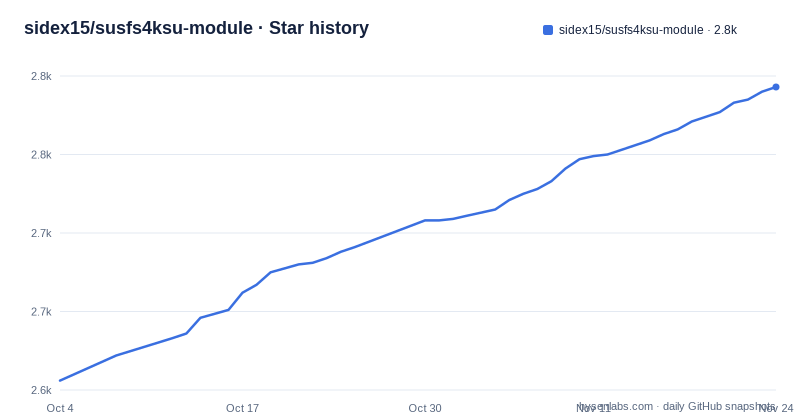
- sidex15/susfs4ksu-module2,793 ★ · +187
| Repository | 2026-10-04 | 2026-11-24 |
|---|---|---|
| sidex15/susfs4ksu-module | 2.6k | 2.8k |
187 Stars in the last 51 days, measured from the daily GitHub snapshot. Compare with other projects
Editorial analysis
The default branch is named v1.5.2+, and each tag is that version plus a revision
The versioning model is unusual enough to explain on its own. The repository's default branch is called `v1.5.2+`, and the release tags hang revisions off that same string: `v1.5.2+_R26`, `v1.5.2+_R27` and `v1.5.2+_R28`.
So the project is versioned against a SUSFS feature level rather than against itself, with a revision counter appended. The README's first requirement lines up with that base: the kernel should be running SUSFS 1.5.2 or later for hiding to be effective.
The release dates show an uneven rhythm. R26 is dated 2026-03-06, R27 is dated 2026-03-27, and R28 is dated 2026-07-26. Twenty-one days between the first two, then a gap of about four months. The last push on the branch is dated 2026-09-08, which is after the newest tag, so master is ahead of R28 by another stretch of work.
Revisions also carry features, not only fixes. A section headed for revision 16 onward describes a new SUSFS parameter called Spoof Kernel Build, which means revision numbers mark behaviour changes a user might notice.
The work happens in the kernel, so a patched custom kernel is the first requirement
What the module installs is two userspace helper tools, `ksu_susfs` and `sus_su`, placed into `/data/adb/ksu`, plus a script to communicate with the SUSFS kernel. The claim it makes for itself is root hiding for KernelSU at the kernel level.
That last phrase sets the dependency chain. The first note is to make sure you have a custom kernel with SUSFS patched into it, and to check the custom kernel source to see whether it has SUSFS. The second is the version floor described above. This is not a userspace root hiding tool that works on a stock kernel, and nothing in the repository suggests a way to achieve the same result without the patch.
The rest of the prerequisites place the module in a specific ecosystem rather than standing alone. Shamiko v1.2.1 or later is called acceptable but highly optional to use. HideMyApplist is acceptable. The module is stated to be compatible with the ReVanced root module, and bindhosts is recommended if you want systemless hosts.
Read together, that is a module for an already-rooted, already-custom-kernel device, not an entry point into rooting one.
VerifiedBootHash puts a value you supply where a boot attestation is expected
One section describes a directory the module now creates, called `VerifiedBootHash` in `/data/adb`, containing `VerifiedBootHash.txt`. Its stated purpose is for users who are missing a `ro.boot.vbmeta.digest` value, and it is described as preventing partition modified and abnormal boot state detection.
The instructions are to copy your VerifiedBootHash out of the Key Attestation demo and paste it into `/data/adb/VerifiedBootHash/VerifiedBootHash.txt`.
So the mechanism is that a value you supply, via a demo application on the device, is placed where the system will later read it as a verified boot attestation. That property is one of the inputs integrity checks on Android consult, and the section is titled as something that will be deprecated in the next release and the latest CI.
Two things to take from that. The feature is on its way out by the project's own statement, so building a workflow around the file means building it on something scheduled for removal. And if your device has a legitimate `ro.boot.vbmeta.digest`, the section says this is for users missing it, which is a narrower case than it first appears.
SUSFS reports a spoofed kernel build string separately from the kernel version
A guide introduced at revision 16 exists because SUSFS gained a parameter called Spoof Kernel Build, and the README says plainly that it may confuse some users about what those are.
The distinction is between the two uname fields, and the README gives you the two commands to tell them apart:
#This is for the Kernel Version
uname -r
#This is for the Kernel Build
uname -v
The kernel version, read with `uname -r`, is a string like `6.1.75-android14-11-g16c5f6cd5e9b-ab12268515`. The kernel build, read with `uname -v`, is a different string entirely, like `#1 SMP PREEMPT Fri Aug 23 03:08:10 UTC 2024`.
So the parameter exists to let the build half be reported independently of the version half. The example shown is a plausible stock-looking build string, complete with a compile timestamp, on a device whose version string identifies a custom kernel build.
That is worth understanding for what it is. Kernel and application code routinely read `uname -v` to decide whether a build looks official, and this mechanism exists to make that answer something you choose rather than something the kernel reports.
Seven list files at the top level are the module's configuration surface
Almost everything the module does is configured by text files sitting in the root of the repository, and they are named for what they intercept.
There is `sus_maps.txt` for memory maps, `sus_mount.txt` for mounts, `sus_open_redirect.txt` for open redirection, `sus_path.txt` for paths, and `sus_path_loop.txt` for path loops. Alongside those are `legit_mounts.txt` and `try_umount.txt`, which read as the allow-list and the unmount attempts.
Two more files carry structured data rather than lists. `sus_kstat_statically.json` holds static kernel stat information, and `sepolicy.rule` ships SELinux rules with the module, which matters because a module operating at this level has to satisfy the policy that would otherwise prevent it.
Everything else is a shell script implementing the module lifecycle: `customize.sh` for installation, `post-fs-data.sh`, `post-mount.sh`, `boot-completed.sh` and `service.sh` for the boot sequence, `action.sh` for the menu action, `config.sh` and `utils.sh` for shared logic, `susfs_reset.sh` and `uninstall.sh` for removal, and `susfs-bin-check.sh` and `susfs-bin-update.sh` for the binaries.
That last pair is the one worth noticing, and it is the subject of the next section.
Two binary management scripts exist because the shipped helpers must match the kernel
The module ships binaries and also ships the scripts to check and update them, which is not something a pure shell module would need.
`ksu_susfs` and `sus_su` are the two helpers installed into `/data/adb/ksu`. Because they talk to kernel-side SUSFS, their expected interface is tied to the SUSFS version in the running kernel, and the requirement that the kernel be on 1.5.2 or later is the same constraint seen from the other side. `susfs-bin-check.sh` and `susfs-bin-update.sh` are the module's answer to a mismatch, checking what is present and replacing it.
The rest of the module plumbing is conventional for this kind of project. `module.prop` carries the module identity the root manager displays, and `update.json` is the update channel the manager reads, which means the module can offer itself a newer revision without you visiting the repository. `banner.png` and `susfsicon.png` are the artwork, and `webroot/` is the settings interface, which is also why HTML is the primary language recorded for a project whose actual logic is shell.
The primary language field is worth a second look for the same reason: a KernelSU module measured by bytes of web interface, not by bytes of root hiding logic.
The icons are Among Us artwork, and the disclaimer names Innersloth LLC as the rights holder
The credits section has three entries. One is software: susfs4ksu, the upstream project, hosted on GitLab. The other two are artwork sources for Among Us characters, one a Reddit thread of Among Us PNGs and one a sticker site.
So the module's icons are fan-made character art, and the legal disclaimer says so directly. The project is described as a non-commercial, fan-made tool, not affiliated with, endorsed by or associated with Innersloth LLC, and it states that Among Us and all related characters and elements are trademarks and copyrights of Innersloth LLC. It is also described as intended for educational and personal use only, not for commercial purposes or distribution.
The licensing asymmetry sits next to that. The repository carries an AGPL-3.0 LICENSE file, which is a strong and well understood licence for the code. The artwork has no licence statement at all, only a trademark notice pointing at someone else's rights, and a trademark disclaimer is not a grant of permission to redistribute the images.
A donations section follows, listing PayPal, BTC, ETH and USDT addresses for the two people named, the upstream author and this module's author.
New languages go through a branch, updates go through Crowdin, and update pull requests are rejected
Translations have two paths and one hard rule about which is which.
Adding a language means working on the `webui` branch, putting translations in the `./languages` directory, and testing thoroughly before submitting. Two constraints are spelled out. The XML filename must match the language code, so English is `en.xml` and Spanish is `es.xml`. And the language has to be registered in `./languages/languages.json` in a specific format, a language code paired with the name of the language written in that language rather than an English translation.
That last parenthetical is the one that catches people out. `de` maps to Deutsch and not to German, because the name is what the dropdown will show to a reader who speaks that language.
The rule about existing languages is absolute: only open a pull request when you are adding a new language. Updates to existing languages go through the Crowdin project, and language update pull requests will be automatically rejected. So a contributor who fixes a typo in an existing translation is following the wrong path, and the rejection is stated in advance rather than discovered afterwards.
Editorial conclusion
susfs4ksu-module is the right fit if you already run a SUSFS patched kernel and want KernelSU to stop advertising itself to applications, and it is the wrong fit if you are rooting a device from scratch or want root hidden without rebuilding anything. Four things to settle first. Confirm your kernel carries SUSFS 1.5.2 or later, because the module states that earlier versions do not hide effectively and offers no diagnostic beyond a binary check script. Decide about the VerifiedBootHash file before you populate it, since it works by having the system read a value you supply as a verified boot attestation, and the README says that mechanism is being deprecated in the next release. Read the licensing position before using the artwork, because the code is AGPL-3.0 while the icons are Among Us character art declared as Innersloth LLC trademarks under a fan-work disclaimer. And pin a revision rather than tracking the branch, since the default branch is named after a kernel feature version and moves independently of the tags. For anyone who needs a verifiable statement about what their kernel is, this module is designed to make that statement untrue.
Frequently asked questions
What is the purpose of the susfs4ksu-module?
It installs two userspace helper tools, `ksu_susfs` and `sus_su`, into `/data/adb/ksu` and provides a script to communicate with the SUSFS kernel, providing root hiding for KernelSU at the kernel level.
How do I patch a kernel with SUSFS?
This repository does not cover patching a kernel. Its first note is to make sure you already have a custom kernel with SUSFS patched in, and to check the custom kernel source to see whether it has SUSFS. The module assumes the patch is already there.
How do I install susfs4ksu-module?
It is a KernelSU module, so it goes in through the root manager rather than through a command in this repository, and the README carries no installation command. What it does cover is the prerequisites, the kernel uname guide, the VerifiedBootHash value, localization and credits.
What does susfs4ksu-module do with uname -v?
SUSFS gained a Spoof Kernel Build parameter at revision 16, so `uname -v` can report a build string such as `#1 SMP PREEMPT Fri Aug 23 03:08:10 UTC 2024` independently of the kernel version that `uname -r` reports.
Which versions does susfs4ksu-module track?
The tags are `v1.5.2+_R26`, `v1.5.2+_R27` and `v1.5.2+_R28`, the last dated 2026-07-26, and the default branch is named `v1.5.2+`. The README states the kernel should be running SUSFS 1.5.2 or later for hiding to be effective.
Official sources
Add this badge to your README
If you maintain this project, the badge below links readers to this analysis and shows its maintenance status from the daily GitHub snapshot. Paste the markdown into your README; add ?metric=license or ?metric=stars to the image URL for a different field.

[](https://hysenlabs.com/projects/sidex15-susfs4ksu-module)Star history chart for your README
[](https://hysenlabs.com/projects/sidex15-susfs4ksu-module)Was this useful?