Ultra-Fusion: multi-sensor SLAM you install as a hashed Debian package
Ultra-Fusion: A Resilient Tightly-Coupled Multi-Sensor Fusion SLAM Framework under Sensor Degradation and Spatiotemporal Perturbation
At a glance
- What is it?
- A tightly-coupled fusion framework for wheeled, legged and aerial platforms, distributed as prebuilt binaries for two ROS generations rather than as source. The engineering scope is clear from the release notes; the thing to weigh first is that you cannot read the estimator yet.
- Who is it for?
- Ultra-Fusion fits a team that needs lidar, camera and inertial fusion running on a robot this month, has a ROS stack already chosen, and can treat the estimator as a black box pinned by hash. Skip it if you intend to modify the optimisation, audit the degradation handling, or reproduce the paper tables yourself, because none of that is possible from this repository yet.
- Can I use it commercially?
- Yes. MIT is a permissive licence: you can use, modify and sell software built on it, as long as you keep its copyright and licence notices.
- Is it still maintained?
- Yes. The repository last received commits 78 days ago.
- What is it written in?
- Mainly Shell, according to GitHub's language statistics.
Answers come from the project's GitHub data, last synced on November 15, 2026, and from our analysis. They are not legal advice.
Star history
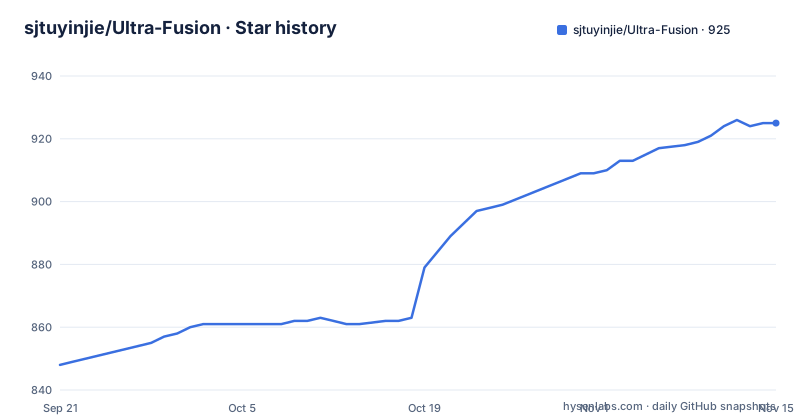
- sjtuyinjie/Ultra-Fusion925 ★ · +77
| Repository | 2026-09-21 | 2026-11-15 |
|---|---|---|
| sjtuyinjie/Ultra-Fusion | 848 | 925 |
77 Stars in the last 55 days, measured from the daily GitHub snapshot. Compare with other projects
Editorial analysis
The repository ships binaries, not source
The most important line in this project is a note, and it is easy to skim past.
The repository currently releases executable binaries and demos. Full source code is promised after paper acceptance. Everything else in the readme, the seven release versions, the benchmark tables, the project website and the video walkthroughs, is built on top of that fact.
So the deliverable is two Debian packages with published checksums, one per ROS generation. The hashes are given in the readme, which is the right thing to publish and the only integrity control you have in the absence of source: if the file you downloaded hashes to the documented value, you at least know you have the artefact the maintainers built.
For an SLAM framework that decides where your robot thinks it is, black-box is a defensible position in a paper-review cycle and an awkward one in a vehicle. If you need to read the estimator, the related implementations the project points at are the way in: Ground-Fusion and Ground-Fusion++ are separate repositories with readable code.
Model weights sit on a Hugging Face collection under the lead contributor's account, and the paper is on arXiv, so the artefacts you can inspect are the weights and the paper, not the optimiser.
Two version lines, two Ubuntu generations, one workflow
The project maintains two release trains in parallel, and the naming tells you which is which.
The ROS1 line is version 0.1.x on ROS Noetic, which means Ubuntu 20.04. The ROS2 line is version 0.2.x on ROS Humble, which means Ubuntu 22.04. Both drive the same node and the same YAML configuration workflow, which is the part that matters: moving between them is a configuration exercise rather than a port.
The release notes are unusually specific, which is a good sign about how the maintainers test. The first ROS1 release shipped prebuilt binaries to reproduce the paper benchmarks. The next added an omnidirectional multi-camera lidar-visual-inertial variant for 360 degree vision with a specific camera rig as the worked example. The following release improved runtime reliability and performance and added map point-cloud export behind a flag rather than by default. The next improved replay stability for the multi-camera rig.
On the ROS2 side, the first Humble release reproduced the same node and YAML workflow on the newer Ubuntu. The next fixed the Humble runtime for one dataset's visual and visual-wheel-inertial configurations and validated the lidar-visual-wheel-inertial path inside a public ROS2 Docker image. The latest brings the newer estimator work and the same opt-in point-cloud export across.
Note the ordering: the most recent tag in the history is a ROS1 patch, three days after the ROS2 line shipped. Both trains are moving.
One optimizer with optional factors, four fusion modes
The method description is short, and the shortness is the point.
Ultra-Fusion timestamp-orders asynchronous sensor streams and converts them into optional factors inside a single sliding-window optimiser, sharing the state representation, the marginalisation and the calibration logic across all of them. Optional is the operative word: a factor can be present or absent at run time, which is how one codebase covers four configurations.
Those configurations are wheel, inertial and odometry; visual, inertial and odometry; lidar, inertial and odometry; and the lidar-visual-inertial combination, with wheel and GNSS fusion available on top and online calibration as an option.
That is what separates the project from a fixed-stack pipeline. A tightly-coupled estimator that ingests its measurements as interchangeable factors can be reconfigured for a different robot by changing which factors exist, rather than by maintaining forks. The stated goal is exactly that: one configurable framework that unifies wheeled, legged and aerial platforms instead of a pipeline limited to one robot or one sensor stack.
The Omnidirectional variant extends the same idea to camera count, using multiple cameras around the vehicle with lidar, with a documented walkthrough for the rig it was developed on.
Degradation is the design target, not an afterthought
The problem the framework names is deployment reality for transportation robots, and it lists the failure modes concretely: poor illumination, lidar degeneracy, wheel slippage and GNSS outage.
Those are four different kinds of failure. Illumination is a camera problem, degeneracy is a geometry problem where the lidar sees too little structure, wheel slippage is a kinematic model problem, and GNSS outage removes an absolute reference. Handling all four inside one estimator, with factors that can be switched off, is the plausible version of the claim.
The evaluation covers five public benchmarks chosen to match those failure modes. M3DGR, from the same maintainer, is a wheeled dataset with real and simulated runs and explicit sensor-degradation stress tests. M2DGR-Plus is a larger wheeled ground dataset from another group. KAIST Complex Urban is large-scale urban driving. GrandTour is legged robots in the wild. MARS-LVIG is aerial.
The reported result is worded carefully, as competitive accuracy together with improved localisation availability under degradation, calibration perturbation and long-duration or high-speed operation. Availability rather than raw accuracy is the interesting claim, since a resilient system can win by not losing track at all. Whether it does is a question for the tables on the project website, not for the summary.
The container pins OpenCV 4.2 and PCL 1.10 from focal
The Dockerfiles tell you what the binaries were built against, which matters more than usual when you are installing a closed binary into your own environment.
The ROS1 image starts from Ubuntu 20.04, adds the ROS apt repository with a dearmored signing key, and then installs a long explicit list of development packages. The OpenCV entries are versioned component packages on the 4.2 line, and the point cloud library entries are the 1.10 series, alongside Eigen, glog, gflags, fmt, SuiteSparse, TBB, Boost threads, Qt5 GUI, and the usual X11 and Mesa graphics stack needed to run a viewer.
That list is a precise record of the build environment and it constrains you. A binary built against OpenCV 4.2 expects that version's ABI, so pairing it with a newer OpenCV from another source is where install problems will appear. Installing the package therefore means accepting the system versions that shipped with that Ubuntu generation.
The build also declares proxy arguments in both cases, both upper and lower case, which is the detail that saves you if you are building behind a corporate proxy and have lost an afternoon to a failed apt step.
There is a second Dockerfile for the ROS2 variant, so the two trains are built from separate images rather than one image with a flag.
Adaptation happens through profiles, and profiles are your only lever
Because the estimator is a binary, the section on adapting it to your device is really the section on what you can configure.
The documented knobs are: the fusion mode itself, camera intrinsics, GNSS fusion, extrinsics, calibration and delay handling, and map point-cloud export. Point-cloud export is described as opt-in and flag-gated in both release lines, so it is off unless you ask for it.
Delay handling deserves specific attention in this project, because spatiotemporal miscalibration is one of the named failure modes alongside degradation and extrinsic errors. The method description says the streams are timestamp-ordered, and the adaptation section has a calibration-and-delays entry, which together suggest that time offsets are first-class configuration rather than something you patch in.
What you cannot do is change the optimiser, the factor set beyond what is exposed, or the robustness machinery. If your robot needs a sensor the four modes do not cover, or a constraint the estimator does not express, your options are to ask the maintainers or to move to a readable implementation.
That is the trade this repository makes, and it is worth being explicit about it before you spend a week configuring rather than debugging.
Verified hashes, a paper, and a promise of source
The distribution story is tidy in a way many research projects are not.
Each release names its runtime, the asset file and a SHA256 digest. The ROS1 asset is a Debian package at version 0.1.3 for the amd64 architecture, and the ROS2 asset is a separate package at 0.2.2, each with its own hash listed in the readme. Publishing both is the minimum you would want from a project distributing binaries rather than source.
The project site carries videos, benchmark tables and interactive demos, and the model weights are on Hugging Face. The paper is linked from the readme with its arXiv identifier, and the stated condition on releasing the source is acceptance of that paper.
On activity: the repository is MIT licensed, the last push was 2026-08-29, and the readme closes with a note that more demos and releases are on the way. The core contributors are four people, with the dataset and the paper leading and the site maintained alongside.
So the honest summary is this. The scope is coherent, the release notes are specific enough to suggest the maintainers run their own regressions, and the packaging is verifiable. What you cannot do today is read the code, and that is the single fact that should decide whether this framework is yours.
Editorial conclusion
Ultra-Fusion fits a team that needs lidar, camera and inertial fusion running on a robot this month, has a ROS stack already chosen, and can treat the estimator as a black box pinned by hash. Skip it if you intend to modify the optimisation, audit the degradation handling, or reproduce the paper tables yourself, because none of that is possible from this repository yet. Before installing, check the checksum of the package you downloaded, match it to your Ubuntu generation, and read the adaptation sections to see whether the parameters you would need to change are actually exposed.
Frequently asked questions
What is Ultra-Fusion?
A tightly-coupled multi-sensor fusion SLAM framework for intelligent transportation systems. It supports WIO, VIO, LIO and LVIO with optional wheel and GNSS fusion and online calibration, running as optional factors inside one sliding-window optimiser.
Can I read the Ultra-Fusion source code?
Not yet. The repository states that it currently releases executable binaries and demos, with full source to follow after paper acceptance. Readable related implementations are Ground-Fusion and Ground-Fusion++.
Which ROS version does Ultra-Fusion support?
Both. ROS1 Noetic on Ubuntu 20.04 is at v0.1.3 and ROS2 Humble on Ubuntu 22.04 is at v0.2.2, and both runtimes share the same YAML-driven uf_node workflow.
How do I verify an Ultra-Fusion release?
The readme publishes SHA256 digests for the Debian assets, one for the ROS1 package and one for the ROS2 package, so you can check the file you downloaded against the documented value.
What benchmarks does Ultra-Fusion report on?
Five public datasets: M3DGR and M2DGR-Plus for wheeled ground SLAM, KAIST Complex Urban for driving, GrandTour for legged robots, and MARS-LVIG for aerial fusion, with the tables and videos on the project website.
Official sources
Add this badge to your README
If you maintain this project, the badge below links readers to this analysis and shows its maintenance status from the daily GitHub snapshot. Paste the markdown into your README; add ?metric=license or ?metric=stars to the image URL for a different field.

[](https://hysenlabs.com/projects/sjtuyinjie-ultra-fusion)Star history chart for your README
[](https://hysenlabs.com/projects/sjtuyinjie-ultra-fusion)Was this useful?