SolidInvoice, two port numbers and one empty database password
Simple and elegant invoicing solution.
At a glance
- What is it?
- An MIT licensed invoicing platform for freelancers and small businesses, with a flat monthly hosted tier attached. The self-hosted and hosted columns of the comparison table differ on eight rows, and only two of them matter. The install instructions name three different ports for the same application, and the bundled compose file starts its database with an empty password.
- Who is it for?
- SolidInvoice is a sensible pick for a freelancer or small team that wants its own database and would rather not hand invoice data to a service. Four things to check first.
- Can I use it commercially?
- Yes. MIT is a permissive licence: you can use, modify and sell software built on it, as long as you keep its copyright and licence notices.
- Is it still maintained?
- Yes. The repository last received commits 1 day ago.
- What is it written in?
- Mainly PHP, according to GitHub's language statistics.
Answers come from the project's GitHub data, last synced on November 15, 2026, and from our analysis. They are not legal advice.
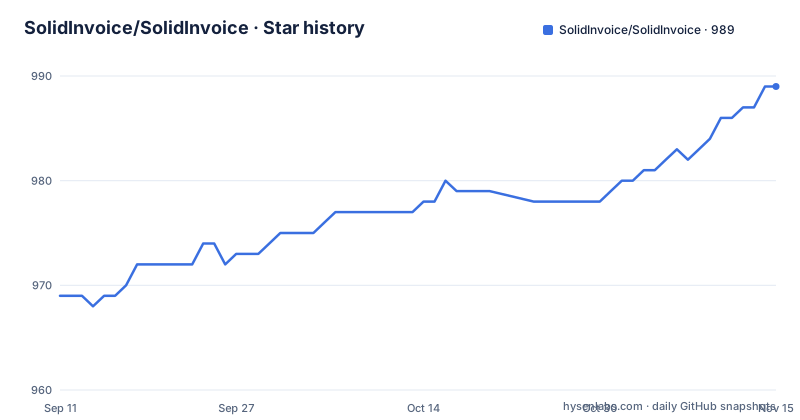
Star history
- SolidInvoice/SolidInvoice989 ★ · +20
| Repository | 2026-09-11 | 2026-11-15 |
|---|---|---|
| SolidInvoice/SolidInvoice | 969 | 989 |
20 Stars in the last 65 days, measured from the daily GitHub snapshot. Compare with other projects
Editorial analysis
The self-hosted and hosted tiers differ on exactly two rows
The comparison table between the free install and the paid hosted service has eight rows, and six of them say the two are the same. Price differs only in that one is free and one is a flat monthly figure with no per-client fees. Data ownership is listed as full on both sides, with export any time on the hosted side too. What separates them is updates, backups, setup, and then two narrower rows. Branding is one: the hosted version has the project's branding removed, the self-hosted version keeps yours. Early access to new features is the other, marked absent for self-hosted and present for hosted. That second row is the real cost of running this yourself, and it is the one to read before choosing. A free MIT project whose paid tier differs mainly in branding and feature timing is a different proposition from one where the paid tier adds capability.
The recommended quick start is the paid one
There are four install routes, and they are numbered. The first is the hosted service at a flat monthly fee, described as the recommended option and as the fastest way to start sending invoices. The other three are self-hosted. Two of those are unusually thin: a single container run, and a self-contained binary that the page says needs no PHP, no web server, and no extensions to install. The fourth is the developer path, a clone followed by a composer install, then a package manager install and a dev run, with a separate command for a production build. So a project published under MIT leads with the route that costs money, and the free routes are the ones further down the page. The hosted table is also the only place the comparison mentions anything about who does the backups, and there it says daily and managed.
Three self-hosted routes, three different ports for one application
The port the application answers on is not consistent across the three self-hosted instructions. The single container run publishes 8080 to port 80 on the host:
docker run -p 8080:80 solidinvoice/solidinvoiceThe compose file publishes 8765 to 8765. The binary route closes by telling you to open localhost on 8765. So a reader who follows the one-line container command and then types the port from the binary section finds nothing, and the page never reconciles the two numbers. The compose file is the route that agrees with the binary, and it is also the only one of the three that names a database at all. The developer requirements line is the fullest statement of what a bare server needs: PHP 8.4 or newer, seven named extensions covering curl, imaging, internationalisation, openssl, database access, soap, and xsl, and either MySQL, MariaDB, or PostgreSQL.
The compose file starts its database with an empty password
The bundled compose file is short, and one setting in it deserves attention. The database service runs an image tagged 8.0, sets a database name, and sets a flag that allows an empty password, with no password anywhere else in the file. The service publishes no port, so the database is reachable only from inside the compose network, which limits how far that setting reaches. The application service pulls the latest image tag, declares a dependency on the database, publishes 8765, and mounts a named volume at the application's data directory. That volume is the practical catch in this file. The page leads with owning every byte of your data, and a compose operation that removes named volumes takes those bytes with it, so the volume name is worth writing down before your first run.
The single binary works because FrankenPHP is in the tree
The claim that the binary needs no PHP, no web server, and no extensions is not a trick, and the repository layout shows how it is done. There is a Caddyfile at the root and a directory named after FrankenPHP, which is a build that carries a PHP runtime and a web server together. Beside them sit a packaging platform configuration file and a packaging directory, which are the conventional artefacts of turning a PHP application into one executable, plus a multi-stage build definition that builds more than one target. So the same codebase produces three genuinely different deployment shapes, and the tree is arranged to make the third one possible. Nothing about the paid hosted tier is required for any of them; the binary is a build target, not a feature that is unlocked.
The frontend install cannot run without composer filling a vendor directory
The JavaScript manifest declares no runtime dependencies, only development ones, and seven of those are file references rather than registry versions. One is a first-party package under the author's own vendor namespace, and six are Symfony UX packages, each pointing into a vendor directory. That directory is populated by the PHP package manager, not by the JavaScript one. The developer instructions do list the PHP install first and the JavaScript install second, so the order given is right, but the consequence stands: a JavaScript install on its own points at paths that do not exist yet. Two other details sit in the same file. Its version is 3.0.1, which matches the newest release, while the repository's default branch is named for a 3.1 line and the readme's own licence badge points at a 3.0 branch, so three different version names are in play.
Four analysis files, two lint configs, and three agent instruction files
The root is crowded with tooling, and some of it overlaps. Static analysis has a configuration, a separate test configuration, and a baseline for each, so four files where one pair would do. JavaScript linting has both an older-style dotfile and a flat configuration file, which is a config style migration left half finished. Git hooks are managed through a hooks package with its own manifest, coverage runs through one service, a second commercial static analysis product has its own configuration file, and the language version pins come to three separate files for PHP, JavaScript, and the package manager. Alongside that tooling sit three agent instruction files, one generic and one each for two named assistants, plus a product description, a design document, a security policy, a translation guide, and an upgrade guide.
Editorial conclusion
SolidInvoice is a sensible pick for a freelancer or small team that wants its own database and would rather not hand invoice data to a service. Four things to check first. The hosted and self-hosted columns are nearly identical, and the two rows that separate them are branding removal and early access to new features, which means the free version can trail the paid one on capability. The install instructions give three different ports for the same application, so read the route you are actually following. The bundled compose file sets a flag that allows an empty database password, which is fine on a laptop and not fine anywhere else. And the JavaScript install cannot run on its own, because seven of its development dependencies are file references into a directory that composer fills.
Frequently asked questions
What is SolidInvoice and who is it for?
It is an open source invoicing platform for freelancers, consultants, and small businesses, under the MIT license. It sends quotes and invoices, takes online payments through bring-your-own gateways, and handles recurring billing. The page describes it as free to self-host forever, with a hosted option at a flat eight dollars a month and no per-client fees.
What is the difference between the self-hosted and hosted SolidInvoice?
The table lists eight rows. Data ownership is full on both sides, and price differs only in that one is free and one is a flat monthly fee. The rows that separate them are branding, which the hosted version removes, and early access to new features, which the self-hosted version does not have. Updates are manual for the free version and automatic for the hosted one, and backups are yours to manage or done daily for you.
How do I install SolidInvoice on my own machine?
Four routes are given: a hosted signup, a single container run, a self-contained binary installed through Homebrew or downloaded and made executable, or a from-source clone. The binary route needs no PHP, no web server, and no extensions. The from-source route runs a PHP package install and then a JavaScript install, with a separate production build command.
Can SolidInvoice run more than one company from one install?
Yes, multi-tenancy is listed as available out of the box, meaning multiple companies from a single install. The privacy section also names encrypted secrets and database-level multi-tenancy filters, and clients carry their own currency, addresses, and contact channels. Full company data export is listed among the integrations.
Does SolidInvoice have an API for other tools to use?
There is a REST API powered by API Platform 4 offering JSON-LD, JSON-HAL, JSON, and XML, with token-based auth through an X-API-TOKEN header. A built-in MCP server with OAuth2 is listed specifically for AI agent automation, and there is also a Meilisearch integration for full-text search across all data.
Official sources
Add this badge to your README
If you maintain this project, the badge below links readers to this analysis and shows its maintenance status from the daily GitHub snapshot. Paste the markdown into your README; add ?metric=license or ?metric=stars to the image URL for a different field.

[](https://hysenlabs.com/projects/solidinvoice-solidinvoice)Star history chart for your README
[](https://hysenlabs.com/projects/solidinvoice-solidinvoice)Was this useful?