speech-swift is an Apple Silicon wrapper around two dozen speech models, and its Apache licence does not reach the weights
AI speech toolkit for Apple Silicon — ASR, TTS, speech-to-speech, VAD, and diarization powered by MLX and CoreML
At a glance
- What is it?
- A Swift package that runs recognition, synthesis, alignment, voice activity detection and diarization on the neural engine and the matrix runtime, wrapping models from a dozen research groups. Three of the models it wraps are non-commercial. Its test target is a hand maintained list of thirty five names.
- Who is it for?
- Adopt it if you need speech on device and you are choosing one model rather than twenty, because the wrapper earns its keep in the streaming and voice activity detection paths and in the real time factors it reports for phone hardware. Two things to check before you commit.
- Can I use it commercially?
- Yes. Apache-2.0 is a permissive licence: you can use, modify and sell software built on it, as long as you keep its copyright and licence notices.
- Is it still maintained?
- Yes. The repository received new commits within the last day.
- What is it written in?
- Mainly Swift, according to GitHub's language statistics.
Answers come from the project's GitHub data, last synced on November 22, 2026, and from our analysis. They are not legal advice.
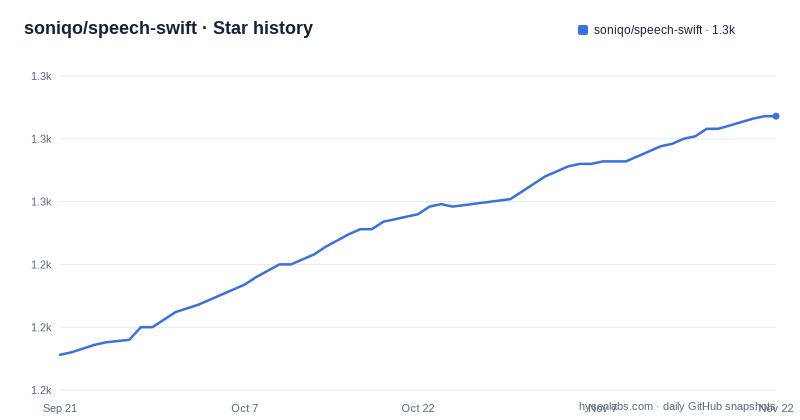
Star history
- soniqo/speech-swift1,284 ★ · +95
| Repository | 2026-09-21 | 2026-11-22 |
|---|---|---|
| soniqo/speech-swift | 1.2k | 1.3k |
95 Stars in the last 62 days, measured from the daily GitHub snapshot. Compare with other projects
Editorial analysis
The Apache licence covers the wrapper and not the models
The project is licensed permissively, and the licence is the natural place to stop reading a repository like this one. It is also the wrong place, because almost nothing in this repository is the author's code.
What the package contains is an interface layer over models built by a dozen other groups, and those models keep their own terms. The synthesis list is explicit about three of them. One voice cloning model is marked as carrying a non-commercial licence. Another, built on a four billion parameter backbone and covering a hundred languages, is marked as research or non-commercial. A third is marked as permissive, with a note that one language needs its diacritic marks supplied.
So the same import gives you a feature whose legality depends on which model you loaded. Two of the higher quality cloning options cannot go into a commercial product regardless of what the wrapper's own licence says, and the README does not hide this, it annotates each entry.
That annotation is the useful part of the catalogue. The failure mode to avoid is assuming that an Apache licensed repository means every artefact reachable through it is Apache licensed.
The test target is a list of thirty five names kept by hand
The makefile has four targets and one of them is much larger than it looks.
The build targets compile the package and then run a shell script that builds a Metal library, in release and debug variants. The clean target delegates to the package manager. The test target depends on the debug build, so running tests always compiles the debug configuration first.
Then it runs the test command with a filter: an alternation of roughly thirty five test names and test class prefixes, joined by pipes. End to end tests are skipped outright.
So the test suite that runs in a normal `make test` is a hand maintained allowlist. A new test file does not run until somebody adds its name to that string, and a renamed test silently stops running. There is a test family in the list whose name suggests it checks the makefile's own selection, which is the project's acknowledgement that the list is a maintenance surface.
Two entries in that list are security test families, one for audio file parsing and one for downloads, which tells you where the project's own risk is. Everything else is unit level, and the end to end tier exists but is not part of the default run.
Three different identities appear across the links
The repository, the model host, the documentation site and the blog do not share a name.
The repository and the documentation site share one name. The models are hosted on a model hub under a different account name entirely, which is the name you will need if you are pulling weights directly rather than through the package. The blog is on a third domain, unrelated to either.
That is not necessarily a problem. Forks, renames and a separate publishing identity are all normal. But it means three things you would want to verify are not verifiable from one place: whether the models on the hub are the ones the package expects, whether the documentation site tracks the current release, and whether the blog describes the same design.
The distribution side has its own naming quirk. The package is called one thing and the Homebrew formula linked in the header is named after a different, shorter word, so searching the package registry and searching the package manager will not obviously find the same artefact.
The readme set is the tidiest part of the header: fourteen languages, and every translation file is at the repository root rather than in a separate directory.
Real time factors are quoted for two different chips in one list
Several model entries carry a real time factor, which is the standard way of expressing how much faster than real time a model runs. The interesting part is that the hardware changes partway through the list and nothing marks where.
Four of the quoted figures are for a phone, specifically a recent professional iPhone, and they are excellent: one for a language count in the thousands on a multimodal alignment model, one for streaming dictation, one for a compact synthesis model, and one for a flow matching synthesis model. One figure is quoted for a desktop chip, a different generation, and it is the best number in the list.
So a reader comparing entries is comparing a phone against a laptop without being told the switch has happened. The phone figures are the more interesting ones, since on-device phone inference is where the neural engine actually matters, and they are the reason to care about the wrapper at all.
The figures are also attached to a model and a hardware pair, not to the framework. A different quantization of the same model will land somewhere else, and the next section explains why that is not a hypothetical.
Supported means something different for every model
The catalogue lists each model with its precision formats, and the list is not uniform.
One recognition entry is offered in half precision, a five-bit and an eight-bit integer format. Another is offered in half and eight-bit. One synthesis model is offered in half precision at one size and eight-bit at another. One is offered as a compiled neural engine model at ninety-nine million parameters with a stated sample rate and a claim that it needs no grapheme to phoneme step at all. One is offered at two sizes, a half precision bundle of a given class, or a much smaller neural engine build with fifty four voices.
The runtime is also per model. Some entries run on the matrix runtime, some on a compiled neural engine model, and some are offered both ways with two different file sizes. Two backends with different numerics mean two different behaviours on the same input.
This is a real usability problem and it is also the value. A package that exposed one uniform interface over twenty models with one precision would be less useful and less honest. Here the variation is in the data, so a caller can read it, and the file sizes in the catalogue are enough to reason about what a phone will download.
Diarization appears once as a model feature and once as a capability group
The toolkit is described as covering five things: recognition, synthesis, speech to speech, voice activity detection, and diarization. The catalogue then organises everything into nine capability groups, and the last of those groups is a bundle: wake word, voice activity detection, diarization and speaker identity together.
That grouping is worth noting because it says the project itself is not sure those four are separate concerns, or because they share the same plumbing: an audio stream, a decision about who is speaking and whether anyone is, and a threshold.
Meanwhile one recognition model in the catalogue generates speaker labels itself, described as offline transcription with model-generated speaker labels and timestamps, using a very long context window on the matrix runtime. So diarization is available both as a standalone toolkit capability and as something a particular model does internally, and those are different code paths with different accuracy characteristics.
The alignment capability is the quiet one: a forced aligner that takes audio and text and returns word-level timestamps. That is the piece most useful for subtitles and for anyone syncing text to a recording, and it is a single line in the catalogue.
A transcript file and three agent instruction files sit at the root
The top level of the repository is larger than a Swift package needs to be, and the entries say why.
There are three instruction files for coding agents, one for each of three tools, plus the two dot directories those tools read from. That is a project that has committed to being worked on by assistants and has chosen to keep the instructions in the repository rather than in each tool's own configuration.
Next to them is a plain text file named as a transcript, sitting at the repository root with no directory and no explanation. Whatever produced it, it is an artefact of a run rather than part of the package, and it is the kind of file that should be ignored by the packaging or deleted.
The rest is conventional for a package of this size: a package manifest, a makefile, a sources directory, a tests directory, a documentation directory, a scripts directory holding the metal library build, a licence, a contributing guide, and a registry metadata file for the Swift package index.
The examples directory breaks the convention, though. It is capitalised while its siblings are not, and it holds six demo directories plus a single HTML file sitting loose at the top with no directory of its own.
Sixteen downstream projects, described as verifiable
The readme lists sixteen public projects that use this package, under a heading that claims each one has a verifiable package reference. That word is doing work: it distinguishes a dependency you can check in a manifest from a mention in a blog post.
The list is a good sample of what people build on it. A document chat application, a voice agent framework, several dictation tools for the desktop, a recorder with transcription, a watchtower style monitor, a speech to speech demo, and a personal assistant bot. Several are small personal projects rather than products, which is what an early package with twenty models behind it tends to attract.
Two of the entries are recognisable large projects and the rest are not, and none of the sixteen carries a version constraint, a quote or a description. So the list tells you the package has reached sixteen projects and tells you nothing about whether any of them are still maintained.
The release record answers the maturity question better than the list does. Three releases are visible, all in the zero hundredths, spaced a couple of weeks apart, with the last commit days after the newest tag. A package at that version is pre one by its own numbering, and the cadence says it is moving fast.
Editorial conclusion
Adopt it if you need speech on device and you are choosing one model rather than twenty, because the wrapper earns its keep in the streaming and voice activity detection paths and in the real time factors it reports for phone hardware. Two things to check before you commit. The project licence covers the wrapper and not the weights, and two of the synthesis models it lists are research or non-commercial, so a voice feature can be blocked by a model choice rather than by your code. And the test target is a list of test names kept by hand, so a new test file will not run until somebody edits the makefile.
Frequently asked questions
What is the licence of the models that speech-swift wraps?
It varies by model and is annotated per entry. One voice cloning model is listed as non-commercial, another as research or non-commercial, and another as permissive, so the project's own Apache licence does not grant what every reachable model permits.
What does make test actually run in speech-swift?
A debug build followed by the test command with a filter listing roughly thirty five test names, with end to end tests skipped. New tests do not run until their name is added to that list by hand.
Which runtimes does speech-swift use on Apple Silicon?
Two, and the choice is per model rather than global. Some models run on the matrix runtime and some as compiled neural engine models, with several offered both ways at different file sizes.
Which hardware are the real time factors in the speech-swift catalogue measured on?
Two different ones. Several entries quote a recent professional iPhone and one quotes a current generation desktop chip, and the catalogue does not mark where the hardware changes.
Where can I find the models used by speech-swift?
On a model hub under an account name that is not the repository's name, which is the identity you need if you pull weights directly rather than through the package.
Official sources
Where developers are discussing it
Posts on Hacker News, dev.to and Lobsters that link to this repository, found by our scan of those communities. 0 in the last 30 days; newest first.
- Kyutai's stream speech recognition on Apple Silicon with MLXHacker News · Oct 16, 2026 · 3 points · 0 comments
Add this badge to your README
If you maintain this project, the badge below links readers to this analysis and shows its maintenance status from the daily GitHub snapshot. Paste the markdown into your README; add ?metric=license or ?metric=stars to the image URL for a different field.

[](https://hysenlabs.com/projects/soniqo-speech-swift)Star history chart for your README
[](https://hysenlabs.com/projects/soniqo-speech-swift)Was this useful?