Step-Audio-EditX pins vLLM to a release candidate wheel and marks training code unreleased while checking three of its four trainers
A powerful 3B-parameter, LLM-based Reinforcement Learning audio edit model excels at editing emotion, speaking style, and paralinguistics, and features robust zero-shot text-to-speech
At a glance
- What is it?
- Step-Audio-EditX is a 3B-parameter, reinforcement-learning audio model for editing emotion, speaking style, and paralinguistics, with zero-shot speech synthesis as a second use. The model code, weights, and tokenizer are published across two model hubs. What is not settled is the release bookkeeping: the open-source plan contradicts itself on training code, the feature tables and the news entries disagree on how many paralinguistic tags exist, and the dependency set pins vLLM to a single development wheel for one CPU architecture.
- Who is it for?
- Step-Audio-EditX is a research release with its weights published and its training story still in flux, and the two should be judged separately. Use the inference path if you want tag-driven editing or zero-shot cloning in Mandarin, English, Sichuanese, or Cantonese, and read the example prompt files first, since they name capabilities the feature list does not mention.
- Can I use it commercially?
- Yes. Apache-2.0 is a permissive licence: you can use, modify and sell software built on it, as long as you keep its copyright and licence notices.
- Is it still maintained?
- Activity is slowing. The repository last received commits 7 months ago.
- What is it written in?
- Mainly Python, according to GitHub's language statistics.
Answers come from the project's GitHub data, last synced on November 22, 2026, and from our analysis. They are not legal advice.
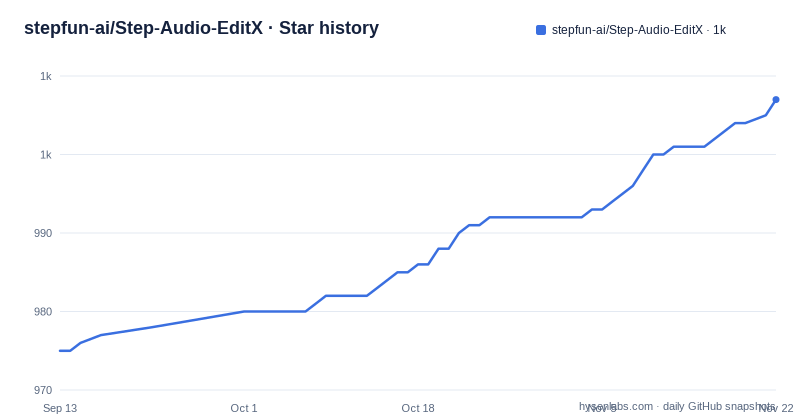
Star history
- stepfun-ai/Step-Audio-EditX1,007 ★ · +32
| Repository | 2026-09-13 | 2026-11-22 |
|---|---|---|
| stepfun-ai/Step-Audio-EditX | 975 | 1k |
32 Stars in the last 70 days, measured from the daily GitHub snapshot. Compare with other projects
Editorial analysis
The open-source plan checks three trainers while marking training code unreleased
The release checklist at the top of the file is the most reliable status document here, and it does not agree with the news entries above it. Four items are checked: inference code, the online demo described as Gradio, the benchmark, and model checkpoints. Under checkpoints, three are checked, the tokenizer, the model, and an Int4 quantized variant. Under training code, the parent item itself is unchecked while three children are checked, SFT, DPO, and GRPO, and the fourth child, PPO, is unchecked. So the checklist says the training code is not released while listing three trainers as released, and the news entry for Jan 29, 2026 says the SFT, DPO, and GRPO training code was released and that training and inference for vLLM are supported. Both readings can be true at once only if the checklist parent was simply never ticked. The same pattern runs through the feature plan. Under editing, polyphonic pronunciation control and more paralinguistic tags are checked while filler word removal is not. Under other languages, Japanese and Korean are checked while Arabic, French, Russian, and Spanish are not. The item describing additional emotion and speaking styles ends with a note that more are on the way, which is a promise rather than a checkbox.
The feature list and the news entry count paralinguistic tags differently
The paralinguistic section claims precise control over 10 types and then lists them: Breathing, Laughter, Surprise-oh, Confirmation-en, Uhm, Surprise-ah, Surprise-wa, Sigh, Question-ei, and Dissatisfaction-hnn. The Jan 29, 2026 news entry says more paralinguistic tags were added, naming exhale, snort, inhale, chuckle, clears throat, and giggle, six more on top of whatever was there, and the plan entry for the same feature says more tags were added with Cough, Crying, and Stress as examples. Those two lists cannot both be the current set, because the feature section still presents exactly ten. The naming conventions also diverge. The ten in the feature section are either single words or hyphenated compounds where the suffix encodes the vowel, so Surprise-oh, Confirmation-en, Question-ei, and Dissatisfaction-hnn. The six added later are plain words and two-word phrases, and clears throat is a phrase with a space in a field that otherwise takes single tokens. Anyone scripting against this model has to reconcile two vocabularies, and the file does not say which one the current weights expect. The emotion and speaking style tables follow a third convention, lower-case single tokens such as happy, angry, fear, and serious.
vLLM comes from one pinned development wheel built for x86_64
The dependency set does not name a vLLM version. It redirects to a specific wheel URL under the tool.uv sources table, and that URL carries the version in its filename: vllm 0.14.0rc2.dev125 with a build tag naming a commit. This is a release candidate development build, pinned by commit hash, so the version cannot drift and also cannot be patched or upgraded without editing the manifest. The wheel is tagged cp38-abi3 for manylinux 2.31 on x86_64, which fixes the interpreter compatibility floor at 3.8 and, more importantly, the architecture. There is no aarch64 or arm64 wheel in the dependency configuration, so on Apple silicon the resolution has to come from elsewhere or not at all. Alongside that, the tool.uv table sets index-strategy to unsafe-best-match, which tells the resolver to search multiple indexes and take the best match rather than the first. Both settings trade reproducibility for convenience, and the project needs the convenience: an inference stack this size has many overlapping version constraints. The manifest also carries a uv.lock, so a working resolution does exist and can be reused, which is the mitigation for both settings.
Two different packages both called whisper are required
The dependency list contains openai-whisper at 20250625 or later and whisper at 1.1.10 or later, which are two separately published projects whose names differ only by a prefix. There is a whisper_wrapper.py module at the repository root, so the boundary between them is enforced in code rather than by the dependency names, and reading that file is the only way to tell which one the inference path actually uses. The same shape appears elsewhere. funasr at 1.3.0 or later is required while a directory named funasr_detach sits at the root, which suggests a local arrangement around the upstream package. onnxruntime-gpu is required, and there is a stepvocoder directory and a tokenizer.py at the root. Two dependencies are harder to place. pytorch-memlab is a memory debugging tool and is listed as a runtime requirement rather than a development one, so it is installed for anyone who installs the package. hdbscan is a clustering library required at 0.8.41 or later, and no feature in the visible documentation describes clustering. The training and serving stack is equally wide: torch at 2.9.1 or later, torchaudio, torchvision, accelerate, bitsandbytes, deepspeed, trl for the trainers, llmcompressor for quantization, datasets, wandb, diffusers, and spaces for the hosted demo.
The container base is CUDA 12.4.1 while a dependency asks for the 12.8 runtime
The Dockerfile starts from nvidia/cuda:12.4.1-cudnn-runtime on ubuntu 22.04 and, inside that image, installs Python 3.12 from the deadsnakes PPA with a comment noting that the manifest requires at least 3.12 and below 3.14. Two things follow. The manifest window allows 3.13, and the image pins 3.12, so the image is the lower edge of the supported range rather than the middle of it. And the dependency list asks for nvidia-cuda-nvrtc-cu12 at 12.8.93 or later alongside a bare cuda-toolkit, which is a newer CUDA runtime than the 12.4.1 the base image provides, so the nvrtc component is installed by the package manager on top of the image's own runtime rather than matching it. The rest of the image is ordinary. A build toolchain and git-lfs, awscli, openssh-server, vim, and networking utilities go in first, ca-certificates are reinstalled and updated separately, and the package manager is uv itself, installed by piping a remote script into a shell. The timezone is pinned to Asia/Shanghai, which matters for anyone comparing logs or timestamps. The entrypoint is the only documented command line surface:
uv run python app.py --model-path /model --model-source localwhich tells you the container expects weights mounted at /model and a source argument of local.
Editing is steered by bracketed tags and inline pinyin
The control surface is text, which is the clearest part of the design. To change the delivery, a bracketed tag goes in front of the input, with Sichuanese, Cantonese, Japanese, and Korean named as the values, and the same mechanism selects a dialect or an added language rather than requiring a separate model. Polyphonic pronunciation is handled by rewriting the ambiguous characters as pinyin inside the sentence, so a phrase with several instances of one polyphonic character becomes the tone-marked form written out, with the number carrying the tone. That means the caller does the disambiguation rather than the model, which removes a class of error and moves it into the caller. Emotion and speaking style are named lists rather than free-form prompts, with emotions including angry, happy, sad, excited, fearful, surprised, disgusted, confusion, empathy, embarrass, depressed, admiration, coldness, humour, and fear, and styles including act_coy, older, child, whisper, serious, generous, exaggerated, serious, arrogant, girl, pure, sister, and sweet. The style names are less a vocabulary than a set of personas, and the document says control is iterative, that dozens of options are supported, and that more are on the way.
The example filenames name capabilities the feature list does not mention
The examples directory is the best inventory of what the code does, and it disagrees with the feature sections in useful ways. It ships denoise_prompt.wav, vad_prompt.wav, speed_prompt.wav, and whisper_prompt.wav, four capabilities that appear nowhere in the visible feature list, alongside the ones that do, including en_happy_prompt.wav, zero_shot_en_prompt.wav, fear_zh_female_prompt.wav, and paralingustic_prompt.wav. Denoising, voice activity detection, and speed control are real paths through this model, and the one word filename for paralinguistics is misspelled, which is a small indication that these files were added as the pipeline grew. There is a text.txt alongside the audio, so the examples pair an input sample with its transcript. Evaluation is not in this repository. The benchmark was released separately as Step-Audio-Edit-Benchmark on its own, and the improvement claim attached to the Jan 29, 2026 model release is an overall improvement of over 4% with no metric, baseline, or dataset named in the same sentence. Anyone wanting to know whether a release is better has to go and read the other repository.
Weights are published on two model hubs and the repository has no releases
There is nothing to download from the repository itself, because it has no GitHub releases, and the visible documentation contains no shell command for installation. Weights are published on HuggingFace and on ModelScope, and the tokenizer ships as its own artifact named Step-Audio-Tokenizer on both, separately from the model. An Int4 quantized checkpoint is published alongside the full one, which matches the llmcompressor and bitsandbytes entries in the dependency set. Three checkpoints, two hubs, two components. The research write-up is on arXiv as 2511.03601, and the release dates in the news section give the sequence: technical report on Nov 6, 2025, code, weights, and tokenizer on Nov 12, a new model version with polyphonic control on Nov 19, the separate benchmark on Nov 23, Japanese and Korean on Nov 28, and the January 29, 2026 update with the six extra paralinguistic tags, the trainers, and vLLM support. After that the news stops, while the default branch was last pushed on 2026-04-09. For interaction there is a demo page, a HuggingFace Space, and a hosted editing tab on the vendor's audio studio. The only community channel named is a WeChat developer group.
Editorial conclusion
Step-Audio-EditX is a research release with its weights published and its training story still in flux, and the two should be judged separately. Use the inference path if you want tag-driven editing or zero-shot cloning in Mandarin, English, Sichuanese, or Cantonese, and read the example prompt files first, since they name capabilities the feature list does not mention. Do not plan around the training code. The plan marks the training code parent item unchecked while checking SFT, DPO, and GRPO beneath it, so which trainers you can actually run has to be read off the repository rather than off the checklist. Before you build, verify three things yourself. That your Python falls in the declared window of 3.12 up to but not including 3.14. That the CUDA runtime in your image matches what the nvrtc dependency asks for, since the container base is 12.4.1 and a dependency asks for 12.8.93. And that your platform is x86_64 Linux, because the pinned vLLM wheel is a development build for that platform only.
Frequently asked questions
What is Step-Audio-EditX?
It is a 3B-parameter, large language model based audio model built with reinforcement learning, specialized for expressive and iterative editing of emotion, speaking style, and paralinguistics, and it also does zero-shot speech synthesis. It is written in Python and licensed Apache-2.0.
Which languages does Step-Audio-EditX support?
Zero-shot cloning covers Mandarin, English, Sichuanese, and Cantonese, and Japanese and Korean were added on Nov 28, 2025. A dialect or added language is chosen by putting a bracketed tag in front of the input text, while Arabic, French, Russian, and Spanish remain unchecked in the feature plan.
What training code has Step-Audio-EditX released?
The Jan 29, 2026 entry states that the SFT, DPO, and GRPO training code was released, along with vLLM support for training and inference, and PPO remains unchecked. The parent training code item in the open-source plan is itself left unchecked even though those three children are ticked.
How do I get the Step-Audio-EditX weights and tokenizer?
Both the model and the tokenizer are published on HuggingFace and on ModelScope, with the tokenizer as a separate artifact named Step-Audio-Tokenizer, and an Int4 quantized checkpoint is offered beside the full one. The repository itself has no GitHub releases.
What Python and CUDA versions does Step-Audio-EditX need?
The manifest declares requires-python of at least 3.12 and below 3.14, and the Dockerfile builds from nvidia/cuda:12.4.1-cudnn-runtime on ubuntu 22.04 with Python 3.12 installed from the deadsnakes PPA. One dependency asks for the nvrtc CUDA 12 runtime at 12.8.93 or later, which is newer than the image's own 12.4.1.
How does Step-Audio-EditX control polyphonic pronunciation?
By rewriting the ambiguous characters in the input text as pinyin, so the caller performs the disambiguation. The documented example turns a phrase with repeated polyphonic characters into the tone-marked pinyin form written inline in the sentence.
Official sources
Add this badge to your README
If you maintain this project, the badge below links readers to this analysis and shows its maintenance status from the daily GitHub snapshot. Paste the markdown into your README; add ?metric=license or ?metric=stars to the image URL for a different field.

[](https://hysenlabs.com/projects/stepfun-ai-step-audio-editx)Star history chart for your README
[](https://hysenlabs.com/projects/stepfun-ai-step-audio-editx)Was this useful?