superiorlu/AITreasureBox: a catalog that says its own text was translated from ChatGPT and re-ranks its rows every two hours
Automatically collected AI repos, tools, websites, papers & tutorials -- a practical AI treasure box.
At a glance
- What is it?
- A five-section list of AI repositories, tools, websites, papers and tutorials, refreshed on a two-hour cycle that updates star counts and re-ranks rows automatically, with no releases and a history consisting only of those refresh commits. The front page states that the writing was translated from ChatGPT and the pictures came from Midjourney, the descriptions are the projects' own taglines rather than curated notes, and the repository's primary language is Ruby with no manifest anywhere in the tree.
- Who is it for?
- Treat this as a starting index rather than a recommendation list, and read the provenance line before you read the rows. The document says its text was translated from ChatGPT and its images came from an image generator, and the descriptions are each project's own one-line tagline rather than anything the maintainer verified.
- Can I use it commercially?
- Yes, with conditions. GPL-3.0 is a copyleft licence: if you distribute software that includes it, you must release that software's source code under the same licence. Running it internally without distributing it does not trigger that obligation.
- Is it still maintained?
- Yes. The repository received new commits within the last day.
- What is it written in?
- Mainly Ruby, according to GitHub's language statistics.
Answers come from the project's GitHub data, last synced on November 15, 2026, and from our analysis. They are not legal advice.
Star history
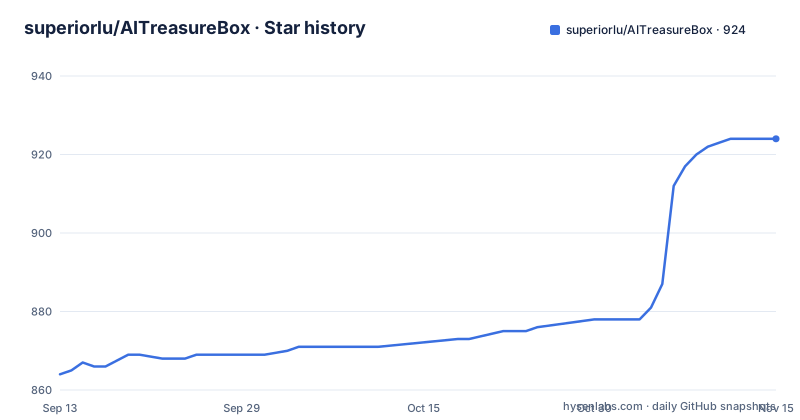
- superiorlu/AITreasureBox924 ★ · +60
| Repository | 2026-09-13 | 2026-11-15 |
|---|---|---|
| superiorlu/AITreasureBox | 864 | 924 |
60 Stars in the last 63 days, measured from the daily GitHub snapshot. Compare with other projects
Editorial analysis
The front page states that its own text was translated from ChatGPT
Two lines near the top of the document settle most of the questions a reader would have about its contents. The first describes the project as collecting practical AI repos, tools, websites, papers and tutorials. The second says the text was translated from ChatGPT and the picture came from Midjourney. That is a provenance statement, not a decoration, and it is the most consequential sentence in the file. It means the descriptions were not written and checked by the maintainer. It also means the images are generated rather than screenshots or logos, so an entry has no visual identity of its own. Set against that, the licence is GPL-3.0 with a LICENSE file at the root, which is a copyleft grant applied to a document whose prose came out of a proprietary model and whose pictures came out of a proprietary image model. The licence covers what the maintainer can license. It does not say anything about the hundreds of other projects the table links to, each of which carries its own terms.
A two-hour refresh that re-ranks the table and ships no release
A single line above the repos table sets the operating model: repos and stars are updated every two hours, and the table is re-ranked automatically. That one sentence changes how everything else in the document should be read. The first column is numbered, which invites treating a position as an identifier, and a position is exactly what re-ranking destroys. If row 7 today was row 12 last month, then citing this list by row number is citing nothing. It also implies that the commits themselves are the refresh, and there is no release in the repository at all, so there is no tag, no version, and no point at which a reader can say which snapshot they saw. The visible history is a two-hourly diff. On a table where rows move, such a diff is large and semantically empty: it reads as a wall of changed line numbers with a few real additions. The practical consequence is that the git history of this repository cannot be used to find out when a project was added or dropped, only that something changed at a timestamp.
The index column mixes sequence numbers with an unexplained star marker
The first column is headed No. and is the narrowest of the three, given a 30-pixel width in the header markup. It holds integers, and it also holds a star marker in front of some of them. Three visible rows carry that marker rather than a plain number: the entry for an agentic skills framework at position 7, a personal directory of skills at position 9, and a repository about writing less code at position 32. Nothing on the page says what earns the mark. There is no legend, no footnote and no threshold, and the marker is not defined in the catalog's five section links either. Meanwhile the line above the table says stars are updated every two hours, and the table has no star count column at all, only this marker. So the document tells you it maintains a number it does not display, and displays a symbol it does not define. A mixed-type column where some rows carry an unexplained prefix is also the kind of thing a reader will copy into their own notes as if it meant something.
The descriptions are the projects' own taglines, not curated notes
Read the description column closely and a pattern appears: the text is upstream. The entry for recreating technologies from scratch carries that project's own one-line pitch. The React framework is described as the React Framework. The editor is described in three words, Visual Studio Code, while the row above it has a sentence and a half about converting office documents to Markdown. So the column mixes two things: some descriptions are the project's registered tagline copied verbatim, and the length ranges from three words to roughly forty. If the whole column were machine-translated you would expect uniform phrasing, and you do not get that. What you get is a mixture, which is consistent with the stated method: whatever a language model reproduced from each project's page, kept as found. That has a specific consequence for a reader. A tagline is marketing copy written by the project's authors about their own project, so a table of taglines conveys enthusiasm rather than assessment, and the ranking that orders those taglines was produced by a script the page does not describe.
The AI table contains a proxy client and a video downloader
The repos section is presented as the AI portion of the catalog, and a few rows do not fit that description. Position 34 is a continuation of a Clash Verge project, described as a Clash Meta graphical interface built on Tauri for Windows, macOS and Linux, which is a network proxy client and not an AI repository. Position 17 is a command-line audio and video downloader. Position 18 is a code editor. Position 37 is a web framework. All four are reasonable things for a developer to want, and all four appear in the same numbered table as the agent frameworks and model runtimes, with no column distinguishing them. The table also mixes levels of the stack in one list: a machine learning framework, a low-code application builder, a workflow automation tool, an inference runtime, a stable diffusion interface, a prompt directory, and now a proxy client. There is no second table for infrastructure and no tag column, so the only way to find the agent tooling is to read the descriptions.
One entry is a catalogue of system prompts taken from commercial products
Position 36 deserves separate attention because of what it indexes rather than what it is. Its description announces full system prompts, tools and models for a named list of commercial AI coding and browsing products, alongside the claim that the collection is open sourced. Position 13 sits next to it as a single instruction file derived from one developer's observations on large language model coding pitfalls. Position 25 is a prompt directory that also offers self-hosting for organisations that want privacy. So a meaningful slice of this catalog is made up of repositories whose product is the extracted or reproduced prompts of somebody else's product, which is a different kind of artefact from an open-source tool and carries a different set of questions. None of that is a reason to skip the list, and this article makes no claim about any individual project in it. It is a reason to notice that the table applies one ranking and one presentation to entries with very different provenance.
Primary language Ruby, with no manifest and no entry point in the tree
The repository metadata reports Ruby as the primary language, and the top-level file list has one code directory in it. There is a .github directory, a LICENSE, the two language versions of the readme, an images directory and lib/. That is the whole inventory. There is no Gemfile, no gemspec, no Rakefile, no bin directory, no script directory, no package manifest and no lockfile of any kind. So whatever runs every two hours to fetch repositories and rewrite the table is Ruby code living under lib/ with nothing in the repository declaring what it needs, how to run it, or what version of Ruby it targets. That matters for anyone who wants to fix a broken entry, add a category, or understand why a row moved: the mechanism is not inspectable from what is published. It also explains the two-hour commit cadence without needing any further explanation.
Markdown tables with hard-coded pixel widths and one row formatted differently
The tables are written as raw HTML inside markdown, and the header row carries width attributes on every cell: 30 pixels for the index column, 250 for the repository name and 400 for the description. On GitHub those attributes do nothing, so the widths that were chosen for somewhere else survive as dead markup. The same pattern appears in a centred paragraph element near the title that carries an id attribute and contains nothing. Formatting consistency is also not uniform. Rows 1 through 27 and 29 onward close the repository cell with a line break tag followed by a single space before the pipe, while row 28 closes it with a long run of spaces and no separating space, and its description runs considerably longer than most in the table. Those are small blemishes individually and the natural signature of a document rewritten by a script rather than by hand, which is consistent with the rest of what the page says about itself.
Editorial conclusion
Treat this as a starting index rather than a recommendation list, and read the provenance line before you read the rows. The document says its text was translated from ChatGPT and its images came from an image generator, and the descriptions are each project's own one-line tagline rather than anything the maintainer verified. The refresh cycle rewrites rows and re-ranks them every two hours, so the sequence numbers are positions and not identifiers, and no row can be cited by where it sat. That also means the git history is a two-hourly diff rather than a record of editorial decisions. Two things to check specifically. Three rows carry a star marker in the index column with no stated threshold, and the note above the table claims star counts are updated while the table has no star column, so the marker's meaning is not recoverable from the page. And one entry in the list is a catalogue of system prompts extracted from commercial AI products, which is worth a separate look on your own terms rather than on this page's authority. For a fast survey of what exists in the ecosystem this is fast and current. For curation, licensing decisions, or anything you intend to depend on, none of it is here.
Frequently asked questions
What is in the AITreasureBox catalog?
Five sections: Repos, Tools, Websites, Report&Paper, and Tutorials, covering AI repositories, tools, websites, papers and tutorials. The repos section says it updates repositories and star counts every two hours and re-ranks rows automatically.
Who wrote the text in AITreasureBox?
The page states that the content was translated from ChatGPT and that the picture came from Midjourney. The repository is licensed GPL-3.0 with a LICENSE file at the root, and the descriptions in the repos table are the listed projects' own taglines rather than notes written by the maintainer.
How do I contribute or run the update script?
The published tree contains a .github directory, LICENSE, README.md, README.zh-CN.md, an images directory and lib/, with no Gemfile, gemspec, Rakefile, script directory or lockfile. The repository has no GitHub releases, and the primary language reported is Ruby. Nothing in the tree declares how the two-hour refresh is invoked.
Official sources
Add this badge to your README
If you maintain this project, the badge below links readers to this analysis and shows its maintenance status from the daily GitHub snapshot. Paste the markdown into your README; add ?metric=license or ?metric=stars to the image URL for a different field.

[](https://hysenlabs.com/projects/superiorlu-aitreasurebox)Star history chart for your README
[](https://hysenlabs.com/projects/superiorlu-aitreasurebox)Was this useful?