tach: the repository moved to tach-org and the links still say gauge-sh
A Python tool to visualize + enforce dependencies, using modular architecture 🌎 Open source 🐍 Installable via pip 🔧 Able to be adopted incrementally - ⚡ Implemented with no runtime impact ♾️ Interoperable with your existing systems 🦀 Written in rust
At a glance
- What is it?
- A boundary enforcer for Python projects, written in Rust and installed with pip, that checks that imports respect declared dependencies, public interfaces and an acyclic graph. The implementation tells more than the feature list does: Python is parsed by five ruff crates pinned to one tag, the native module defaults to a pyo3 extension module, and the web graph option uploads your configuration file.
- Who is it for?
- tach is for a codebase that has outgrown its import discipline and where a rewrite is not on the table, because its selling point is that it can be adopted module by module and runs entirely at check time with no runtime component. Two things make it more than a lint rule.
- Can I use it commercially?
- Yes. MIT is a permissive licence: you can use, modify and sell software built on it, as long as you keep its copyright and licence notices.
- Is it still maintained?
- Yes. The repository last received commits 24 days ago.
- What is it written in?
- Mainly Rust, according to GitHub's language statistics.
Answers come from the project's GitHub data, last synced on November 22, 2026, and from our analysis. They are not legal advice.
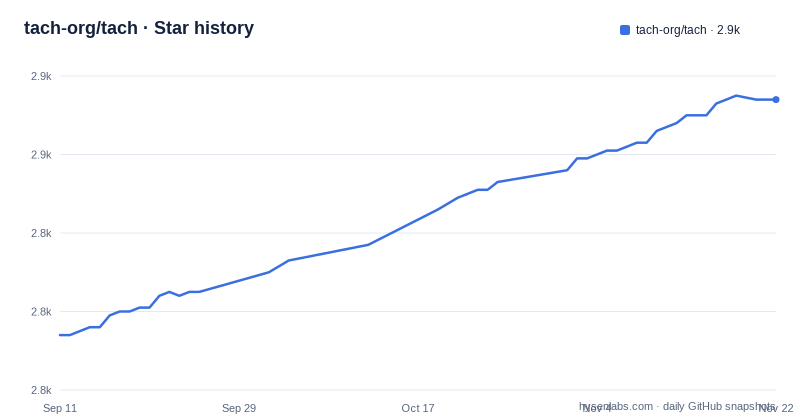
Star history
- tach-org/tach2,874 ★ · +60
| Repository | 2026-09-11 | 2026-11-22 |
|---|---|---|
| tach-org/tach | 2.8k | 2.9k |
60 Stars in the last 72 days, measured from the daily GitHub snapshot. Compare with other projects
Editorial analysis
The repository is tach-org/tach and the documentation still points at gauge-sh
The project moved and the navigation did not. The repository is `tach-org/tach`, while the continuous integration badge resolves to a workflow in `github.com/gauge-sh/tach`, the contributors graph links to the same older path, and the invitation to open an issue goes to `github.com/gauge-sh/tach/issues`. The documentation site is `docs.gauge.sh`, and every documentation link in the page uses that host. The editor integration is a further step removed: the README points at a marketplace extension published under a third party's name rather than one built from this repository. Version numbers, by contrast, are consistent across the two manifests and the release record: both `Cargo.toml` and `pyproject.toml` carry 0.35.2, the newest release is v0.35.2, and its publication time matches the last push to the default branch to the minute. So the code and the tags agree, and only the outbound links lag behind the move.
Python is parsed by five ruff crates, all pinned to the tag 0.16.7
The Rust side does its own parsing, and it does it with ruff's internals rather than with a Python bridge:
ruff_python_ast = { git = "https://github.com/astral-sh/ruff.git", package = "ruff_python_ast", tag = "0.16.7" }
ruff_python_parser = { git = "https://github.com/astral-sh/ruff.git", package = "ruff_python_parser", tag = "0.16.7" }
ruff_linter = { git = "https://github.com/astral-sh/ruff.git", package = "ruff_linter", tag = "0.16.7" }
Five crates are taken from the ruff repository by git tag rather than from a registry, and the development group pins the Python side to the same version with `ruff==0.16.7`, so the parser and the linter a developer runs locally cannot drift apart. The wider dependency style is the opposite of Cargo's default. Every entry carries an exact patch version with no caret, `regex = "1.12.3"`, `once_cell = "1.21.4"`, `toml = "1.0.6"`, `serde_json = "1.0.149"` and so on, which means a routine security bump is an edit to the manifest rather than a resolution against a range.
The crate defaults to a pyo3 extension module built for abi3-py37
The packaging choices explain why a `pip install tach` gives you a native module. The library target is declared as both a `cdylib` and a `lib`, built through pyo3 with the `abi3-py37` feature, so the compiled object uses the stable ABI and stays loadable on interpreters from 3.7 upwards. The Python side then raises the floor: `requires-python` is `>=3.10` and the classifiers run from 3.10 to 3.15. Those two numbers are not in conflict, but they are chosen for different reasons, and the binary is deliberately broader than the package claims to support. The feature table is the other half of the story. `extension-module` is a feature that forwards to pyo3, and it is in the default set, so a default build produces something meant to be imported by Python rather than linked by another Rust program. A `profiling` profile inherits release settings with debug info turned on, which the Makefile uses through maturin.
tach show --web is documented as generating the graph remotely
The visualization command has two modes and the documentation separates them explicitly:
tach show [--web]Plain `tach show` writes a GraphViz DOT file named `tach_module_graph.dot` into the working directory, which is the form you can render locally. The note attached to the web mode says the graph is generated remotely with the contents of your `tach.toml`, so the module names, the dependency edges and any paths that appear in that file leave the machine when that flag is used. That is the only remote step described anywhere in the workflow; `tach check` and `tach report` are described in purely local terms. `tach report` is the third command and prints both directions for a given path, dependencies and usages, each entry as a file, a line number and the import that caused it, so the same report answers both what a module reaches and what reaches it.
tach init is an arrow key file tree, and source roots are a separate keypress
Setup is interactive rather than declarative. `tach init` prints an introductory message and opens a file tree where the arrow keys navigate and Enter marks a module boundary; you can mark every top level Python package or only a few. A different key, `s`, marks Python source roots, which is the setting that matters when code does not sit at the project root or when the project is a monorepo with several packages. Configuration then lives in `tach.toml`, and the enforcement command is `tach check`, which prints a success line when the boundaries hold and otherwise one line per violation with a file path, a line number and the reason, for example a module that cannot depend on one of its own children. The process exits non zero on a violation, which is what makes it usable in a pipeline. The documentation also points at an extension reference in the same host, so the check and the write up live next to each other.
Graph libraries exist on both sides, and a language server ships in the same crate
The dependency lists show a deliberate split. Python keeps the graph work: `networkx>=2.6,<4.0` for the algorithms and `pydot>=2,<5` for DOT output, alongside `rich` and `prompt-toolkit~=3.0` for the interactive tree and `GitPython~=3.1` for repository operations. Rust keeps a second, faster stack for the check path: `petgraph` for graphs, `cached` with the `disk_store` feature for on-disk caching between runs, `ignore` for walking a tree, `dashmap` for concurrent maps and `rayon` for parallelism. Alongside those sit `lsp-server` and `lsp-types` with `crossbeam-channel`, plus `ctrlc` for handling interrupts, which is a language server inside the same binary as the command line tool. The repository layout matches: `src/` for the crate, `python/` for the package, and a `tach.toml` at the root because the project holds itself to the boundaries it enforces.
make docs serves the documentation, and GNU make is skipped on Windows on ARM
The Makefile sets the default goal to the help screen, empties `PYTHONPATH` and forces bash, then branches on the platform for the virtualenv directory, using `Scripts` on Windows and `bin` elsewhere. Every Python invocation goes through a wrapper script committed at the root as `pw`, with `pw.bat`, `pw.ps1` and `pw.lock` beside it, so `./pw uv sync` and `./pw uv run --group docs zensical build` do not assume uv is on the path. The targets divide the way you would guess: `fmt` rewrites, `lint` verifies, `lint-rust` runs `cargo fmt --check` and clippy, `lint-python` runs ruff check and the formatter check, and `type-check` calls basedpyright. Two documentation targets overlap, since `docs` is an alias for `docs-serve` rather than a build, and `docs-check` runs the same build without the `--strict` flag that `docs-build` uses. One dependency marker explains a Windows gap: gnumake is excluded where there is no wheel and the sdist does not build.
Editorial conclusion
tach is for a codebase that has outgrown its import discipline and where a rewrite is not on the table, because its selling point is that it can be adopted module by module and runs entirely at check time with no runtime component. Two things make it more than a lint rule. It can enforce a public interface per module rather than only a dependency edge, so callers cannot reach into internals, and it ships an unchecked-module escape hatch, which is what lets a large existing codebase start with two boundaries instead of all of them. Before wiring it into a pipeline, note what the implementation is: the check is a Rust extension module pinned to a single ruff tag and a single patch version of nearly every dependency, so upgrades are deliberate edits rather than a lockfile refresh. And read the note on the web graph option before running it on a private codebase, because that path is documented as generating the graph remotely from the contents of your configuration file.
Frequently asked questions
What does tach enforce in a Python project?
Three rules from the top: imports may only come from declared dependencies, cross module calls must go through the declared public interface, and the dependency graph must have no cycles. It also supports deprecating individual dependencies, layered architecture, unchecked modules for incremental adoption, JSON dependency maps, domain ownership, inline ignore comments and pre-commit hooks.
How do I start using tach on an existing codebase?
Install it with pip install tach, run tach init for the interactive file tree where Enter marks a module boundary and s marks a Python source root, then run tach check from the project root. A violation exits with a non-zero code, so the check can be put into a pipeline, a pre-commit hook through tach install, or an editor.
Does tach send my project anywhere?
tach show writes a local GraphViz file named tach_module_graph.dot, while the documentation states that tach show --web generates the graph remotely with the contents of your tach.toml. tach check and tach report are described as local commands.
Is tach written in Python or in Rust?
It is described as a Python tool written in Rust. The crate builds a cdylib and a lib through pyo3 with the abi3-py37 feature and an extension-module feature enabled by default, and the repository holds src/ for the Rust side, python/ for the package and a tach.toml at the root, so the tool is configured against its own tree.
Official sources
Add this badge to your README
If you maintain this project, the badge below links readers to this analysis and shows its maintenance status from the daily GitHub snapshot. Paste the markdown into your README; add ?metric=license or ?metric=stars to the image URL for a different field.

[](https://hysenlabs.com/projects/tach-org-tach)Star history chart for your README
[](https://hysenlabs.com/projects/tach-org-tach)Was this useful?