TanStack Router and TanStack Start: type-safe routing first, a full-stack framework on top, and a Solid line still in release candidate
🤖 A client-first, server-capable, fully type-safe router and full-stack framework for the web (React and more).
At a glance
- What is it?
- TanStack Router is an MIT-licensed, client-first router whose types reach from route definitions into params, search params and loaders. TanStack Start builds server rendering, streaming and server functions on top of it in the same repository. The router is the part to adopt today; Start's Solid packages are still at 2.0 release candidates.
- Who is it for?
- TanStack Router fits TypeScript teams that want route params, search params and loader data checked by the compiler, and who are willing to describe search params with validation schemas instead of reading raw query strings. It is a weaker fit for plain JavaScript projects, which give up the type checking that is the router's main selling point.
- Can I use it commercially?
- Yes. MIT is a permissive licence: you can use, modify and sell software built on it, as long as you keep its copyright and licence notices.
- Is it still maintained?
- Yes. The repository received new commits within the last day.
- What is it written in?
- Mainly TypeScript, according to GitHub's language statistics.
Answers come from the project's GitHub data, last synced on November 15, 2026, and from our analysis. They are not legal advice.
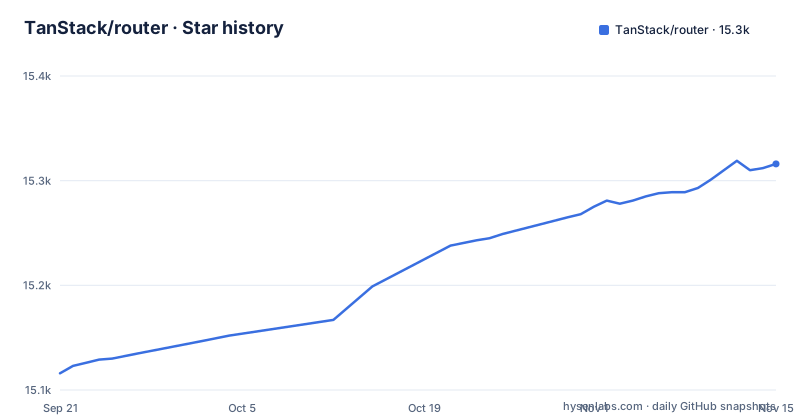
Star history
- TanStack/router15,316 ★ · +200
| Repository | 2026-09-21 | 2026-11-15 |
|---|---|---|
| TanStack/router | 15.1k | 15.3k |
200 Stars in the last 55 days, measured from the daily GitHub snapshot. Compare with other projects
Editorial analysis
Types flow from route definitions into params and loaders
The router's central promise is end-to-end type safety across routes, params and loaders. Instead of treating a URL as a string you parse and then trust, routes are declared in a way the TypeScript compiler can follow, so mistakes in routes, params or loader data can surface as type errors at build time rather than as bugs in production.
This is also where the router asks the most of you. The benefit exists only if your project is written in TypeScript and the route tree is visible to the compiler. A JavaScript codebase can still use the router, but it gets none of the checking that distinguishes it, and at that point the extra structure is cost without return.
The repository describes the project as client-first and server-capable. Client-first means the router stands on its own in a single-page app; you do not need TanStack Start, a server or a particular bundler pipeline to use it. That makes incremental adoption realistic: replace the router in an existing client app first, and decide on server rendering separately.
Search params are schema-validated state, not loose strings
Most routers expose query strings as untyped key-value pairs. TanStack Router treats search params as schema-driven, validated state. You declare what a route's search params should look like, and the router validates incoming values against that schema before your components see them.
The effect is that filters, pagination, sort orders and other state kept in the URL get the same type guarantees as path params. A bookmarked or hand-edited URL with a bad value is caught at the validation step rather than flowing into a component as an unexpected string. For apps that already keep a lot of UI state in the URL, this is the feature that changes daily work the most.
The trade is up-front design. Every route with search params needs a schema, and changing a search param later means changing that schema along with every link that sets it. Teams used to reading whatever happens to be in the query string will find this stricter, which is the point, but it is extra work during early prototyping when the shape of the state is still moving.
Loader caching, prefetching and invalidation live inside the router
Data loading is part of the routing model. Routes have loaders, and the router includes built-in caching, prefetching and invalidation for that data. A navigation can start fetching a route's data before the user arrives, cached results can be reused across navigations, and invalidation lets you mark data stale after a mutation.
Alongside this, the router supports nested layouts, transitions and error boundaries, so a failing loader in a child route can be contained to that part of the page rather than taking down the whole screen.
The same organization also publishes TanStack Query, which it lists as async state and caching. Both layers can cache server data, so a team using Query already has to decide which one owns a given piece of data. Running both without a clear rule means two caches with their own invalidation, which is a source of stale data bugs. Pick one owner per resource before migrating, and keep the router's loader cache for data that is tied to a specific route.
TanStack Start adds server rendering on top of the same router
TanStack Start is the full-stack framework built on the router, developed in the same repository. It adds full-document server-side rendering with streaming, server functions with end-to-end type safety, and bundling and builds intended for deployment. It keeps everything the router offers and layers the server features on top.
The split matters for planning. If you only need client routing, Start is optional and you do not inherit its build requirements. If you need SSR, streaming or server functions, Start is the path the project provides, and it brings its own build and deployment setup that replaces whatever you used to bundle the client app.
Server functions extending type safety across the client and server boundary is the main reason to choose Start over pairing the router with a separate backend. The cost is coupling: application code that calls server functions depends on Start's runtime and build pipeline, so moving off Start later means rewriting those calls as ordinary API requests. Check the Start docs at tanstack.com/start for the deployment targets you need before committing a production app to it.
Solid Start 2.0 is still a release candidate
Release status differs by package, and the newest tags make that visible. On 2026-10-31 the repository published @tanstack/[email protected] and @tanstack/[email protected], alongside a dated release batch named release-2026-10-31-1936. A tenth release candidate means the 2.0 Solid line is close to, but not yet at, a stable release.
For a reader, the consequence is concrete. Release candidates can still change behavior between versions, so a Solid project on Start 2.0 should pin an exact rc version and read the changes before each bump. Teams that need a stable major for a production launch should check whether a non-rc release exists for their framework before choosing this stack.
The repository uses changesets, visible in the .changeset/ directory, and publishes many packages from one monorepo, so releases come as batches with per-package tags. When you track updates, watch the tag for the specific package you depend on rather than the dated batch name. The last push to main was on 2026-11-02.
React leads, with Solid and Vue examples in the same monorepo
The project calls itself a router for React and more, and the repository layout shows what more means. The examples directory has separate react, solid and vue folders, and the published packages include React and Solid variants such as @tanstack/react-router, @tanstack/solid-start and @tanstack/solid-start-server.
The npm and bundle size badges point at @tanstack/react-router, which signals where the primary focus sits. Projects on Solid or Vue get the same core ideas, but they should confirm that the specific features they plan to use, especially Start's server features, are released for their framework and not only for React. The Solid Start packages being at rc.10 is one example of the frameworks moving at different speeds.
The repository also carries AGENTS.md files at the root and in examples, a skills/ directory, and a .devcontainer/ setup, which make it easier to get a working development environment or point a coding agent at the conventions. DEBUGGING.md is the file to read when something in the router itself behaves unexpectedly.
Contributing needs pnpm 11.21 and runs everything through Nx
Anyone working on the router itself rather than using it from npm needs pnpm at version 11.21.0 or newer, enforced through the engines field; the pinned package manager is [email protected], and an .nvmrc file sets the Node version. Tasks run through Nx. The test:pr script runs `nx affected` across eslint, unit, e2e, type, build tests and the build itself, so a pull request only exercises packages its changes touch, while test:ci runs the same targets across everything.
The unit, eslint, type and build test scripts exclude examples, and the unit and eslint scripts also exclude the e2e directory, so changes that only affect an example will not be caught by those targets. End-to-end tests run separately with `nx run-many --target=test:e2e`.
Performance is tracked with its own scripts. Bundle size has build, run, query, diff, history and analyze steps under scripts/benchmarks/bundle-size, and there are separate benchmark projects for client navigation, SSR and client memory with flame graphs. For users this matters indirectly: size and speed regressions have dedicated tooling aimed at catching them before a release, and the bundle size history script gives maintainers a record to compare against.
Editorial conclusion
TanStack Router fits TypeScript teams that want route params, search params and loader data checked by the compiler, and who are willing to describe search params with validation schemas instead of reading raw query strings. It is a weaker fit for plain JavaScript projects, which give up the type checking that is the router's main selling point. Teams eyeing TanStack Start, especially on Solid, should check the release status of the exact package they need first, since @tanstack/solid-start was at 2.0.0-rc.10 on 2026-10-31.
Frequently asked questions
What is the difference between TanStack Router and TanStack Start?
TanStack Router is a client-first, type-safe router with validated search params and built-in loader caching, prefetching and invalidation. TanStack Start is a full-stack framework built on the router that adds full-document SSR, streaming and server functions.
Which frameworks does TanStack Router support?
TanStack Router targets React and more: the repository has examples for React, Solid and Vue, and publishes packages such as @tanstack/react-router and @tanstack/solid-start.
Is TanStack Start for Solid stable?
Not yet as a 2.0 release. On 2026-10-31 the repository published @tanstack/[email protected] and @tanstack/[email protected], which are release candidates.
Official sources
Add this badge to your README
If you maintain this project, the badge below links readers to this analysis and shows its maintenance status from the daily GitHub snapshot. Paste the markdown into your README; add ?metric=license or ?metric=stars to the image URL for a different field.

[](https://hysenlabs.com/projects/tanstack-router)Star history chart for your README
[](https://hysenlabs.com/projects/tanstack-router)Was this useful?