UnLua: no release since November 2023, a plugin repository that ships a whole Unreal project, and docs under a Chinese path
A feature-rich, easy-learning and highly optimized Lua scripting plugin for UE.
At a glance
- What is it?
- Tencent's Lua scripting plugin for Unreal Engine, whose real technical claim is that TArray, TSet and TMap are accessed with the engine's own memory layout so nothing is copied. The branch has commits dated 2026-04-02, the newest tag is from 2023, the documentation paths are all under Docs/CN/, and the tutorial list breaks its own numbering at thirteen.
- Who is it for?
- UnLua fits a team already shipping an Unreal project that wants gameplay scripting in Lua without a binding layer per class, and that can live with documentation written in Chinese and support through a chat group. It does not fit a team that needs a versioned, supported plugin package.
- Can I use it commercially?
- Check first. The repository uses a licence we do not classify automatically, so read its LICENSE file before any commercial use.
- Is it still maintained?
- Activity is slowing. The repository last received commits 7 months ago.
- What is it written in?
- Mainly C++, according to GitHub's language statistics.
Answers come from the project's GitHub data, last synced on November 15, 2026, and from our analysis. They are not legal advice.
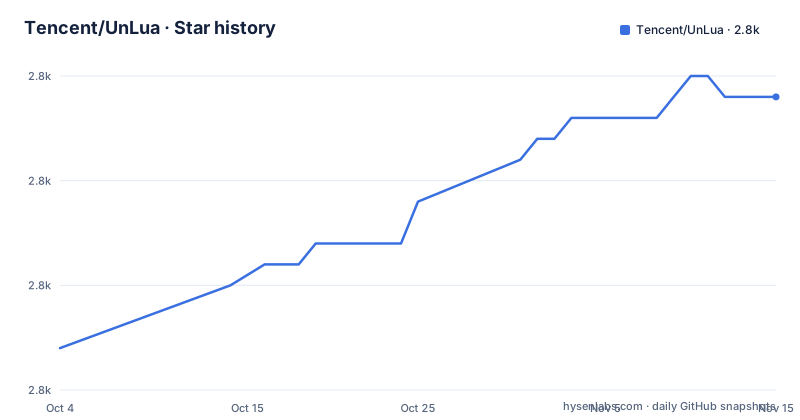
Star history
- Tencent/UnLua2,804 ★ · +12
| Repository | 2026-10-04 | 2026-11-15 |
|---|---|---|
| Tencent/UnLua | 2.8k | 2.8k |
12 Stars in the last 42 days, measured from the daily GitHub snapshot. Compare with other projects
Editorial analysis
No release since November 2023, while the branch moved into April 2026
The version history and the branch disagree about how current this project is. The three newest tags are 2.3.6 from 2023-11-07, 2.3.5 from 2023-05-29 and 2.3.3 from 2023-02-02, all of them in 2023. The last push on the default branch master is dated 2026-04-02, which puts roughly two and a half years of commits above the newest tag. The repository is not archived, so work has continued, but no release has been cut to package it. For a plugin that a team copies into an engine project, that difference is the whole story: installing UnLua today means taking whatever is on master, and the only version number available to record in your own build notes is 2.3.6, which is not what you are running. The repository does carry a CHANGELOG.md at the root, which is where a team would look to bridge that gap.
Container access without copying is the optimization that matters
The optimization section lists four things, and one of them is the reason to choose this plugin over a generic binding. Access to TArray, TSet and TMap works because the memory layout is consistent with the engine, which means no conversion between a Lua table and a container is needed. A script that appends to a TArray is writing into engine memory rather than into a shadow copy that has to be reconciled afterwards, and that is the difference between a binding layer and an interface. The other three items are about call overhead: UFUNCTION calls with persistent parameter caching, optimized parameter passing, and optimized handling of non-const references and return values, plus efficient struct creation, access and garbage collection. The last item is extensibility, with support for statically exporting custom classes, member variables, member functions, global functions and enums into the Lua side.
The 4.17 and 4.18 caveat is the only engine version instruction there is
Platform support is one line each. The run platforms are Windows, Android, iOS, Linux and OSX. The engine versions are Unreal Engine 4.17.x through Unreal Engine 5.x, followed by a note that 4.17.x and 4.18.x need some modification to Build.cs. That note is doing more work than it appears to. It tells you the plugin ships a build script inside its Plugins directory, that the script has drifted from what those two engine versions expect, and that anyone on 4.17 or 4.18 is expected to patch a build file by hand after copying the directory in. For everyone on 4.19 and later the same sentence implies no work at all. It also means the upper end of the range is a moving target: 5.x is written without a minor version, so a team on a recent engine point release has no way to tell from this document whether the plugin's assumptions still hold.
The tutorial list breaks its own numbering at thirteen
Thirteen tutorial scripts are linked, each with a one line Chinese description, and they are the most concrete documentation in the repository: HelloWorld, overriding Blueprint events, binding inputs, dynamic binding, binding and unbinding delegates, native container access, calling Latent functions inside coroutines, calling Lua from C++, statically exporting custom types, overriding network replication events, releasing UMG related objects, a custom loader, and animation notifies. The files are named with a numeric prefix, 01_HelloWorld.lua through 12_CustomLoader.lua. The thirteenth entry, the animation notify example, is not called 13_AnimNotify.lua. Its link points at AN_FootStep.lua instead. Small thing, but it means the one example most likely to be looked up by pattern fails the pattern, and the mismatch also suggests the file was added later than the list around it.
The documentation lives under Docs/CN, and the README has an English twin
The README this project presents is written in Chinese, from the overview heading through the quick start, and every documentation path it links sits under Docs/CN: settings, debugging, IntelliSense, console commands, a FAQ, a programming guide, a plugins and modules page, a features list, a page on implementation principles covering the two overriding mechanisms, and an API reference. The repository root also contains README_EN.md, so an English overview exists alongside it, and the documentation set may exist in another language elsewhere, though nothing in the visible listing says so. What is unambiguous is that a newcomer following the English entry point lands on a Chinese document tree. The quick start itself recommends a graphic tutorial for people new to Unreal, linked as Docs/CN/Quickstart_For_UE_Newbie.md, before walking through the toolbar steps.
A plugin repository that ships a whole Unreal project
The top level listing is not what a plugin package looks like. Besides README.md, README_EN.md, LICENSE.TXT, CHANGELOG.md, Config, Content, Docs, Plugins and Source, there is TPSProject.uproject, an Unreal project file, plus TPSProject.sln.DotSettings for Rider and TPSProject.code-workspace for Visual Studio Code. So the plugin lives inside a sample project rather than being distributed as a plugin on its own, which is also why installation is a directory copy. Two consequences follow. A team that wants UnLua carries the sample project's Content and Config unless they strip them, and the sample project is the reference for how the plugin is meant to be laid out. The listing also has no .github directory, so there is no visible continuous integration configuration for a project that compiles against five operating systems and a wide range of engine versions.
Support is a QQ group number and a marketplace extension
The technical support section is two lines long and both are worth reading carefully. The first gives an official QQ group by number, 936285107, with no invitation link and no statement of what happens when the group is full or how quickly questions are answered. The second recommends a Visual Studio Code extension, Lua Booster, from the editor marketplace, which is the project's advice for Lua editing and IntelliSense rather than a support channel. Neither is version specific, and neither is an English language commitment. Read alongside the release history, the picture for an adopting team is consistent: the code moves, the tags lag, the documentation is Chinese, and the way to ask a question is a numbered chat group. Plan for that before you plan for the API.
Editorial conclusion
UnLua fits a team already shipping an Unreal project that wants gameplay scripting in Lua without a binding layer per class, and that can live with documentation written in Chinese and support through a chat group. It does not fit a team that needs a versioned, supported plugin package. Four things to verify. The newest release is 2.3.6 from 2023-11-07 while the branch has commits dated 2026-04-02, so you are very likely running unreleased code. Installation is a directory copy with no package manager step, so nothing tells you which UnLua build a project is on. Engine support is claimed from 4.17.x through 5.x with one caveat about Build.cs on the two oldest versions, which means the plugin has to be compiled against your engine version. And the licence field on the repository carries no assertion while the root holds a LICENSE.TXT file, so read the file rather than a metadata field.
Frequently asked questions
What is Tencent/UnLua?
A Lua scripting plugin for Unreal Engine that follows the engine's programming patterns. It accesses UCLASS, UPROPERTY, UFUNCTION, USTRUCT and UENUM directly with no glue code, can replace implementations defined in Blueprints, and handles replication, animation and input events.
How do I install UnLua into an Unreal project?
Copy the Plugins directory into your Unreal project root and restart the project. Engine versions from 4.17.x through 5.x are listed as supported, with a note that 4.17.x and 4.18.x require some modification to Build.cs.
Does UnLua copy container data between Lua and the engine?
No. The optimization section states that container types such as TArray, TSet and TMap are accessed with a memory layout consistent with the engine, so no conversion between a Lua table and a container is needed.
Which platforms does UnLua run on?
The platform support section lists Windows, Android, iOS, Linux and OSX as the run platforms, with engine coverage from Unreal Engine 4.17.x to Unreal Engine 5.x.
Where is UnLua documented?
Under Docs/CN, with pages for settings, debugging, IntelliSense, console commands, a FAQ, a programming guide, plugins and modules, a features list, implementation principles covering two overriding mechanisms, and an API reference. The README is in Chinese and the root also carries README_EN.md.
Where can I get technical support for UnLua?
An official QQ group given by number, 936285107, plus a recommended Visual Studio Code extension called Lua Booster from the editor marketplace. No English language support channel is named in the README.
Official sources
Add this badge to your README
If you maintain this project, the badge below links readers to this analysis and shows its maintenance status from the daily GitHub snapshot. Paste the markdown into your README; add ?metric=license or ?metric=stars to the image URL for a different field.

[](https://hysenlabs.com/projects/tencent-unlua)Star history chart for your README
[](https://hysenlabs.com/projects/tencent-unlua)Was this useful?