Friday keeps a signing key and refuses to be given a writing one, then gates every completion on a receipt
Private control plane for AI agents
At a glance
- What is it?
- A local-first control plane that routes each step of a goal to a cloud model you already pay for, routes for free before it spends, and refuses to mark work done without a proof receipt attached across a code boundary. Its own package description admits the consumer application has not been publicly released.
- Who is it for?
- Friday is interesting for one specific claim: that a completion cannot be recorded unless a receipt crosses a persisted code boundary, so a model cannot grade its own homework. Whether or not that boundary is airtight in practice, it is a more interesting design position than asking a model to self-report honestly, and the audit log being hash chained is the second thing worth taking seriously.
- Can I use it commercially?
- Yes. MIT is a permissive licence: you can use, modify and sell software built on it, as long as you keep its copyright and licence notices.
- Is it still maintained?
- Yes. The repository last received commits 128 days ago.
- What is it written in?
- Mainly TypeScript, according to GitHub's language statistics.
Answers come from the project's GitHub data, last synced on November 25, 2026, and from our analysis. They are not legal advice.
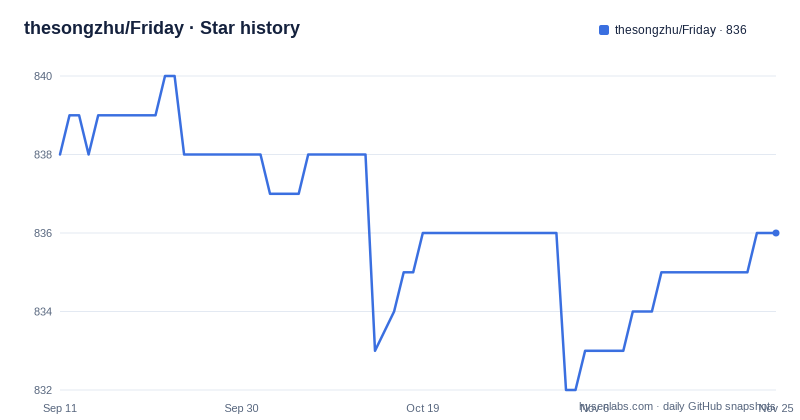
Star history
- thesongzhu/Friday836 ★ · -2
| Repository | 2026-09-11 | 2026-11-25 |
|---|---|---|
| thesongzhu/Friday | 838 | 836 |
-2 Stars in the last 75 days, measured from the daily GitHub snapshot. Compare with other projects
Editorial analysis
The install is a double-clicked shell script, and the consumer app is not out yet
The quickstart is macOS-shaped. Install Node 22 through Homebrew, clone the repository, change into it, and open a file called `Friday Setup.command`. If setup reports an older or missing Node.js, you install Node 22 or newer and run that same file again.
brew install node@22
git clone https://github.com/thesongzhu/Friday.git
cd Friday
open "Friday Setup.command"
So there are two things here: a published package with a `friday` binary in its bin field, and a source-and-double-click path that is the one actually documented. The package description is unusually candid about which is which. It calls itself a developer, build and tooling runtime and a source and CI surface, explicitly not a consumer install, and adds that the native application is the consumer release vehicle and is not yet publicly released. The keyword list includes a term for that status.
The packaged files are informative. Alongside the compiled output and the interface bundle, the package ships five operational shell scripts, one of which installs a launch agent and another of which opens the interface on login, so the desktop presence has a real mechanism behind it. It also ships the policy documents and a capability matrix under an operations folder.
One small thing to know before reading further: the row of badges near the top of the document renders as a stray fragment of markup, so that line is broken rather than merely empty.
Completion is refused without a receipt, and a code boundary is what refuses it
The loop is five steps: find the work, hand it to a model, check it actually did it, write down what is done, pick the next thing. The document is explicit that the third step is the one other systems skip, on the grounds that an agent grading its own homework will cut corners.
The mechanism is a proof receipt. A task cannot flip to complete unless a receipt is attached through the project's persisted mission and work-item code boundary; the database stores references to those receipts and the application boundary rejects completion that arrives without one. A model saying it is finished does not count, and neither does a process that quietly exits.
Two supporting behaviours are described in the same place. A vague goal is not guessed at: the system asks what you meant, and the document says it spends no tokens until the goal is clear. And when a job needs both code and higher-level judgement, one model writes the code and a second is brought in only once the first has proved it finished, so the expensive model is not consulted before there is something to consult about.
The routing itself is claimed to be free. Each model is chosen by a quick decision made before any money is spent, and if a fallback to another model is ever needed, the cost record says which model actually answered.
The kernel holds the key that checks a signature and not the one that writes one
The set of guarantees is presented as structure rather than as settings, and the first one is the most concrete.
The claim is that the project never gave the application a pen. It holds the key that verifies your signature and never the one that produces one, so on anything dangerous it cannot fabricate your own approval. Your sign-off has to come from your hand, offline, on your own device. The second guarantee follows from it: read-only work never needs a sign-off, but anything that changes the world, or looks risky, can only ever resolve to needing your approval or to a refusal. There is no third state that a model can reach on its own, and an agent cannot approve its own side effects.
The audit trail is the other half. Every routed agent turn is recorded as a single all-or-nothing entry carrying who acted, what happened and what it cost, in a hash-chained log, so editing the past breaks the chain rather than rewriting it. Combined with the receipt requirement, that means a completion and the turn that produced it are both on the record and both tamper-evident.
The stated reason for building it this way is a version argument. Models change every few months, so the lasting value is the harness around them, and the harness is the part the project expects you to keep.
Memory is a candidate list, and recalled text is scrubbed before a model sees it
Nothing becomes a real memory without your say-so. The system floats facts as candidates, and not one is promoted until you approve it, so a fact that got into the system wrongly sits there inert rather than quietly steering later runs.
The second half is about what goes back out. When the system recalls something, the text is yours alone and is scrubbed of known secret patterns before any model is allowed to see it. That is a pattern-matching approach rather than a proof, and the document does not describe the pattern list or what happens to a secret that does not match, so it is best read as a mitigation with a stated scope.
The personalisation story is the part to be careful about, because the document flags it itself. The claim is that the system gets to know you the more you use it, turning finished work into a feel for your preferences that, once confirmed, colours later runs. The sentence adds that this part is not switched on yet, and the document then stops mid-clause on the subject of why.
So today the memory system holds candidates you confirm and returns scrubbed recalls, and the behaviour that would make the system feel personal is described as not enabled.
The desktop tool is opt-in and its file operations are confined to a list of roots
The environment example is where the actual boundaries live, because every variable is listed with its default in a comment.
The desktop tool is not registered unless you set a flag to enable it. Once enabled, a principal identifier is used for the desktop permission and audit flow, and file operations are confined to a comma-separated list of absolute roots, which defaults to the workspace root when the variable is unset. That is a narrower grant than an agent that can reach the whole home directory, and it is the kind of default worth checking before you widen it.
The browser runtime has a similar shape, with one preferred variable and a set of older ones explicitly marked as legacy fallbacks that should not be used instead. Those older knobs include whether to run headless, whether to use the host's own Chrome, a websocket endpoint, a Chrome DevTools Protocol port, and an explicit Chrome binary path.
Two more defaults are worth noting. Cross-origin sharing is disabled when the variable is empty, and setting it to a wildcard allows every origin, so the safe default is the empty one. Request logging is off by default. The interface can be served from a static build directory, and the state files, which the comment identifies as SQLite, go to a data directory under the working tree unless you point them elsewhere.
The example file also mentions a channel bridge whose configuration is JSON, with a note that secret fields should use either an environment reference or a secret scheme rather than a literal value.
Provider keys are encrypted at rest with a key that lands in your home directory
Two secrets are generated for you if you do not supply them, and both defaults deserve a moment's thought.
The first is a signing secret for the tokens the interface issues. If the variable is unset, a random secret is generated and written to a file in a hidden directory in your home folder, and the comment tells you to set it explicitly for production. The second is a master key, described as an AES-256 key for encrypting provider API keys at rest, also auto-generated into your home folder when absent.
Encryption at rest with the key stored next to the data is a specific threat model rather than a general one. It protects you from the case that actually happens most often: a database file, a backup, or a copied state directory leaking on its own. It does not protect you from anything running with your user account, because that process can read both the key and the data. Both secrets are outside the data directory, which is deliberate, so a copy of the state directory alone is not enough to read your provider keys.
The trade is availability against strictness. A generated key means the install works with no configuration, and it also means rotating a key is an operation you have to do deliberately rather than something that happens on a schedule.
The repository documents its own claims and carries two lockfiles
The root of this repository is unusually honest about its own state, and the file names do most of the telling.
There is a document whose name is a claim about which file is authoritative, another about a public local candidate release, a third about the policy for release evidence, and a capability matrix under an operations folder. A trust document, a responsible use document, a privacy document, a roadmap and a notices file sit beside them. Secret scanning is configured and its baseline is committed, so the accepted findings are visible in the repository rather than hidden in a service. There are custom git hooks, a mail map, and a directory of stress fixtures.
The build surface is mixed. A Rust core sits beside the TypeScript sources, a test directory and a tests directory sit side by side, and a deployment manifest for a specific hosting platform sits next to a docker directory and a packaging directory. Most tellingly, the root carries both an npm lockfile and a pnpm lockfile, so the project supports two package managers and the two cannot both be the source of truth.
Version state has the same flavour. The package manifest declares 1.0.3 while the newest release tag is 1.0.2, and the newest tag is from May while the default branch was pushed in July.
Editorial conclusion
Friday is interesting for one specific claim: that a completion cannot be recorded unless a receipt crosses a persisted code boundary, so a model cannot grade its own homework. Whether or not that boundary is airtight in practice, it is a more interesting design position than asking a model to self-report honestly, and the audit log being hash chained is the second thing worth taking seriously. Before deploying it, understand three things. The product people describe does not exist yet in public: the package is explicitly a source and CI surface, and the native application is named as the consumer vehicle and is not yet released. The default secrets are generated into your home directory, so provider keys are encrypted at rest against a database leak rather than against anything running as you, and the token secret is marked as one you should set yourself. And the feature that would make it learn your preferences is described as not switched on yet, so today it is a router and a verifier rather than an assistant that knows you.
Frequently asked questions
What is Friday?
A private, local-first control plane for AI agents, and explicitly not a model and not a chatbot. The reasoning models are the cloud AIs you already pay for, with your own keys, and Friday routes each step of a goal to one of them, verifies the result, and pauses for your approval on anything risky. The control plane, your keys, your data and your memory are stated to live on your own machine.
What does Friday need in order to run?
Node.js 22 or newer, and a source checkout. The documented quickstart is macOS-shaped: install Node 22 with Homebrew, clone the repository, change into it, and open the setup command file, running it again if it reports an older or missing Node.js. It also publishes an npm package that installs a friday binary.
How does Friday stop an agent from claiming it finished?
A task cannot be marked complete unless a proof receipt is attached through the persisted mission and work-item code boundary. The database stores references to those receipts and the application boundary rejects completion that arrives without one. A model saying it is done, or a process that quietly exits, is not accepted as proof.
Does Friday ask for approval before every step?
No. Plain read-only work never needs a sign-off, while anything that changes the world or looks risky can only resolve to needing your approval or to a refusal, with no automatic-yes state a model can reach. There is also a trust dial that can pre-approve batches of low-risk work, and irreversible actions are stated to always ask.
Is Friday released as a product yet?
Not as a consumer application. Its package description says it is a source and CI and tooling surface rather than a consumer install, and names the native application as the consumer release vehicle while stating it is not yet publicly released. The version in the package manifest is 1.0.3 while the newest release tag is 1.0.2.
Official sources
Add this badge to your README
If you maintain this project, the badge below links readers to this analysis and shows its maintenance status from the daily GitHub snapshot. Paste the markdown into your README; add ?metric=license or ?metric=stars to the image URL for a different field.

[](https://hysenlabs.com/projects/thesongzhu-friday)Star history chart for your README
[](https://hysenlabs.com/projects/thesongzhu-friday)Was this useful?