Simple Transformers calls Weights and Biases optional and installs it anyway
Transformers for Information Retrieval, Text Classification, NER, QA, Language Modelling, Language Generation, T5, Multi-Modal, and Conversational AI
At a glance
- What is it?
- simpletransformers wraps Hugging Face Transformers behind one model class per NLP task. Reading it closely turns up a dependency list that contradicts its own optional section, a declared version that has no release, a Python floor set years before the library it wraps, and a cleanup target that deletes a file the repository ships.
- Who is it for?
- This library fits someone already working with Hugging Face model types who wants a task-shaped wrapper and accepts a large install. It does not fit someone who wants a small dependency footprint or a release history to pin against, because install_requires pulls in wandb, streamlit, tensorboard and more and the newest published tag predates the declared version by several minor releases.
- Can I use it commercially?
- Yes. Apache-2.0 is a permissive licence: you can use, modify and sell software built on it, as long as you keep its copyright and licence notices.
- Is it still maintained?
- Yes. The repository last received commits 175 days ago.
- What is it written in?
- Mainly Python, according to GitHub's language statistics.
Answers come from the project's GitHub data, last synced on November 22, 2026, and from our analysis. They are not legal advice.
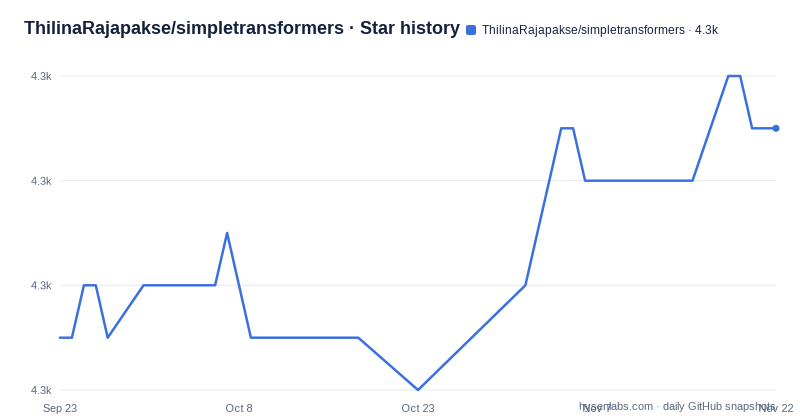
Star history
- ThilinaRajapakse/simpletransformers4,259 ★ · +4
| Repository | 2026-09-23 | 2026-11-22 |
|---|---|---|
| ThilinaRajapakse/simpletransformers | 4.3k | 4.3k |
4 Stars in the last 60 days, measured from the daily GitHub snapshot. Compare with other projects
Editorial analysis
The optional section installs what setup.py already requires
The installation page has an Optional heading, and under it one command.
$ pip install wandbThe setup script lists the same package in `install_requires`, with a floor, so it arrives whether you ask for it or not. The page presents it as an add-on for tracking and visualising training in a browser; the manifest treats it as a requirement of the library.
The same is true of a second package further down the list. A web framework for interactive apps is a hard requirement here, and the distribution installs a command-line script called `simple-viewer` from its `bin/` directory.
The declared version has no matching release tag
The setup script declares `version="0.70.8"`. That is the version that ends up on the package index.
The release list on the repository tells a different story. The three most recent releases are v0.60.0 published 2021-02-01, v0.51.0 in December 2020 and v0.49.0 in November 2020. There is no GitHub release for 0.70.8, or for anything between 0.60.0 and it.
So the number you see when you install is not a number you can find a release note for. The change log in the repository is the only record of what moved between those two points, and the last push on the default branch is dated 2026-05-31.
For anyone pinning a version in a lockfile, that gap is the thing to check first, because the tag list will not tell you whether a given patch was published.
A Python floor of 3.6 next to a transformers requirement of 4.31
Two version constraints sit side by side in the same manifest, and they describe different eras.
The interpreter floor is declared as `python_requires=">=3.6"`. The wrapper library it exists to serve requires `transformers>=4.31.0`. Apart from floors on tqdm and wandb, everything else in the list, including a tokeniser package and a datasets package that sit alongside the transformer library in that ecosystem, is unpinned.
So the floor is far older than the thing the floor exists for. On an interpreter old enough to satisfy 3.6, the resolver will look for a modern transformers that does not install there, and the failure arrives as an unsatisfiable requirement rather than as a syntax error.
The classification list has the same looseness in a different place: it names Python 3 as the language and lists no minor versions, which is common in older distributions and tells an index nothing about which interpreters were tested.
One environment command and two PyTorch variants
The environment setup is written for Conda and offers exactly two PyTorch paths.
$ conda create -n st python pandas tqdm
$ conda activate st
The GPU variant and the CPU-only variant differ by a single line each.
$ conda install pytorch>=1.6 cudatoolkit=11.0 -c pytorch$ conda install pytorch cpuonly -c pytorchThen the library itself is a plain pip install.
$ pip install simpletransformersThe CUDA toolkit version named here is 11.0 and the PyTorch floor is 1.6, both fixed in the text. Anyone on a newer graphics stack is left to work out the substitution themselves, and the CPU-only line installs no framework version at all beyond what the channel resolves.
One class covers four of the twelve listed tasks
The task table maps twelve task names onto ten model classes, and the imbalance is worth reading.
`ClassificationModel` appears three times: binary and multi-class text classification, regression, and sentence-pair classification. Named entity recognition gets `NERModel`, question answering gets `QuestionAnsweringModel`, conversational training gets `ConvAIModel`, and document retrieval gets `RetrievalModel`. Language generation, language modelling, multi-label classification, multi-modal classification and text representation each get their own.
So the wrapper is not strictly one class per task: three tasks share ClassificationModel, while the rest each get their own class.
Every task follows the same four steps: initialise the model, train it, evaluate it, then predict on unlabelled data.
The Makefile skips one package in three of its targets
The build file is short and its exclusions are the interesting part.
formatter:
	black --line-length 119 simpletransformers tests --exclude simpletransformers/experimental\

lint: clean
	flake8 simpletransformers tests --exclude=simpletransformers/experimental
	black --check --line-length 119 . simpletransformers tests --exclude simpletransformers/experimental
Formatting, linting and type checking all name the same package as excluded, so `simpletransformers/experimental` is outside the project's own style and type gates by design.
The test target does not exclude it, but it also does not cover everything: the coverage list names six subpackages, and the six are classification, question answering, language modelling, T5 and seq2seq alongside NER. The repository also carries ten example directories, from named entity recognition to retrieval, and none of them is wired into the test command.
The cleanup target deletes a file the repository ships
There is a `clean-test` target that removes test byproducts.
clean-test:
	-rm -r .coverage*
	-rm -r data
	-rm -r runs
	-rm -r outputs
	-rm -r cache_dir
	-rm -r wandb
	-rm train.txt
`train.txt` is the last entry, and a file with that name is committed at the top level of the repository, outside the package directory and outside the examples.
Every line is prefixed to tolerate failure, so the target does not stop when a path is missing. That prefix makes the removal of a tracked file easy to miss: the command reports success whether or not anything was there, and the file only reappears on the next checkout.
The plain `clean` target is narrower, removing only compiled Python artefacts and editor backups, and it is the one the lint target depends on.
The usage documentation lives on two different domains
The repository carries a homepage of its own and points the detailed documentation somewhere else.
The project site is simpletransformers.ai, while every usage link, the task sections and the example pointers resolve to a documentation site hosted under the author's account on GitHub Pages. So there are two domains in play, and only one of them is where the reference material is.
The README states plainly that all documentation is now hosted off this page, and that the model types available for each task are found under their respective sections there. Pretrained weights are not listed on this page either; the pointer is to the Hugging Face documentation, on the path under its earlier project name, and the instruction is to set the model type and model name in the arguments dictionary.
One more convention is stated in the page: if you use the library in published work, you are asked to cite a 2024 SIGIR Asia Pacific paper by three authors, with a DOI.
Editorial conclusion
This library fits someone already working with Hugging Face model types who wants a task-shaped wrapper and accepts a large install. It does not fit someone who wants a small dependency footprint or a release history to pin against, because install_requires pulls in wandb, streamlit, tensorboard and more and the newest published tag predates the declared version by several minor releases. Before you depend on it, check four things. Which transformers version you have, since the manifest asks for 4.31.0 or newer while declaring a Python floor of 3.6, and those two statements do not agree. Whether the tracking and viewer packages are acceptable, because both are installed by default rather than on request. Which number you pin, given that the setup script says 0.70.8 and the release list stops at v0.60.0. And where your documentation comes from, since the detailed usage material has moved off this page to a separate documentation site.
Frequently asked questions
How do I install simpletransformers?
The documented path is a Conda environment followed by a plain pip install: conda create -n st python pandas tqdm, then conda activate st, then pip install simpletransformers. PyTorch is installed separately, either with a CUDA toolkit version from the PyTorch channel or as a cpuonly build, and a virtual environment is recommended first.
What version of simpletransformers should I pin?
The packaging script declares version 0.70.8, while the release list on the repository stops at v0.60.0, published on 2021-02-01. There is no GitHub release for the declared version, so the changelog in the repository is the only record of what changed after 0.60.0.
Which tasks does simpletransformers support?
The table maps tasks onto classes: binary and multi-class text classification, regression and sentence-pair classification all use ClassificationModel, while named entity recognition, question answering, conversational training, document retrieval, language generation, language modelling, multi-label classification, multi-modal classification and text representation each get their own class. Every task follows the same four steps of initialising, training, evaluating and predicting.
Official sources
Add this badge to your README
If you maintain this project, the badge below links readers to this analysis and shows its maintenance status from the daily GitHub snapshot. Paste the markdown into your README; add ?metric=license or ?metric=stars to the image URL for a different field.

[](https://hysenlabs.com/projects/thilinarajapakse-simpletransformers)Star history chart for your README
[](https://hysenlabs.com/projects/thilinarajapakse-simpletransformers)Was this useful?