JeeSite: a Java low-code platform whose GitHub repo is the Vue3 monorepo
A Java low-code, lightweight platform built on Spring Boot, MyBatis, Flowable, TypeScript, Vue and Antdv, with core modules including organization management, roles and users, permission and data authorization, content management, workflow, and Spring Cloud microservices.
At a glance
- What is it?
- thinkgem/jeesite on GitHub is described as a Java low-code platform on Spring Boot, MyBatis and Flowable, but the tree you clone is the Vue3 frontend built with pnpm and Turborepo. This analysis separates what that repo contains from what lives in the sibling backend repository.
- Who is it for?
- Use thinkgem/jeesite if you want a Vue3, Antdv Next and Vben Admin style admin frontend that pairs with the JeeSite Java backend, and start from the Docker image to see both together. Do not expect this repository alone to give you a running system, and verify the AI, microservice and compliance claims against the backend repository and the official docs before you plan around them.
- Can I use it commercially?
- Yes. Apache-2.0 is a permissive licence: you can use, modify and sell software built on it, as long as you keep its copyright and licence notices.
- Is it still maintained?
- Yes. The repository last received commits 2 days ago.
- What is it written in?
- Mainly Vue, according to GitHub's language statistics.
Answers come from the project's GitHub data, last synced on November 15, 2026, and from our analysis. They are not legal advice.
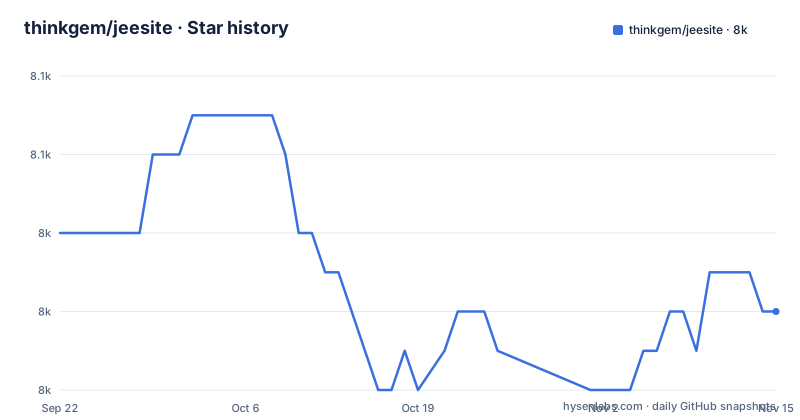
Star history
- thinkgem/jeesite8,046 ★ · -2
| Repository | 2026-09-22 | 2026-11-15 |
|---|---|---|
| thinkgem/jeesite | 8k | 8k |
-2 Stars in the last 54 days, measured from the daily GitHub snapshot. Compare with other projects
Editorial analysis
The repository you clone holds the Vue3 frontend, not the Java backend
The GitHub description talks about Spring Boot, MyBatis, Flowable, workflow and Spring Cloud microservices, and the platform text names Spring Boot, Shiro and MyBatis for the backend. But the top level of this repository is a frontend workspace: package.json, pnpm-workspace.yaml, turbo.json, uno.config.ts, tsconfig.json, packages/ and web/. The primary language is listed as Vue, and the README opens with the heading JeeSite Vue3 front-end source.
The backend lives elsewhere. The backend source is published as jeesite5 on Gitee, GitCode and GitHub, the frontend as jeesite-vue on the same three hosts, and this repository is listed as the source collection. The consequence is practical: cloning thinkgem/jeesite gives you screens and components that need a JeeSite backend to talk to, so you cannot judge the workflow engine or the permission model from this tree.
preinstall runs npx only-allow pnpm, so npm and yarn installs are refused
The root package is named @jeesite/root at version 5.19.1 and is private. Its preinstall script is npx only-allow pnpm, which rejects other package managers before dependencies install. The bootstrap script is pnpm install, and dev runs cd web && pnpm run dev.
Builds go through Turborepo: build is turbo build --concurrency 20, and type:check uses the same concurrency. There is also build:tomcat, which runs inside web, for deployments that package the frontend for a Tomcat host. Formatting and linting use oxlint --fix and oxfmt rather than ESLint and Prettier. The reinstall scripts delete pnpm-lock.yaml and node_modules, then reinstall, so running them rewrites your lockfile and you should not use them casually on a branch you intend to merge. The learning list also points to Node.js 24, VSCode, Vite, TypeScript, Vue Router 4, Vue Vben Admin and Antdv Next.
The workspace is split into @jeesite packages so modules can be published separately
The README gives four reasons for the monorepo layout: pnpm and Turborepo speed up compilation and unify scripts, features are split into packages so teams can manage source separately and publish packages as needed, modules are loosely coupled around shared components and tools, and an older traditional-architecture version can be upgraded to the modular one.
The dependency list shows the real package names, all resolved from the workspace: @jeesite/app, assets, cms, core, dbm, dfm, test, types, vite and web. Third-party pins include vue 3.5.41, vue-router 5.2.0, antdv-next 1.5.0, axios 1.19.0 and dayjs 1.11.21. Because versions are exact, upgrading Vue or Antdv Next is a deliberate edit rather than a silent range bump. Teams that only want the content-management or core pieces can depend on those packages, but they still carry the shared types and build plugins.
Data-driven list and form views are meant to make frontend upgrades cheap
The frontend defines many components with small convenient properties, and lists and forms are driven by data rather than by hand-written templates. The README gives the reasoning: backward compatibility on the frontend is the biggest long-term problem, and a standard for describing views means business code changes very little when the framework is upgraded. It also says this layout prepares the ground for a drag-and-drop custom form builder later and keeps the stored data structure clearer.
The tradeoff is that you learn the data description format before you are productive, and the README tells readers to study the commented source for the form view and list view, which also cover complex forms and several forms used together. A developer who prefers writing plain Vue templates for each screen will fight this model. A team building many similar CRUD screens gets the benefit.
The Docker quick run pulls from a personal Aliyun registry in Qingdao and binds port 8980
The fastest way to see the system is a single Docker command for Linux or macOS:
docker pull crpi-u3zm0t8trv68xpyx.cn-qingdao.personal.cr.aliyuncs.com/thinkgem/jeesite:latest && docker run --name js5 -p 8980:8980 -d -v ~/jeesite-data:/data crpi-u3zm0t8trv68xpyx.cn-qingdao.personal.cr.aliyuncs.com/thinkgem/jeesite:latest && docker logs -f js5The Windows version is a cmd /c line that uses %USERPROFILE%\jeesite-data instead:
cmd /c "docker pull crpi-u3zm0t8trv68xpyx.cn-qingdao.personal.cr.aliyuncs.com/thinkgem/jeesite:latest && docker run --name js5 -p 8980:8980 -d -v %USERPROFILE%\jeesite-data:/data crpi-u3zm0t8trv68xpyx.cn-qingdao.personal.cr.aliyuncs.com/thinkgem/jeesite:latest && docker logs -f js5"System data persists in ~/jeesite-data or %USERPROFILE%\jeesite-data. The image comes from a personal container registry host in Qingdao, tagged latest, so pull speed outside mainland China is uncertain and the tag is not pinned to a release. After startup, the Vue split version is at http://127.0.0.1:8980/vue/login and the full-stack version at http://127.0.0.1:8980/a/login. An online demo is at https://vue.jeesite.com.
One backend serves both a Vue3 split frontend and a classic full-stack frontend
The platform text says the backend is built on Spring Boot, Shiro and MyBatis. Its frontend is either the separated Vue3, Vite, TypeScript, Antdv Next and Vben Admin stack, or the classic Beetl, Bootstrap and AdminLTE mode. The 2021 year-end release introduced the Vue3 separated version, which is why a single backend service supports both /vue/login and /a/login.
This matters if you assumed the Vue repo replaces the older full-stack pages. It does not remove them. If you adopt the Vue frontend you are choosing one of two interfaces for the same server, and customizations to one do not carry to the other. The README also states the platform has used a dual structure since a full restructuring in 2019, so documentation or answers you find online may describe either generation.
The AI, microservice and compliance claims cannot be checked from this repository
The platform introduction lists a lot: online data source management, table modeling and code generation, a workflow engine, content management, single sign-on, scheduled jobs, object storage, report designer, full-text search, SaaS extension, clustering, read-write splitting, sharding and Spring Cloud microservices. It also claims connections to OpenAPI, Ollama and DeepSeek models with retrieval-augmented generation for an enterprise knowledge base, local tool calls plus MCP server and client calls, domestic hardware and software support, and support for the Chinese classified protection evaluation.
None of that is implemented in this frontend tree, which only has @jeesite packages for the UI. Treat these as vendor claims to confirm against the backend repository and the documentation at jeesite.com/docs before you commit. The README also says the commercial edition extends the community edition from one codebase, while the community edition is Apache-2.0 and free. Which features are commercial only is not something this repository settles.
Releases carry a .vue suffix, and support runs through Gitee issues and chat groups
Recent tags are v5.19.1.vue on 2026-10-14, v5.19.0.vue on 2026-09-17 and v5.18.1.vue on 2026-08-05, each titled as a JeeSite Vue release for rapid development. The .vue suffix marks frontend releases, so match it with the backend version you run rather than assuming the numbers are interchangeable. The last push to this repository was on 2026-10-09 and it is not archived.
For help, the README points to Gitee issues for problem reports and requirements, a must-read post for newcomers, the jeesite.com documentation and a WeChat official account. Several QQ groups are marked full, and a WeChat group can be joined by adding the customer service account jeesitex. If you work outside the Chinese-speaking community, plan to search the docs yourself, because live help is organized around those channels. GitHub issues are not the primary support path named in the README.
Editorial conclusion
Use thinkgem/jeesite if you want a Vue3, Antdv Next and Vben Admin style admin frontend that pairs with the JeeSite Java backend, and start from the Docker image to see both together. Do not expect this repository alone to give you a running system, and verify the AI, microservice and compliance claims against the backend repository and the official docs before you plan around them.
Frequently asked questions
Is JeeSite J2EE or JEE?
JeeSite is described as a Java low-code platform built on Spring Boot, Shiro and MyBatis, with a Vue3 frontend as the main option. The GitHub repository itself holds the Vue3 frontend source.
What is the JeeSite GitHub repository thinkgem/jeesite?
It is the source collection for the JeeSite platform. Its tree is the Vue3 frontend monorepo built with pnpm and Turborepo, while the backend is published separately as jeesite5.
How do I run JeeSite quickly?
Install Docker and run the documented docker pull and docker run command, which publishes port 8980. Then open http://127.0.0.1:8980/vue/login for the Vue version or /a/login for the full-stack version.
Official sources
Add this badge to your README
If you maintain this project, the badge below links readers to this analysis and shows its maintenance status from the daily GitHub snapshot. Paste the markdown into your README; add ?metric=license or ?metric=stars to the image URL for a different field.

[](https://hysenlabs.com/projects/thinkgem-jeesite)Star history chart for your README
[](https://hysenlabs.com/projects/thinkgem-jeesite)Was this useful?