seyfert, no runtime dependencies and three lockfiles
the black magic Discord framework . There are many reasons to use Seyfert, but they dont all fit in this tiny readme, so here is a list of the most awesome reasons!
At a glance
- What is it?
- seyfert is a TypeScript framework for Discord bots whose package manifest lists no runtime dependencies at all, ships compiled output, and installs under Node, Deno, and Bun. The README is 184 words and half of it is a joke. The engineering signal is elsewhere: a memory benchmark with the garbage collector exposed, changesets configured next to no releases, and three lockfiles in one repository.
- Who is it for?
- seyfert suits a bot project that wants full control of its own dependency graph and does not mind writing its own plumbing, since a framework with no runtime dependencies cannot pull anything into your process that you did not ask for. Check four things first.
- Can I use it commercially?
- Yes. MIT is a permissive licence: you can use, modify and sell software built on it, as long as you keep its copyright and licence notices.
- Is it still maintained?
- Yes. The repository last received commits 4 days ago.
- What is it written in?
- Mainly TypeScript, according to GitHub's language statistics.
Answers come from the project's GitHub data, last synced on November 15, 2026, and from our analysis. They are not legal advice.
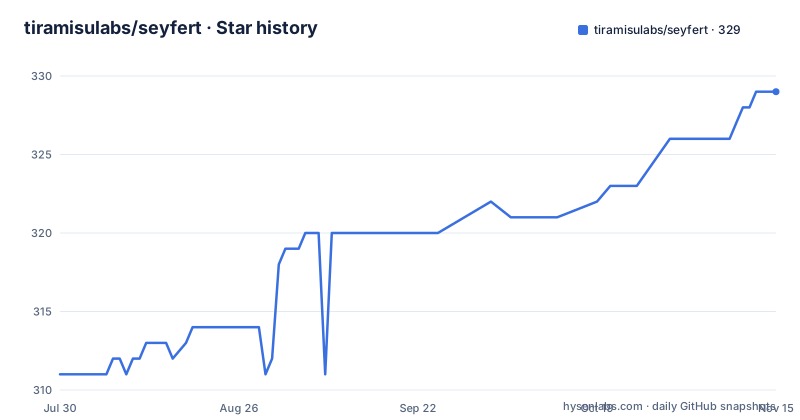
Star history
- tiramisulabs/seyfert329 ★ · +18
| Repository | 2026-07-30 | 2026-11-15 |
|---|---|---|
| tiramisulabs/seyfert | 311 | 329 |
18 Stars in the last 108 days, measured from the daily GitHub snapshot. Compare with other projects
Editorial analysis
The repository description is the README's own paragraph
The blurb on the repository page is a sentence copied out of the readme.
The description field reads that this is the black magic Discord framework, and then says there are many reasons to use it that do not all fit in a tiny readme, so here is a list of the most awesome reasons. The README's own question about why you should use it opens with the same two sentences, nearly word for word.
The reasons themselves are six bullets and a shrug: low RAM usage, latest features, dev experience, support six days a week with a parenthetical about Sundays, written from scratch, type-safe, and a final exclamation that there are many more.
That is the entire case for the framework, and it is worth being clear about what it does and does not tell you. It names six virtues and quantifies none of them. There is no comparison, no benchmark table, and no list of what the cache control actually does.
What it does establish is tone. This is a project that would rather be understated than make claims it cannot back, and the missing apostrophe in the readme is consistent with that.
Four install commands for three runtimes
The installation section is four code blocks and one note, and the note is where the requirements are.
Node 18 or newer is required, or Node 16 with an experimental fetch flag enabled. Deno needs a specific minimum patch release, 2.6.9 or newer, which is an unusual thing to pin and suggests the code depends on a behaviour introduced there. Bun, Node, and Deno long-term-support releases are all recommended.
Then one command per ecosystem: the package manager add command, the Deno add command targeting the npm namespace, the Bun add command, and the npm install command. A trailing note says or other package manager, which covers the rest.
pnpm add seyfertThree runtimes with three clients is more support surface than most Discord frameworks take on, and it comes from the fact that the package is plain JavaScript with type declarations and no runtime dependencies. Nothing in the manifest ties it to one of them.
The manifest also names the package manager it develops with, at a specific major and patch, while the readme lists the package manager first among the install options. Those are different statements and both are true: one is where development happens, the other is where you install from.
There are no runtime dependencies at all
The dependency section of the manifest is empty, and for a bot framework that is the headline.
Everything listed is a development dependency: a linter and formatter, a versioning tool, a commit message linter and its conventional preset, type definitions for Node, a git hooks installer, the TypeScript compiler, and a test runner. Nothing appears that a consumer's process would load at runtime.
That is a direct consequence of writing the framework from scratch rather than assembling existing pieces, and it has two consequences worth naming. A bot built on it inherits no transitive dependency tree, so there is no supply chain surface beyond Discord itself and whatever you add. And there is also nothing to inherit behaviour from, so anything you would get from an ecosystem package, whether a rate limiter, a logger, a schema validator, or a router, you either get from this framework or write yourself.
The manifest also lists no exports map. Entry points are declared as a main field, a module field pointing at the same file, and a types field. That combination is the older way of telling a bundler where the ES module build is, and it leaves deep imports into the published directory reachable rather than fenced off.
A benchmark with the garbage collector exposed backs the RAM claim
One of the six bullet points is low RAM usage, and there is exactly one benchmark in the repository that appears to exist to test it.
The script is named for a limited-cache scenario and it does two things before it measures anything: it builds the project, then runs a benchmark file with the garbage collector explicitly exposed to the runtime.
Exposing the collector is the detail that gives the benchmark meaning. Without it, memory numbers from a long run are whatever the collector happened to leave behind, and a framework whose main selling point is footprint cannot be measured on that basis. Asking the runtime to collect on demand makes the numbers comparable between runs.
The build step before the benchmark is there because the benchmark loads the compiled output rather than the sources, so the measurement covers what consumers actually run.
The readme does not quote a result from it. The claim is made in a bullet and the tool to check it is in the manifest, which is the same pattern the rest of the project follows: assert the property, ship the way to test it, and leave the number to you.
Changesets are configured and the repository has no releases
The release tooling is fully set up and the release history is empty.
There is a changesets directory at the root and the changesets command line tool pinned in the development dependencies. There is also a conventional commit configuration, a commit linter, and a git hooks directory, with a prepare script that builds the project and installs the hooks on every install.
That is the complete release apparatus for a package published to a registry with public access. What is missing is any evidence of it having been used: the repository shows no releases at all.
The changesets workflow publishes to the package registry and can optionally create a GitHub release, so an empty release list is consistent with a project that ships to the registry and uses tags without the second step. It is also consistent with a workflow that has never been run.
Either way, the practical consequence for a consumer is the same. You pin a version from the registry and there is no release note to read alongside it, so the changelog lives in commit messages under a conventional format rather than in a page written for humans.
Three lockfiles, a Deno config, and two test workspaces
The repository carries the install state of more runtimes than it needs at once, on purpose.
At the root there is a Bun lockfile and its config file, a pnpm lockfile, a workspace definition, and a Deno configuration file. Four files whose only job is to describe dependency resolution, for three runtimes.
The workspace definition is narrow: two members, a tests package and a nested package inside it. So the workspace exists to give the test suite its own dependency boundary rather than to split a library into independently versioned pieces.
That matters given the zero runtime dependencies. The framework needs nothing at runtime, but the tests need a test runner, a config file for it, and a type-check configuration, and those are easier to scope in a workspace than at the root.
The other roots are conventional: an editor configuration, a linter and formatter configuration, a TypeScript configuration, an editor settings directory, a git attributes file, a directory of agent instructions, a benchmarks directory, an assets directory, and the usual metadata files.
Version 5.1.0, one author, and support that skips Sundays
The last three details describe the shape of the project rather than its features.
The package is at version 5.1.0, which puts it past the point where the major version carries API guarantees and into the range where it tracks the framework's own churn. It is published with public access and its entry point is the compiled directory.
There is one named author and a separate list of maintainers that is not shown in full. The contributing section invites you to fork the repository and make your changes, and there is no separate contributing document in the repository root. What stands in for one is the combination of a conventional commit preset, a commit linter, a changesets directory, and an agent instruction file, which is a contribution process expressed as tooling rather than as prose.
The support line is the part that says most about the project's voice. It offers support six days a week and explains that Sunday is for church. That is a joke, but it is also an accurate statement about who maintains it.
Editorial conclusion
seyfert suits a bot project that wants full control of its own dependency graph and does not mind writing its own plumbing, since a framework with no runtime dependencies cannot pull anything into your process that you did not ask for. Check four things first. Which runtime you run, since three are supported and each has its own install command and its own minimum version. Whether you need more than the core package, since the links section implies other published packages exist. Whether the release flow suits you, since versioning is handled through changesets while the repository shows no releases at all. And whether you accept a single maintainer-shaped project, since the manifest lists one author and the support line jokes about not working Sundays.
Frequently asked questions
What is seyfert?
It is a TypeScript framework for Discord bots, published to the npm registry as seyfert. The README describes it as making it easy to interact with the Discord API, with large cache control, scalable code, and a development experience it considers good.
What runtimes and versions does seyfert support?
Node 18 or newer, or Node 16 with the experimental fetch flag, and Deno 2.6.9 or newer. Bun, Node, and Deno long-term-support releases are all recommended, and the README gives a separate install command for the package manager, Deno, Bun, and npm.
Does seyfert have any runtime dependencies?
No. Every entry in the manifest is a development dependency, covering linting, formatting, versioning, commit message checks, type definitions, git hooks, the TypeScript compiler, and a test runner. Nothing is installed into a consuming bot's process.
How is seyfert versioned and released?
The package is at version 5.1.0 and the repository includes a changesets directory, the changesets command line tool, a conventional commit preset, and a commit linter, with the prepare script building and installing git hooks. The repository itself shows no releases.
Official sources
Add this badge to your README
If you maintain this project, the badge below links readers to this analysis and shows its maintenance status from the daily GitHub snapshot. Paste the markdown into your README; add ?metric=license or ?metric=stars to the image URL for a different field.

[](https://hysenlabs.com/projects/tiramisulabs-seyfert)Star history chart for your README
[](https://hysenlabs.com/projects/tiramisulabs-seyfert)Was this useful?