tModLoader patches Terraria rather than shipping its own game
A mod to make and play Terraria mods. Supports Terraria 1.4 (and earlier) installations
At a glance
- What is it?
- A community C# mod layer for Terraria 1.4 and earlier that lets players create and play mods, built by patching the game instead of reimplementing it. The repository ships patches, setup scripts and wiki links rather than any build or install steps of its own.
- Who is it for?
- tModLoader fits a Terraria player who wants community mods on an existing Terraria 1.4 or earlier installation and has friends prepared to install the loader too, and it fits a C# developer who is willing to follow the developer guide in the wiki. It does not fit a group with mixed vanilla and modded installs, or a contributor who expects the released binaries to match the default 1.4.5 branch.
- Can I use it commercially?
- Yes. MIT is a permissive licence: you can use, modify and sell software built on it, as long as you keep its copyright and licence notices.
- Is it still maintained?
- Yes. The repository last received commits 1 day ago.
- What is it written in?
- Mainly C#, according to GitHub's language statistics.
Answers come from the project's GitHub data, last synced on November 13, 2026, and from our analysis. They are not legal advice.
Star history
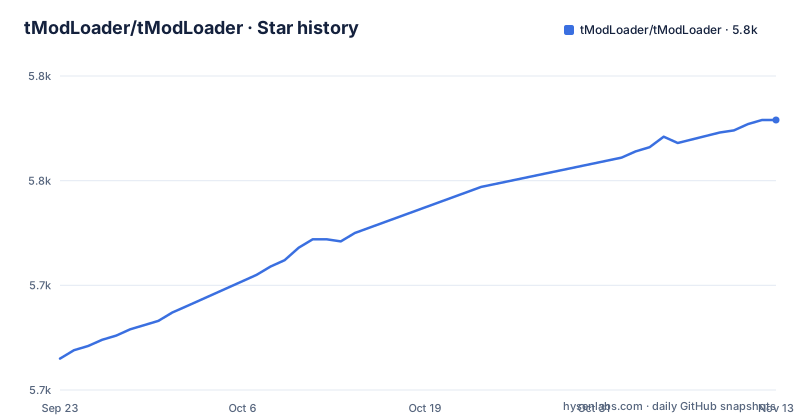
- tModLoader/tModLoader5,779 ★ · +114
| Repository | 2026-09-23 | 2026-11-13 |
|---|---|---|
| tModLoader/tModLoader | 5.7k | 5.8k |
114 Stars in the last 51 days, measured from the daily GitHub snapshot. Compare with other projects
Editorial analysis
Every friend in a session needs the loader installed
The multiplayer rule is the first thing to understand, and it is stated in the README before anything else: it is required that all your friends also install tModLoader if you want to play together, and vanilla users cannot play with tModLoader users. That single sentence decides how you host a session. Solo play is unaffected, and you can load one mod or many, so a single-player install is easy. Multiplayer is a shared decision that every participant has to agree to before anyone queues up, and a friend who declines ends up in vanilla Terraria while you are in the modded one. There is no matchmaking across the two, which means the mod list you pick for a group is a promise that everyone else installs the loader as well. TML describes itself as designed so that you play alone or together, with one mod or with multiple mods, so the freedom is real but it stops at the door of the other player's installation.
The default branch runs ahead of the released build
There is a note at the top of the README that changes how you should read this repository: the code on it will be ahead of the current released version. So the default branch, named 1.4.5, is not the same thing as what players get from the Steam page. The release history makes that concrete. Three versions show up, v2026.09.3.1 dated 2026-11-03, v2026.10.2.3 dated 2026-11-03 and v2026.09.2.1 dated 2026-10-01, and each one was published from a branch name of the form 1.4.4-refs/heads/preview or 1.4.4-refs/heads/stable. Those branch names carry the number 1.4.4 while the default branch is 1.4.5. The consequence for anyone building from source is that you have to choose deliberately: the default branch gives you newer code than the released build, and the stable and preview tags are where shipped versions came from.
A patch pipeline with its failures written down
The root listing shows how the game is reached. There is a patches directory, a file called FailedPatches_1.4.2.txt, a patching_todo.txt and a reworking_todo.txt, alongside PortingNotes_1.4.4.9.md, PortingNotes_1.4.5.md and MigrationGuide_1.4.5.md. Those are the artefacts of a project that modifies an existing game rather than writing a new one, and they turn a Terraria version bump into a documented job. When a patch stops applying, the failure goes in a text file named after the version it broke on. When behaviour changes across versions, the change is written up in porting notes and a migration guide. A contributor reading this tree learns that the hard part of this project is not the mod API, it is keeping a patch set aligned with a game that keeps shipping updates, and the project keeps both the failures and the remaining work in plain files at the root.
Setup is three scripts and a directory, none of them explained
There is no install command anywhere in the README, and the operational surface of the repository is these entries:
setup.bat
setup-cli.bat
setup-cli.sh
setup/
solutions/
tModLoader.sln
tModLoader.targets
tModBuildTasks/
ExampleMod/
test/
Three setup entry points for two shells: a .bat for Windows, a .bat and a .sh that both carry cli in the name, and a setup directory that probably holds what they invoke. Nothing in the repository's own instructions says what any of them run, so a new contributor learns the sequence from the wiki guide instead. The rest of the listing fills in the shape of the work: tModBuildTasks for the build, tModCodeAssist beside it for editor support, tModPorter for porting, ExampleMod as a starting point, test for tests, and a tModLoader.code-workspace file for the IDE. A .gitmodules file and a directory named FNA suggest something is pulled in from another repository rather than written here.
Players, developers and contributors each get a different link
The Instructions block asks you to click the text that applies to you, which makes the split of audiences explicit. There are four destinations: a Steam store page for getting tModLoader, a guide for players who want to play mods, a guide for developers who want to create mods, and a guide for contributors who want to help create tModLoader. The three guides are wiki pages, so the repository deliberately keeps its instructions short. The project homepage is tmodloader.net, and support and questions go through a Discord server that the README links directly, with a note that you need to register an account on Discord's own site first. The consequence is that the repository is a code drop rather than a manual: it tells you what exists, the wiki tells you how to use it, and a reader working only from this page never learns the sequence for their own role.
Money goes through Patreon, or through a direct message
The funding section is unusually direct about what tModLoader is and is not. It describes itself as a largely community endeavor, built by the community and used by the community, calls itself a free-to-use modification of the game that will stay that way, and states plainly that it was not created to create a profit. Support is therefore optional rather than a licence fee. The preferred route is a pledge through Patreon, money shared equally among the core members who want a share, and a patron gets a special role on the Discord server by coupling the two accounts. The fallback is not a public form: if you do not want a subscription, you are told to contact a core team member through Discord and find a method that suits you. The core team is named on the page as Blushiemagic, Chicken-Bones, Jopojelly, Jofairden, Mirsario and Solxanich, and the README says they keep improving and maintaining the project free of charge.
A publisher EULA and project terms sit next to the MIT license
The tree carries three legal files: LICENSE, TERMS_OF_USE.md and MS-EULA.rtf, alongside TML_TEAM.md and a PULL_REQUEST_TEMPLATE.md. The project's own code is under the MIT license, which is the same permissive licence the README links from. The presence of MS-EULA.rtf in the root is the part worth pausing on: this is a modification of a commercial game, so a file named MS-EULA.rtf is checked into the repository that builds the modification, and the project keeps its own TERMS_OF_USE.md as well. Nothing in the repository's own instructions explains how the MIT license, the project terms and that EULA relate to each other, or which one applies to a mod that a player writes. For a developer publishing a mod, that division is the question to settle before distribution rather than after.
Editorial conclusion
tModLoader fits a Terraria player who wants community mods on an existing Terraria 1.4 or earlier installation and has friends prepared to install the loader too, and it fits a C# developer who is willing to follow the developer guide in the wiki. It does not fit a group with mixed vanilla and modded installs, or a contributor who expects the released binaries to match the default 1.4.5 branch. Before committing, read the note that the repository runs ahead of the released version, check which branch you are actually on, and expect the setup scripts and the wiki to carry every step the README leaves out.
Frequently asked questions
What is tModLoader used for?
It makes it possible to make and play Terraria mods. tModLoader is described as a modification and expansion of the game that expands Terraria adventures with new content created by the community, and you can play alone or with friends, with one mod or with multiple mods.
How much does a tModLoader cost?
It is free to use, and the project says it will stay that way and that it was not created to create a profit. If you want to support the core team, the preferred method is a pledge through Patreon, or you can contact a core team member through the Discord server to find another method.
how to install tmodloader
The repository sends you to four places depending on what you are doing: a Steam store page for getting tModLoader, and wiki guides for players, developers and contributors. It also warns that the code in this repository is ahead of the current released version, so what you see in the tree is newer than what players download.
how does tmodloader work
It is an open-source modification and expansion of Terraria that lets players create and play mods, alone or with friends. For multiplayer, every friend in the session has to install tModLoader as well, because vanilla users cannot play with tModLoader users.
how to use tmodloader
You choose how you want to play: alone or together, with one mod or with multiple mods. Anything you add to Terraria comes from the community, and for multiplayer the whole group has to run tModLoader before you can play together.
Official sources
Add this badge to your README
If you maintain this project, the badge below links readers to this analysis and shows its maintenance status from the daily GitHub snapshot. Paste the markdown into your README; add ?metric=license or ?metric=stars to the image URL for a different field.

[](https://hysenlabs.com/projects/tmodloader-tmodloader)Star history chart for your README
[](https://hysenlabs.com/projects/tmodloader-tmodloader)Was this useful?