Not one Wallet Core install instruction contains a version
Cross-platform, cross-blockchain wallet library.
At a glance
- What is it?
- Trust Wallet Core is a C++ wallet library behind strict C interfaces, with Swift and Kotlin wrappers and packages for five more languages. Its integration guide is thorough about where things are and silent about versions, and its Swift Package Manager routes are explicitly unpinned.
- Who is it for?
- Wallet Core is a serious choice if you are building a wallet and want chain support you did not write yourself, and the C interface plus per-platform wrappers is a workable shape for that. Three things to sort out before you adopt it.
- Can I use it commercially?
- Yes. Apache-2.0 is a permissive licence: you can use, modify and sell software built on it, as long as you keep its copyright and licence notices.
- Is it still maintained?
- Yes. The repository last received commits 4 days ago.
- What is it written in?
- Mainly C++, according to GitHub's language statistics.
Answers come from the project's GitHub data, last synced on November 15, 2026, and from our analysis. They are not legal advice.
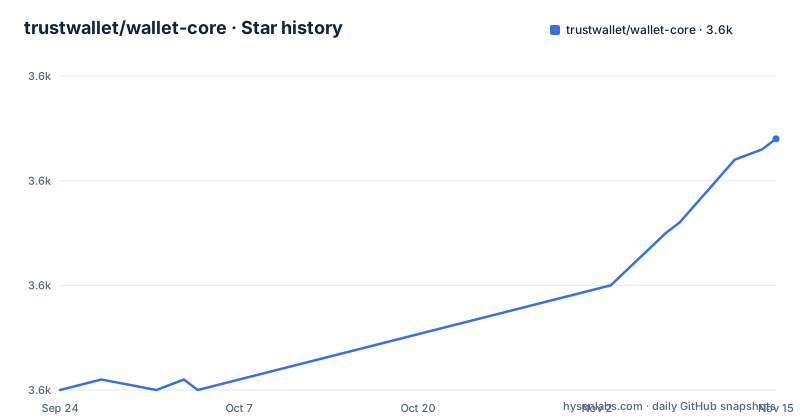
Star history
- trustwallet/wallet-core3,594 ★ · +24
| Repository | 2026-09-24 | 2026-11-15 |
|---|---|---|
| trustwallet/wallet-core | 3.6k | 3.6k |
24 Stars in the last 52 days, measured from the daily GitHub snapshot. Compare with other projects
Editorial analysis
No install instruction contains a version
Read the integration section line by line and notice what is missing. The Android instructions say releases are hosted on the forge's package registry, that you need an access token to install one, and then to follow a guide or copy the sample build file, ending with a reminder to replace the version in the code with the latest. No version appears. The CocoaPods instruction is a single pod line with no version and no branch. The npm instruction is a single install line with no tag. The Go and Kotlin Multiplatform sections point at sample directories instead of giving commands at all. So every route is correct and none is reproducible, and the reader's first job is to go and discover which build they are being asked to take.
npm install @trustwallet/wallet-coreThat is consistent with a library that ships a binary per platform rather than a source package, but it means a build that resolved a version six months ago and one that resolved it today are not comparable from the documentation alone.
Both Swift Package Manager routes are unpinned on purpose
The iOS section is the only one that explains itself, and what it explains is that it cannot promise a version. There are two ways in. The first is to download the latest package manifest from the releases page, put it in a local folder named for the library, and reference it by path. The second is to reference the repository URL and the master branch, and the README attaches a warning to that option directly: it points to a recent binary release, which is not always the latest one. Then you add two products to your target, one for the library and one for its protobuf support. It is an honest piece of documentation: it tells you the branch route is a compromise rather than pretending otherwise.
Three of the six language routes are marked beta
The language coverage reads as a maturity ladder once you count the labels. The core is C++ behind a strict C interface, with idiomatic wrappers for Swift and Kotlin, and those are not labelled. Beyond that there are three routes marked beta: the npm package, the Go sample, and the Kotlin Multiplatform sample. Those three are the ones a reader should treat as experiments rather than integrations. Filling the remaining gaps is the community section, which lists a Flutter binding, a Python binding and a Windows port, each with a link and an explicit statement that the list is not an endorsement and that readers should do their own research first.
Two code generation directories sit side by side
The repository listing is long and the interesting entries are the ones that suggest work in progress. There is a code generation directory and a separately named second version of it, which is what a migration in flight looks like from the outside: both are present, and the README does not say which one produces the bindings you are consuming. The generated output is published as machine-readable data too, since the blockchain registry exists as a JSON file at the root alongside a generated markdown list of the supported chains, and the supported count is stated as more than 130. There is also a protobuf plugin directory, which is consistent with a library whose interface definitions are generated rather than written.
A third-party crypto library arrives as a submodule
The tree includes a submodules file and a directory named after a well-known hardware wallet project, which is where the low-level elliptic curve and hashing code comes from rather than from this repository. That has two consequences worth stating plainly. Building from a clone without initialising submodules gives you an incomplete tree, and the licensing picture has a second file: beside the project's own Apache 2.0 licence there is a separate third-party licence text, which is the correct place for the terms of everything that came from elsewhere. The audits directory sits alongside both, which is the arrangement you want from a library that handles key material.
Seven build workflows and a coverage file at the root
The badge row lists seven build workflows by name, and the names are the project map: iOS, Android, Linux, Linux with Rust, WebAssembly, Kotlin, and Docker. That is seven toolchains to keep green for one library, which tells you something about the cost of contributing before you open a pull request. The repository listing also contains a committed coverage statistics file at the root, a static analysis configuration alongside the two C++ style and lint configurations, a shell script for bootstrapping, and a project file for a Windows IDE. The sample directory holds eight platform samples, from C++ and Node through Rust and WebAssembly, which is the shortest way to see how each binding is meant to be called.
The container build pins a downloaded installer by checksum
The development container is a single long instruction set on an Ubuntu base, and one part of it is more careful than the rest. After installing the C++ toolchain, a specific compiler version and symlinking the generic compiler names to it so that the build system cannot be overridden by an environment variable, it installs Rust by downloading the installer from the language's own archive, for a pinned release number, and verifies it against a per-architecture SHA-256 checksum chosen by a case statement on the machine architecture. Anything else fails the build with a message about an unsupported architecture. The comment above that step explains why the more obvious approach was rejected: the installer script is served as a rolling file whose digest changes on every release, so pinning it breaks the build each time upstream publishes.
The disclaimer admits the app may not use everything
The last section before the licence is a disclaimer, and one sentence in it is more useful than the rest. Trust Wallet products use this library, the text says, but they may or may not use all of the capabilities, features and assets available in it, because of their own product requirements. That is a vendor telling you that the reference implementation is not the ceiling and not the floor. The rest of the section gives the project's stated goal, which is to give other wallets an easy way to add chain support, and describes it as led by Trust Wallet with a larger contributor community behind it. The contributing section splits feedback by target: library bugs go to the issue tracker, app bugs go to customer support tickets instead.
Editorial conclusion
Wallet Core is a serious choice if you are building a wallet and want chain support you did not write yourself, and the C interface plus per-platform wrappers is a workable shape for that. Three things to sort out before you adopt it. Pin a version yourself, because no snippet in the integration guide names one and the two Swift Package Manager routes are described as pointing at a recent rather than always the latest build. Read the audit directory before you trust it with keys. And decide how you will track the repository, since the generated registry and two code generation directories suggest the layout is still moving.
Frequently asked questions
What is Trust Wallet Core?
An open-source, cross-platform, mobile-focused library implementing low-level cryptographic wallet functionality for more than 130 blockchains. Most of the code is C++ behind a set of strict C interfaces, with idiomatic Swift for iOS and Java or Kotlin for Android on top.
How do I add Wallet Core to an iOS project?
Either with Swift Package Manager, by downloading the latest package manifest from the releases page into a local folder and referencing it by path, or by referencing the repository's master branch, which the README says points at a recent rather than always the latest binary. The CocoaPods route is a single pod line and is described as being discontinued in the future.
How do I add Wallet Core to an Android project?
Releases are hosted on the forge's package registry and installing one needs a GitHub access token. The README points at an installation guide and at the sample build file, and tells you to replace the version with the latest yourself.
Which languages does Wallet Core support?
C++ internally behind C interfaces, with Swift for iOS and Kotlin for Android. Packages also exist for npm, Go and Kotlin Multiplatform, all three marked beta, and community projects cover Flutter, Python and Windows.
Are there security audits for Wallet Core?
The README points at an audit directory in the repository for security audit reports. The repository also carries a separate third-party licence file alongside its own Apache 2.0 licence.
Official sources
Add this badge to your README
If you maintain this project, the badge below links readers to this analysis and shows its maintenance status from the daily GitHub snapshot. Paste the markdown into your README; add ?metric=license or ?metric=stars to the image URL for a different field.

[](https://hysenlabs.com/projects/trustwallet-wallet-core)Star history chart for your README
[](https://hysenlabs.com/projects/trustwallet-wallet-core)Was this useful?