A design system prompt that documents how to weaken itself for older models
Reverse-engineered system prompt and skill library that turns an LLM into an opinionated, accessibility-aware, AI-slop-resistant design collaborator.
At a glance
- What is it?
- A reverse engineered twenty chapter system prompt with fourteen procedural skills, shipped in two variants, where the more interesting half is the calibration note: it explains which prompting habits were removed because a specific model generation treats quotas as literal contracts, and what to restore when you move to an older one.
- Who is it for?
- This repository is worth reading for its calibration note even if you never paste the prompt, because it names four prompting habits that were removed on purpose for a specific model generation and says what to restore when you are elsewhere. It is a working document, not a framework: no code, no releases, no version, and a last commit from July 2026, so expect the model names and the calibration advice to age faster than the design chapters.
- Can I use it commercially?
- Yes. MIT is a permissive licence: you can use, modify and sell software built on it, as long as you keep its copyright and licence notices.
- Is it still maintained?
- Yes. The repository last received commits 1 day ago.
- What is it written in?
- GitHub does not report a main language for this repository.
Answers come from the project's GitHub data, last synced on November 22, 2026, and from our analysis. They are not legal advice.
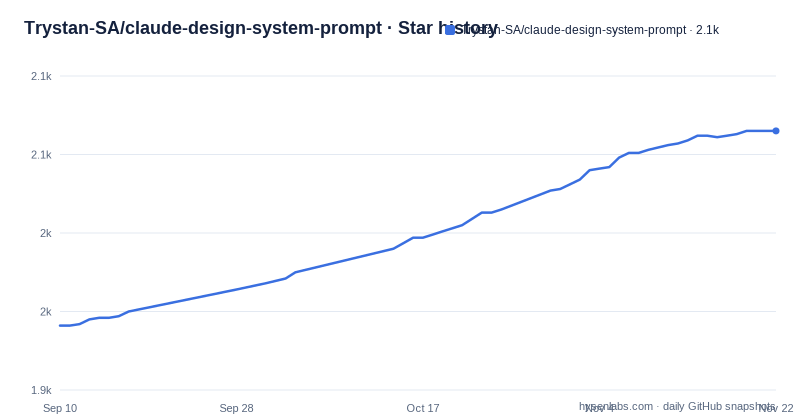
Star history
- Trystan-SA/claude-design-system-prompt2,065 ★ · +124
| Repository | 2026-09-10 | 2026-11-22 |
|---|---|---|
| Trystan-SA/claude-design-system-prompt | 1.9k | 2.1k |
124 Stars in the last 73 days, measured from the daily GitHub snapshot. Compare with other projects
Editorial analysis
The repository is prose, and the provenance claim is reverse engineering
There is no code here. The top level is a licence file, a readme and two directories, one per model variant, and the hosting service records no primary language because there is none to record: the deliverable is Markdown meant to be pasted somewhere else. The readme states its provenance in the first line, describing itself as the reverse engineered system prompt of a design tool from Anthropic, and then hedges that claim in the middle of the calibration section by calling the features it exhibits an architectural coincidence created without intent, which is the language of someone who has looked at a prompt and reconstructed its logic rather than its text. Nobody should read this as documentation from the vendor. There are no releases, so there is no version to pin, and the last recorded commit on main is dated 2026-07-06, which is the only maintenance signal available.
Fourteen skills in three groups, and the listing shows five
The skills are the load-bearing part, and they divide cleanly. Seven are for production work: a kickoff question protocol, a step for committing to an aesthetic direction when no brand exists, a low fidelity wireframe step that is told to produce at least three variations, a deck builder that emits slide presentations as HTML, a clickable prototype builder, a step for making output tweakable, and one for generating variations. Two are for extraction: pulling a design system apart and pulling components out of existing work. Five are for review: an accessibility audit, an AI slop check, a hierarchy and rhythm review, a pass over interaction states, and a polish pass. Seven plus two plus five is the fourteen the page claims, so the count is internally consistent. The directory listing in the readme, though, stops mid-word after the fifth file, so the structure block shows less than half of what the prose describes.
The prompt is tuned for one model generation and says how to untune it
This is the section that makes the repository worth reading even if you never paste the prompt. The calibration note says the Claude variant is written for a named set of current frontier models, and then lists four things it deliberately does not do. It avoids quotas and shouting: no asking for a minimum number of questions, no emphasis in capital letters, because those models treat a quota as a literal contract and over-trigger on it. It states conditions instead, plus an autonomy clause telling the agent to pick a reasonable option and note it rather than ask. It adds explicit triggers, because the same models under-reach for optional capabilities, so every skill description says when to use it and delegation to a reviewer has a stated trigger of after every substantive visual change. And it inverts review coverage, which is the subject of its own section below. Then the note tells you what to do when you are elsewhere: on older models or non-Anthropic ones the calmer phrasing may under-trigger, and the fix is to restore stronger imperative language if you see question rounds or reviews being skipped.
Reviews report everything on purpose, because filtering happens later
The review pipeline is built backwards from a failure mode. The prompt tells review agents to report every finding with a confidence and severity estimate, and leaves the filtering to the aggregation step. The stated reason is that current models follow an instruction like only report important issues far too literally, which silently drops findings nobody knows were suppressed. That is a real and specific failure, and the fix is the obvious one once you have named it: do the sorting with something that can be measured, not with a judgement the model is bad at. The same instinct shows up elsewhere. The page names the aesthetic these models default to, a cream background with serif display type and terracotta or amber accents, and treats it as a failure mode rather than a preference: one skill checks for it by rule and another pre-empts it by forcing a choice among four explicit directions before any work starts.
Variety has to come from specifications now, not from sampling
One line in the calibration notes is a bigger statement than it looks. Sampling parameters no longer exist on the models this variant targets, so the temperature that used to give a design agent natural visual variety is gone, and the prompt has to replace it. What it substitutes is explicit per-variation specifications, which is why the wireframe step is told to produce three or more variations rather than one: on a model that will not sample differently, asking twice gets you the same output unless each attempt is specified differently. The four-directions protocol in the aesthetic skill is the same move at the start of the process. It is a coherent adjustment from a prompting era where randomness was doing work that now has to be written down, and it is the kind of thing that silently rots if the page is not updated when the models change again.
Two flows are documented, one for nothing and one for an existing brand
The readme gives two chains as worked examples, and they differ in what happens first. The greenfield path opens with the discovery question protocol, moves to committing to an aesthetic direction, then a wireframe with several variations, then a clickable prototype, then the polish pass.
discovery-questions → frontend-aesthetic-direction → wireframe → make-a-prototype → polish-passThe brand-aware path starts by extracting the existing design system, generates variations from it, makes the result tweakable, and finishes with the polish pass.
design-system-extract → generate-variations → make-tweakable → polish-passThe polish step is common to both, which says something about where the author thinks the value is. The two paths also reveal that the skills are meant to be chained rather than chosen, with one skill's output feeding the next, and that a request can plausibly trigger more than one. The design system extraction step is the one that makes the second flow possible at all, since a system built from a screenshot is a different artefact from one extracted from real tokens.
Twenty chapters, and the page says which twelve travel
The chapter list runs from identity and role through workflow, asking questions first and rooting designs in existing context, into the substance: content principles with no filler, aesthetic principles, visual hierarchy and rhythm, typography, colour, accessibility, interaction states, simplicity with one clear call to action, system thinking, respecting the medium, understanding users and quality over quantity. Then it returns to process with output principles, collaboration and delivery, intellectual property and content boundaries, and the skill inventory. The adaptation note draws the line the page cares about: the prompt assumes an environment that outputs HTML, comparable to a hosted design tool, so a Figma plugin, a code-only assistant or a chat-only coach will need the workflow chapters and tool references adjusted by hand, while the principles in the middle range of chapters are said to translate to any medium. The contributing guide asks for exactly that kind of adaptation, plus more review skills, real failure cases and translations, with a request to keep the tone and not add chapters that do not earn their place.
Editorial conclusion
This repository is worth reading for its calibration note even if you never paste the prompt, because it names four prompting habits that were removed on purpose for a specific model generation and says what to restore when you are elsewhere. It is a working document, not a framework: no code, no releases, no version, and a last commit from July 2026, so expect the model names and the calibration advice to age faster than the design chapters. Two things to check before adopting it wholesale. The prompt assumes a hosted design tool that outputs HTML, and the page itself says the workflow chapters and tool references need hand adjustment for anything else, while the design principles in the middle chapters carry over. And the anti-slop rules target one generation's default look by name, which is a useful trick and also a rule that will need rewriting when that default changes.
Frequently asked questions
What is in the claude-design-system-prompt repository?
A twenty chapter system prompt and fourteen invokable skills, in two variants, under an MIT licence. Seven skills are for production work, two for extracting structure and five for review, and the repository contains no code at all.
How do I use the design system prompt?
Paste the contents of the main system prompt file as the system prompt for any model that supports one, and the agent follows the design philosophy while referencing skills by name when a request matches. Each skill is a self contained phased procedure triggered by its description.
Which model generation is this prompt calibrated for?
The page names current Anthropic frontier models, describing them as Fable 5 and the Opus 4.7 and 4.8 lineage, and explains that they need less aggressive prompting than earlier generations. On older or non-Anthropic models the calmer phrasing may under-trigger, and the advice is to restore stronger imperative language.
Why does the review pipeline report everything instead of filtering?
Because current models follow an instruction to report only important issues too literally, which silently suppresses findings. Review agents therefore report everything with confidence and severity estimates and leave the filtering to the aggregation step.
Does this prompt work outside an HTML design environment?
Not unchanged. The readme says the prompt assumes an HTML output environment comparable to a hosted design tool, so a Figma plugin, a code-only assistant or a chat-only coach needs its workflow chapters and tool references adjusted, while the principles in chapters five to sixteen are said to translate to any medium.
Official sources
Add this badge to your README
If you maintain this project, the badge below links readers to this analysis and shows its maintenance status from the daily GitHub snapshot. Paste the markdown into your README; add ?metric=license or ?metric=stars to the image URL for a different field.

[](https://hysenlabs.com/projects/trystan-sa-claude-design-system-prompt)Star history chart for your README
[](https://hysenlabs.com/projects/trystan-sa-claude-design-system-prompt)Was this useful?