Scientify: an OpenClaw plugin, not the research agent the README describes
Automatic and end-to-end scientific research workflow. Produces state-of-the-art level research results.
At a glance
- What is it?
- The repository packages a TypeScript plugin for OpenClaw with one runtime dependency. The autonomous research loop, the hosted workspace and the experimental results all live outside this codebase, which changes what installing it actually gets you.
- Who is it for?
- The repository is worth reading if you build OpenClaw plugins and want to see how a research workflow is packaged as skills plus an arxiv tool, since the plugin boundary is small and legible. It is not where the autonomous behaviour lives: the README routes users to a hosted workspace at scientify.tech, and the code here cannot reproduce the results the README claims.
- Can I use it commercially?
- Not without permission. GitHub finds no licence file in the repository, and without a licence all rights are reserved by default: you may read the code but not reuse it. Check the README, or ask the authors, before using it.
- Is it still maintained?
- Yes. The repository last received commits 60 days ago.
- What is it written in?
- Mainly TypeScript, according to GitHub's language statistics.
Answers come from the project's GitHub data, last synced on November 7, 2026, and from our analysis. They are not legal advice.
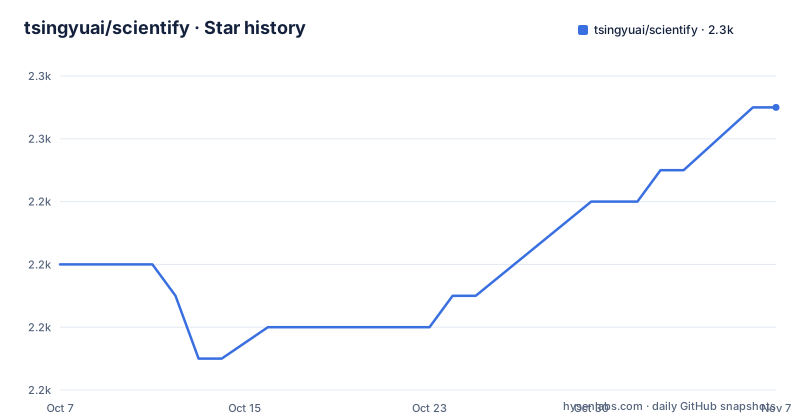
Star history
- tsingyuai/scientify2,251 ★ · +5
| Repository | 2026-10-07 | 2026-11-07 |
|---|---|---|
| tsingyuai/scientify | 2.2k | 2.3k |
5 Stars in the last 31 days, measured from the daily GitHub snapshot. Compare with other projects
Editorial analysis
What is actually in the package
The `package.json` is short and settles the question of what this project is. It is named `scientify`, typed as an ES module, compiles to `dist/`, and its description calls it an AI-powered research workflow automation plugin for OpenClaw. The shipped `files` array is `dist`, `skills` and `openclaw.plugin.json`, which means the published artifact is compiled JavaScript, a directory of skills, and a plugin manifest.
Dependencies are listed honestly: `@sinclair/typebox` at `^0.32.0` is the only runtime dependency. Everything else in `devDependencies` is release tooling, `@semantic-release` with conventional-changelog plugins and the npm publisher, plus `@types/node`. A research agent that talks to a model, runs experiments and produces papers plainly does not ship its inference stack in this package.
The repository tree matches that reading: `src/`, `skills/`, `docs/`, `index.ts`, `openclaw.plugin.json`, `tsconfig.json`, a `pnpm-lock.yaml`, and at the root a `CLAUDE.md`, `CHANGELOG.md` and `.releaserc.json`. There is no model weights directory, no dataset, and no experiment harness at the top level.
The README documents a hosted product
The README is written in Chinese, with an English version at `README.en.md` in the tree. Its how-to-use section is four sentences long and all of them point somewhere else: go to scientify.tech, register or log in, type a research goal into the workspace, and the system runs.
It then describes execution that the repository cannot perform. Tasks run continuously in an isolated cloud computer, literature, code, data and experimental results are kept in the same workspace, and closing the computer does not stop the task, with progress viewable from a phone. None of that is in this codebase. What is in this codebase is the plugin that connects a client to that service.
That is not a criticism so much as a reading instruction, but it changes who should install what. Someone evaluating whether this system can do research should read the README's two case studies. Someone maintaining or extending the integration should read `skills/` and `src/`. Those are different jobs, and the repository serves the second one.
The controlled study behind the metabolism claim
The README's second section is the most falsifiable content in the project, and it comes with a table. Scientify compares its continuous knowledge metabolism approach against a batch baseline across 50 research topics and 892 generated hypotheses. The table reports a hypothesis hit rate, defined as the share of hypothesis directions later validated by a paper, rising from 3.0 percent to 5.8 percent. Effective hypotheses per topic go from 13.7 to 17.3, an LLM-judged novelty score on a one-to-ten scale moves from 6.39 to 6.82, and token cost per hypothesis falls from 434K to 30K, which the README rounds to 92 percent.
The README states the ratio as 1.9 times the baseline. That follows from 5.8 divided by 3.0, so the arithmetic is consistent with its own table.
What a reader cannot check here is the methodology. The novelty score is judged by an LLM, the hit rate depends on later papers appearing, and neither the topic list nor the 892 hypotheses are in the repository. The project links a paper, Continuous Knowledge Metabolism, to arXiv and says it was accepted at ICML 2026, which is the right place to look for the protocol.
One detail from the release history is worth noting. The commit that added these results to the README is tagged v3.3.0, and v3.3.1 the same day fixed the colors in the SVG assets carrying the chart. The numbers arrived as documentation, in a release whose only code change was presentation.
Building and developing the plugin
Because the published surface is compiled output, the scripts are about the build and about hot reload against a running gateway. Release automation is `@semantic-release`, so version numbers and changelogs come from commit messages rather than by hand, which matches the changelog entries that read as conventional commits.
"build": "tsc",
"clean": "rm -rf dist",
"dev": "tsc --watch"
The longer scripts are about wiring the plugin into a local OpenClaw installation. `dev:link` builds and then symlinks the working directory into place, `dev:unlink` removes the symlink, and `dev:reload` watches `src` and `skills` for TypeScript, Markdown and JSON changes, then rebuilds and signals the gateway process:
make test-tool TOOL=arxiv_searchThat Makefile target is the clearest evidence of what this plugin exposes: individual tools addressable by name, with arxiv search as one of them. The same Makefile offers gateway lifecycle commands, a link and unlink pair for the plugin, enable, disable and toggle targets for pluggable activation, and a `status` target.
A pattern worth naming, because it is a real maintenance cost: the plugin manifest, the `skills/` directory and the gateway all have to agree on a tool surface. Three releases on one day in April 2026 include a change that drops an owner suffix from the plugin id to simplify the install command, which is exactly the kind of coupling that shows up as a breaking change.
No license reported, MIT claimed in the manifest
GitHub reports no license for this repository. The `package.json` states `"license": "MIT"`, and there is no LICENSE file in the tree listing. Those two facts are usually reconciled the same way: the SPDX field is a claim by the author, while the absence of a LICENSE file means no full text ships with the code.
This is worth resolving before you depend on it, and the resolution is cheap. Read the `package.json` field as the author's stated intent and check whether a LICENSE file exists in a branch or an earlier commit before treating the grant as complete. A missing license identifier on a package with only one runtime dependency and no source-level headers is the kind of gap that is usually an oversight rather than a decision, but the distinction matters if you plan to redistribute.
The last push was on 2026-09-08, and the newest release is v3.4.0 from 2026-04-30. The three most recent releases, v3.3.0, v3.3.1 and v3.4.0, all landed on that single date, so the release history is dense in one afternoon and quiet for the five months since.
Editorial conclusion
The repository is worth reading if you build OpenClaw plugins and want to see how a research workflow is packaged as skills plus an arxiv tool, since the plugin boundary is small and legible. It is not where the autonomous behaviour lives: the README routes users to a hosted workspace at scientify.tech, and the code here cannot reproduce the results the README claims. Read `skills/` and `src/` for the integration, and evaluate the product itself at scientify.tech, checking the MIT grant in `package.json` yourself since GitHub reports no license for this repository.
Frequently asked questions
Can I run Scientify locally instead of using the hosted service?
The README's usage instructions send you to scientify.tech to register and enter a research goal in a workspace, and describe tasks running on isolated cloud computers. The repository builds a plugin for OpenClaw, so the research loop itself is not something this codebase runs on your machine.
What does Scientify add to OpenClaw?
The published package contains `dist`, a `skills/` directory and `openclaw.plugin.json`, with `@sinclair/typebox` as its only runtime dependency. The Makefile exposes a `test-tool` target that addresses a single tool by name, arxiv search being one example, along with link, unlink and enable targets for installing the plugin.
What is the continuous knowledge metabolism approach?
The README describes a pattern where frontier literature is tracked continuously, new knowledge is linked to what has accumulated before, and experimental results correct existing hypotheses. Across 50 topics and 892 hypotheses it reports a hit rate of 5.8 percent against a 3.0 percent batch baseline, and token cost per hypothesis of 30K against 434K.
Under what license is Scientify released?
The `package.json` declares MIT, while GitHub reports no license for the repository and the tree listing contains no LICENSE file. Treat the manifest field as the author's stated intent and verify a LICENSE file yourself before relying on the grant.
Official sources
Add this badge to your README
If you maintain this project, the badge below links readers to this analysis and shows its maintenance status from the daily GitHub snapshot. Paste the markdown into your README; add ?metric=license or ?metric=stars to the image URL for a different field.

[](https://hysenlabs.com/projects/tsingyuai-scientify)Star history chart for your README
[](https://hysenlabs.com/projects/tsingyuai-scientify)Was this useful?