tungbq/devops-basics: DevOps Learning and Practice Library
🚀 Practical and document place for DevOps toolchain
At a glance
- What is it?
- tungbq/devops-basics organizes DevOps documentation, introductory examples, and practice material across tools such as Docker, Kubernetes, Terraform, and Ansible. It works best as a learning map, not as a production automation platform.
- Who is it for?
- Adopt devops-basics when you need a structured map of DevOps subjects, introductory references, or paths into more detailed practice material. Do not adopt it as a production control plane, deployment system, or replacement for official product documentation.
- Can I use it commercially?
- Yes. Apache-2.0 is a permissive licence: you can use, modify and sell software built on it, as long as you keep its copyright and licence notices.
- Is it still maintained?
- Yes. The repository last received commits 40 days ago.
- What is it written in?
- Mainly Shell, according to GitHub's language statistics.
Answers come from the project's GitHub data, last synced on October 23, 2026, and from our analysis. They are not legal advice.
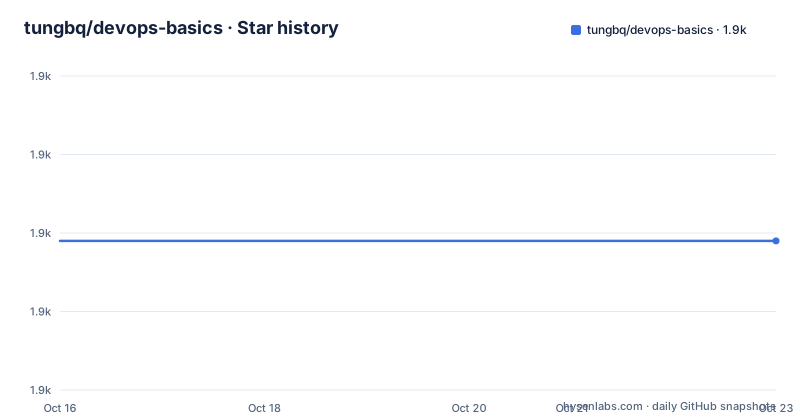
Star history
- tungbq/devops-basics1,879 ★ · +0
| Repository | 2026-10-16 | 2026-10-23 |
|---|---|---|
| tungbq/devops-basics | 1.9k | 1.9k |
0 Stars in the last 7 days, measured from the daily GitHub snapshot. Compare with other projects
Editorial analysis
What devops-basics Covers and Who It Is For
tungbq/devops-basics addresses a learning and reference problem. It collects DevOps subjects in one repository containing topic overviews, links to official documentation, cheat sheets, introductory examples, advanced examples, and additional resources. According to the README, the intended audience includes people who are new to DevOps, engineers who want to improve their tool skills, and practitioners who need a place to bookmark DevOps documentation.
The repository covers a wide portion of the DevOps toolchain. Listed subjects include Docker, Kubernetes, Terraform, Ansible, AWS, Azure, Istio, monitoring, cloud services, infrastructure as code, and security-related tools such as Vault, Trivy, Snyk, and SonarQube. The README says the collection includes more than 40 subjects, but it does not provide a completeness matrix showing which topic has every content type listed in the introduction.
This is not a single tool that automates deployment, configuration, monitoring, or infrastructure provisioning. Its role is to organize learning paths around products that perform those jobs. That distinction matters for engineers looking for a command-line application or library. The repository's primary language is Shell, but the README does not document an installable CLI, package, service, or stable public API. It is better understood as a documentation collection with example directories than as a runtime dependency.
The README also describes devops-basics as the first of three related repositories. The other two are devops-practice and devops-project, with the names suggesting a progression from documentation to practice and then larger project work. The README assigns that progression but does not document the contents or commands of those companion repositories, so this repository should be judged on its own organization and examples.
How devops-basics Organizes Topics and Examples
The repository layout is topic-oriented. Content lives under the topics directory, with individual subjects such as ansible, docker, k8s, istio, aws, and azure. The README presents several topic entries through a table with columns for content, official documentation, basics, and practice. This gives readers a visible learning sequence rather than an undifferentiated collection of links.
Ansible illustrates that structure well. Its row points to the Ansible topic directory, the official Ansible documentation, a hello-world basics directory, and a practice directory. Docker links to its own topic directory, Docker documentation, a basics directory, and a practice directory. Kubernetes uses the shorter k8s directory name and includes both a hello-world example and practice material. These directory names suggest that readers can start with a small example before moving into broader exercises.
The top-level repository also contains docs, getting-started, projects, templates, tools, troubleshooting, and tags. Files such as mkdocs.yml, CNAME, and requirements-docs.txt indicate a documentation publication structure. The CNAME entry and the documented homepage point to devops-basics.thedevopshub.org, while mkdocs.yml is the configuration associated with that publication layout. The README does not specify the exact documentation build command, so a first-time publisher should inspect the repository configuration before attempting to build the site.
The organization is practical for browsing, but it also creates a maintenance boundary. Each external product has its own documentation, release cycle, and configuration syntax. Linking a topic to an official manual does not guarantee that every local example matches the linked documentation at the same moment. The repository makes navigation easier, while version compatibility remains a separate verification task.
Why the devops-basics Learning Sequence Is Useful
The clearest value of devops-basics is the consistent path from overview to external reference, basics, and practice. This structure suits engineers who need to choose a subject without searching across unrelated sites. It also gives beginners a practical starting point: read the topic introduction, consult the official manual for precise behavior, inspect the basic example, and then look for practice content.
The distinction between basics and advanced examples supports progressive study. A small hello-world directory can help explain the shape of an Ansible or Kubernetes workflow before a reader encounters a more involved scenario. The README also refers to cheatsheets and additional resources, although the displayed table does not prove that every topic includes all of them. Topic completeness therefore varies unless the repository explicitly lists those files.
The external links add another benefit. Rather than presenting the repository as the sole authority for tools such as AWS, Azure, Docker, or Kubernetes, the README points readers to each product's official documentation. That is the right division of responsibility for an educational index. Local material can explain a workflow, but official documentation should determine supported options, installation requirements, and current syntax.
This approach is less compelling for an engineer who already knows the domain and needs one precise answer. Such a reader may prefer the vendor documentation directly. The repository adds value when the task involves selecting what to learn, comparing related tools, or finding an introductory example. It does not replace a maintained reference for product-specific decisions.
Getting Started with devops-basics Without an Install Step
The README does not provide installation or package-manager instructions for devops-basics itself. It directs readers to GitHub, the topics directory, and the public documentation site. There is therefore no documented application installation step to reproduce, and examples should not begin with an invented setup command.
A first use starts with choosing a topic. Open the topics directory, select the tool relevant to your work, and inspect the topic entry linked by the README. The Content and Docs entries provide the local introduction and official reference. The Basics entry is the sensible first stop for a learner because it includes introductory examples such as the Ansible and Kubernetes hello-world paths. Practice material comes later.
The documentation site is another documented route:
https://devops-basics.thedevopshub.org
The README does not state whether that site can be replaced with a local documentation build, and it does not document a build command for mkdocs. Anyone interested in publishing or modifying the site should inspect mkdocs.yml and requirements-docs.txt directly rather than infer a command from other MkDocs projects.
No prerequisites are given for Docker, Kubernetes, AWS, Azure, Terraform, Ansible, or the other subjects. The README also does not specify whether examples require local software, a remote cluster, cloud credentials, paid services, or all three. Before executing an example, read its local instructions and identify each dependency. The topic itself is the relevant source for setup details that the top-level README does not provide.
Version Drift and Operational Gaps in devops-basics
The main technical limitation is that a broad educational repository can drift from the tools it documents. Each external project has independent releases and configuration rules. The README links to official documentation but does not publish a compatibility matrix, supported-version list, or per-example test date. It also does not describe an automated process that runs every subject example.
A concrete failure mode is copying a configuration example that remains syntactically recognizable but no longer matches a current cloud service or Kubernetes release. A second problem is assuming that all examples are local. A topic labeled AWS, Azure, Kubernetes, or Istio may require external infrastructure even when the repository describes the example as basic. The README does not provide enough information to rule that out, so infrastructure requirements need to be checked in each topic directory.
devops-basics also lacks documented production operations features such as a centralized deployment controller, policy enforcement, managed secrets, or a compatibility promise across its examples. That is acceptable for a documentation library, but it limits its role in an architecture. The repository should not be selected when an organization needs one supported execution engine, deterministic upgrades, or a control plane that manages every example.
The documented releases provide version markers, not a compatibility contract. Recent releases include v2026.07.27 on 2026-07-27, v2026.06.02 on 2026-06-02, and v2025.08.26 on 2025-08-26. The README does not explain release contents or migration procedures, so adopting a repository version does not confirm that a particular external tool example is current.
Apache-2.0 Coverage for Repository Content and Examples
The repository uses the Apache-2.0 license. That license applies according to its terms to the repository content and any covered code published in the repository. It should not be read as a license grant for AWS, Azure, Kubernetes, Docker, Terraform, Ansible, or every external tool linked from the documentation. Those products have their own terms, and cloud services can impose additional account and usage conditions.
For example, a Shell script stored in this repository is covered by the repository's license notice, but an external action or service that the script invokes may be governed by separate terms. The README does not add exceptions or additional licensing terms, and it does not explain which examples depend on paid resources. Anyone planning to reuse examples should inspect the local license headers, dependency files, and referenced service terms.
Upgrade cost is not measured in the README. Since the project organizes many independent subjects, maintenance effort may vary by directory. A documentation edit can be small, while keeping an advanced cloud or orchestration example accurate may require verification against a separate product release. The top-level release history shows that versions are produced, but it does not document migration notes, automated validation, or support windows for individual subjects.
DevOps Basics Compared with Official Manuals and Companion Repositories
The closest alternative to devops-basics is an official product manual such as the linked Ansible, Docker, or Kubernetes documentation. The difference is scope. An official manual is the primary source for one product, while devops-basics places documentation for many tools into a common learning structure and adds local examples, cheatsheets, and practice paths.
That breadth creates both an advantage and a cost. It can shorten the path from choosing a subject to finding related resources, but it does not replace the authority of product documentation. A reader dealing with a precise configuration issue should follow the official link after using the repository to understand the topic.
The README also names devops-practice and devops-project as companion repositories. Their documented roles are different: devops-basics supports learning and bookmarking, devops-practice supports practice, and devops-project supports applying DevOps in a project. The README does not detail their individual mechanisms, so the comparison should not be extended beyond those stated purposes.
For an organization, devops-basics is closest to a curated training catalog. It is useful for onboarding and self-directed study because it groups subjects and learning levels. It is the wrong choice as the sole source for production standards, since the repository does not claim that role.
Maintenance Signals and Adoption Boundaries for devops-basics
The GitHub repository is not archived. Its last push was on 2026-09-13, which indicates recent repository activity. Recent tagged releases include v2026.07.27, v2026.06.02, and v2025.08.26. These facts support checking for recent changes, but they do not prove that every topic is current or that every example is tested by an automated release process. The README contains no test matrix or compatibility statement.
Adopt the repository as an educational index if you need a broad map of DevOps, a path that separates basics from practice, and links to official product documentation. Its directory model is more useful for that purpose than a single product manual. It also gives an engineer a way to compare subject areas before selecting tools for deeper study.
Do not adopt it as the sole source for production infrastructure, regulated procedures, or security controls. The README positions DevSecOps tools within the curriculum, but listing Vault, Trivy, Snyk, or SonarQube does not define an organizational security policy or prove that the related examples are sufficient for a particular system.
The first project-specific verification should be the chosen topic directory. Check its prerequisites, commands, credentials, external services, and referenced product version. If that example does not explain those requirements, use the linked official documentation before executing it. This repository is a reasonable entry point for structured DevOps study, subject to that example-level verification.
Editorial conclusion
Adopt devops-basics when you need a structured map of DevOps subjects, introductory references, or paths into more detailed practice material. Do not adopt it as a production control plane, deployment system, or replacement for official product documentation. Before using an example, verify its prerequisites, supported tool version, required credentials, and external infrastructure; for this repository, that means inspecting the specific topic directory rather than assuming that every example runs in a fresh environment.
Frequently asked questions
What is devops-basics used for?
It is a DevOps documentation and practice repository for finding topic guides, official references, basic examples, and more involved learning material. The listed subjects include Docker, Kubernetes, Terraform, Ansible, cloud platforms, monitoring, and security tools.
Does devops-basics provide an installable DevOps platform?
No. The README describes devops-basics as a documentation and practice repository. It does not document an installable platform, managed service, public API, or unified command-line application.
How can a beginner start using devops-basics?
The README directs readers to the topics directory, where topic entries connect content, official documentation, basics, and practice. A beginner can select a relevant tool, read its topic page, inspect the basics example, and then consult the linked official documentation.
Is devops-basics suitable for production infrastructure?
The README does not position it as a production automation framework or infrastructure control plane. Engineers should verify each example's prerequisites, tool version, credentials, and external resources before using it outside a learning environment.
Does devops-basics require a local installation?
The README does not specify an installation command or package for devops-basics itself. Individual tools covered by the repository may have their own requirements, which are not enumerated in the top-level README.
Official sources
Add this badge to your README
If you maintain this project, the badge below links readers to this analysis and shows its maintenance status from the daily GitHub snapshot. Paste the markdown into your README; add ?metric=license or ?metric=stars to the image URL for a different field.

[](https://hysenlabs.com/projects/tungbq-devops-basics)Star history chart for your README
[](https://hysenlabs.com/projects/tungbq-devops-basics)Was this useful?