type-challenges: an online judge for TypeScript type puzzles, with a private root package
Collection of TypeScript type challenges with online judge
At a glance
- What is it?
- Every challenge is a numbered folder under questions/ graded by the site at tsch.js.org, and the manifest marks the package private, so type-challenges is a practice corpus with contributor tooling rather than a library you can install.
- Who is it for?
- Adopt type-challenges if you learn TypeScript by writing types and want a verdict on your answer without a mentor in the room. Skip it if you need shipped type helpers in production code, because the package is private and the alternative named in the project README is type-fest.
- Can I use it commercially?
- Yes. MIT is a permissive licence: you can use, modify and sell software built on it, as long as you keep its copyright and licence notices.
- Is it still maintained?
- Yes. The repository last received commits 20 days ago.
- What is it written in?
- Mainly TypeScript, according to GitHub's language statistics.
Answers come from the project's GitHub data, last synced on November 15, 2026, and from our analysis. They are not legal advice.
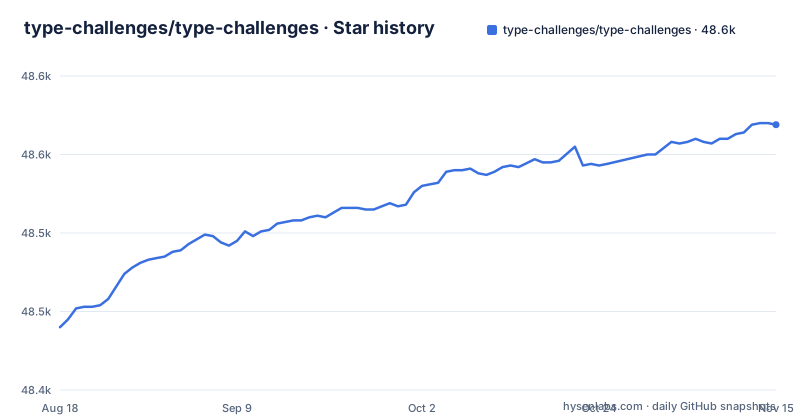
Star history
- type-challenges/type-challenges48,569 ★ · +129
| Repository | 2026-08-18 | 2026-11-15 |
|---|---|---|
| type-challenges/type-challenges | 48.4k | 48.6k |
129 Stars in the last 89 days, measured from the daily GitHub snapshot. Compare with other projects
Editorial analysis
The questions/ tree is the syllabus and the number prefix is the difficulty
Every challenge is a directory under questions/ carrying its own README, and the tier word in the folder name (warm, easy, medium) is the only difficulty signal you get. 00013-warm-hello-world is the warmup, 00004-easy-pick, 00189-easy-awaited and 00043-easy-exclude are the easy tier, and 00002-medium-return-type, 00009-medium-deep-readonly and 00020-medium-promise-all are the medium tier. Index links resolve to paths such as `questions/00004-easy-pick/README.md`, so browsing the site is browsing the folder tree.
The consequence for a learner is that nothing sequences the set. No file declares which question comes after which, and the numeric prefixes are issue-style identifiers rather than a curriculum, so 00002 sits in the medium tier while 00004 is easy. Choosing what to solve next means scanning filenames. The single warmup folder is the only hint about where to begin.
Grading assumes strict mode, so a loose tsconfig changes the verdict
One line states the precondition, and it links to the TypeScript config reference for the setting. Challenges work in strict mode. That single flag decides whether your answer passes, and a solution leaning on implicit any, on optional properties, or on index signatures that widen quietly can compile in your project and still be rejected at tsch.js.org.
The repository ships tsconfig.base.json and tsconfig.json at the root, and it does not document which of the two the site applies to a submitted answer. A green run of your own compiler is therefore not evidence of anything the judge will agree with. If you want a local signal, mirror the strict setting in your own tsconfig before you paste anything.
The manifest sets private to true, so nothing is published to npm
The head of the repository manifest is explicit about the distribution story:
{
  "name": "type-challenges",
  "version": "0.0.0",
  "private": true,
  "packageManager": "[email protected]"
}
The private flag is what blocks publication and 0.0.0 is a placeholder, not a version you can pin. The one workspace package with a release path sits in utils/ and is reached through the utils:release script, which runs `pnpm -C utils release`. If you want these type helpers in production code, this is the wrong repository, and the alternative named in the project README is type-fest.
Six scripts build the site and none of them tests your answer
For contributors the entire toolchain is the scripts block, and there is no test entry among it:
"readme": "esno ./scripts/readme.ts",
"build": "esno ./scripts/build.ts",
"generate": "esno ./scripts/generate-play.ts",
"lint": "eslint .",
"translate": "esno ./scripts/translate-cli.ts",
"utils:release": "pnpm -C utils release"
Two details decide how you work. First, no script grades a candidate answer, so validation happens by pasting into the judge at tsch.js.org and reading the result there. Second, the readme script exists because the question wall in the index is generated: the index file carries a `<!--challenges-start-->` marker with the question links inside it. Drop a folder into questions/ and the index will not show it until that script runs.
Two routes in, and neither of them is an install command
The first documented route is the playground plugin, reached through a link that opens the TypeScript playground with the plugin already selected:
https://www.typescriptlang.org/play?install-plugin=%40type-challenges%2Fplayground-pluginThat gives you a browser editor and the challenge list without touching a local checkout. The second route is the site itself at tsch.js.org, the online judge where a candidate answer gets its verdict.
The dependency list tells you what a source checkout pulls in: esno, fast-glob, fs-extra, js-yaml and lz-string at runtime for the scripts, with prompts and ansis on the command line side.
Translated indexes exist, translated problem statements do not
Four localized indexes sit at the root: README.zh-CN.md, README.ja.md, README.ko.md and README.pt-BR.md, and the package.json has a translate script. Every question link in the index resolves to a README.md inside its own folder.
Two other root entries are worth opening before you start: TODOs.md and guides/.
type-fest ships the answers, the stale packages only lend you the technique
type-fest is the difference in approach, and the project README puts it first among the things to read. It is a library of utilities you install and import, so a type lands in your codebase as a dependency. Here every answer is something you write yourself in a scratch file, and nothing in the repository produces runtime code, because the subject is entirely the compile step.
The same README names utility-types, ts-toolbelt and SimplyTyped and labels them as stale packages that are not actively maintained. That wording matters for a reader deciding what to copy from: these are reference implementations whose maintainers the project itself has flagged, so borrowing a pattern is fine and depending on them is a decision you have to justify. Note that utility-types still appears in this repository's own devDependencies at ^3.10.0.
No releases and a last push on 2026-05-16 leave nothing to pin
The repository has no GitHub releases, the manifest version is 0.0.0, and the last push was on 2026-10-26. It is not archived, so commits still land, but a team that copies a question into an internal exercise set has no tag to diff against and no release to roll forward on. You maintain your own copy of the folder and the answer beside it.
The toolchain is pinned loosely as well. typescript is at ^5.3.3 and eslint at ^8.56.0 with @antfu/eslint-config at ^2.6.0, and the lint script runs `eslint .` across the tree.
Editorial conclusion
Adopt type-challenges if you learn TypeScript by writing types and want a verdict on your answer without a mentor in the room. Skip it if you need shipped type helpers in production code, because the package is private and the alternative named in the project README is type-fest. Verify first that your editor runs the same strict settings the judge applies, since every question assumes strict mode.
Frequently asked questions
What are the different types of challenges?
The question folders are tiered by the tier word in the folder name: 00013-warm-hello-world sits above the easy tier, which includes 00004-easy-pick, 00189-easy-awaited and 00043-easy-exclude, while the medium tier runs from 00002-medium-return-type through 00009-medium-deep-readonly and 00020-medium-promise-all. Each one is its own folder with a README under questions/.
What are examples of challenges?
Named examples in the easy tier are easy-pick, easy-readonly, easy-tuple-to-object, easy-first, easy-tuple-length, easy-exclude, easy-awaited, easy-if, easy-concat, easy-includes, easy-push, easy-unshift and easy-parameters. The medium tier includes medium-omit, medium-readonly-2, medium-deep-readonly, medium-promise-all and medium-type-lookup.
Can I install type-challenges from npm and use its types in my project?
No. The manifest sets private to true with version 0.0.0, so nothing is published under that name. The only release path in the repository is pnpm -C utils release, which builds the utils workspace package.
Do I need strict mode enabled to solve the type-challenges questions?
Yes. The project states that challenges work in strict mode, with a link to the TypeScript config reference for that setting. A solution that only compiles with the flag off will not match what the online judge accepts.
Is there a local command that checks whether my solution passes?
There is no test script in the manifest. The root scripts are readme, build, generate, lint, translate and utils:release, so grading happens by pasting the candidate answer into the online judge at tsch.js.org.
Official sources
Add this badge to your README
If you maintain this project, the badge below links readers to this analysis and shows its maintenance status from the daily GitHub snapshot. Paste the markdown into your README; add ?metric=license or ?metric=stars to the image URL for a different field.

[](https://hysenlabs.com/projects/type-challenges-type-challenges)Star history chart for your README
[](https://hysenlabs.com/projects/type-challenges-type-challenges)Was this useful?